ISBN:
9780323826884
Copyright:
2026
Publication Date:
10-03-2025
Page Count:
752
Imprint:
Elsevier
List Price:
$236.99
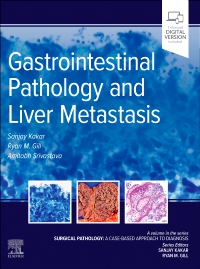
Gastrointestinal Pathology and Liver Metastasis: A Case-Based Approach to Diagnosis, 1st Edition
by Sanjay Kakar, MD, Ryan M. Gill, MD, PhD and Amitabh Srivastava, MD
Hardcover
ISBN:
9780323826884
Copyright:
2026
Publication Date:
10-03-2025
Page Count:
752
Imprint:
Elsevier
List Price:
$236.99
In Stock
Most review copies are eBooks – how fast!
A review copy request is most likely to be fulfilled as an eBook on VitalSource rather than a print product, unless no eBook is available. eBooks become available in as little as a few hours. Print products will take between 7 and 10 days to arrive. To request a print copy, please contact us through the Evolve Support Center for further assistance or contact your Elsevier Sales Rep.
The first title in the new Case-Based Approach to Diagnosis series, Gastrointestinal Pathology and Liver Metastasis offers a practical, real-world approach to this complex area of surgical pathology. Actual cases, highlighted by hundreds of high-quality clinical and histologic photographs, help you learn and retain key information, including which pathologic findings are clinically significant and which are not. Useful as both an everyday bench-side reference and as an authoritative review for certification and recertification exams, this new volume uses diagnostically relevant cases to teach how to evaluate and interpret even the most challenging lesions.
-
- Discusses advances in molecular diagnostic testing, its capabilities and its limitations, including targeted and personalized medicine
- Incorporates the latest TNM staging and WHO classification systems, as well as new diagnostic biomarkers and their utility in differential diagnosis, newly described variants, and new histologic entities
- Contains more than 700 high-quality, full color illustrations—a complete visual guide to each tumor or tumor-like lesion that assists in the recognition and diagnosis of any tissue sample under the microscope
- Presents extensively detailed information throughout, with descriptions of macroscopic features, microscopic findings, and cytopathology
- Incorporates relevant data from ancillary techniques such as immunohistochemistry, cytogenetics, and molecular genetics, providing you with all of the necessary tools required to master the latest breakthroughs in diagnostic technology
- An eBook version is included with purchase. The eBook allows you to access all of the text, figures, and references, with the ability to search, customize your content, make notes and highlights, and have content read aloud. Additional digital ancillary content may publish up to 6 weeks following the publication date
-
Part 1: Esophagus, 1
Inflammatory Disorders
1.1 Eosinophilic Esophagitis Versus Reflux Esophagitis
1.2 Lymphocytic Esophagitis Versus Candida Esophagitis Versus Lichen Planus Esophagitis
1.3 Candida Esophagitis Versus Other Neutrophil-Predominant Esophagitis
1.4 Viral Esophagitis Versus Pill and Corrosive Esophagitis
1.5 Epidermoid Metaplasia Versus Glycogenic Acanthosis
1.6 Melanosis or Melanocytosis (“Brown” Esophagus) Versus Acute Necrosis (“Black” Esophagus)
Glandular Dysplasia and Carcinoma
1.7 Columnar-Lined Esophagus Versus Barrett’s Esophagus
1.8 Multilayered Epithelium Versus Barrett’s Esophagus
1.9 Ancillary Stains for the Diagnosis of Barrett’s Esophagus
1.10 Barrett’s Esophagus Versus Carditis With Intestinal Metaplasia
1.11 Reactive Changes Versus Dysplasia (Including “Crypt Dysplasia”) in Barrett’s Esophagus
1.12 Low-Grade Versus High-Grade Conventional Dysplasia
1.13 Conventional Versus Foveolar Dysplasia
1.14 p53 Immunohistochemistry for Diagnosis of Dysplasia in Barrett’s Esophagus
1.15 High-Grade Dysplasia Versus Intramucosal Adenocarcinoma
1.16 Early Adenocarcinoma Reporting in Endoscopic Mucosal Resection and Endoscopic Submucosal Dissection Specimens
1.17 Esophageal Adenocarcinoma Variants
Squamous Dysplasia and Carcinoma
1.18 Grading and Management of Squamous Dysplasia
1.19 Typical and Variant Squamous Cell Carcinoma
Uncommon and Rare Esophageal Tumors and Therapy-Related Changes
1.20 Giant Fibrovascular Polyp Versus Atypical Lipomatous Tumor
1.21 Leiomyoma Versus Granular Cell Tumor
1.22 Poorly Differentiated and Undifferentiated Esophageal Carcinomas
1.23 Diagnostic Challenges in Post-neoadjuvant Esophageal Cancer Resection Specimens
1.24 Esophageal Adenocarcinoma Versus Salivary Gland–Type Tumors
1.25 Primary Versus Secondary Esophageal Carcinomas
Part 2: Stomach
Benign Conditions
2.1 Normal Stomach Versus Chronic Gastritis
2.2 Chronic Gastritis Versus Reactive Gastropathy
2.3 Helicobacter Pylori Gastritis: To Stain or Not to Stain
2.4 Autoimmune Gastritis Versus Helicobacter Gastritis
2.5 Iron Pill Gastropathy Versus Other Gastric Siderosis
2.6 Doxycycline Injury Versus Nonspecific Erosion
2.7 Lanthanum Injury Versus Other Histiocytic Infiltration
2.8 Lymphocytic Versus Collagenous Gastritis
2.9 Gastric Biopsy With Increase in Eosinophils
2.10 Acute Gastritis With Ulcer Versus Cytomegalovirus Gastritis
2.11 Acute Gastritis With Ulcer Versus Adenovirus Gastritis
2.12 Phlegmonous Gastritis
2.13 Chronic Gastritis With Intestinal Metaplasia: To Type or Not to Type
2.14 Chronic Gastritis With Reactive Changes Versus Intestinal-Type Dysplasia
2.15 Chronic Gastritis With Reactive Changes Versus Foveolar Dysplasia
2.16 High-Grade Dysplasia Versus Intramucosal
Adenocarcinoma
Polyps
2.17 Hyperplastic Polyp Versus Fundic Gland Polyp
2.18 Hyperplastic Polyp With Dysplasia Versus Intestinal-Type Adenoma
2.19 Pyloric Gland Adenoma Versus Foveolar-Type Adenoma
2.20 Oxyntic Gland Adenoma Versus Other Adenomas
2.21 Hyperplastic Polyp Versus Peutz-Jeghers Polyp
2.22 Multiple Fundic Polyps Versus Gastric Adenocarcinoma and Proximal Polyposis of the Stomach
Malignant Epithelial Tumors
2.23 Gastric Adenocarcinoma: Intestinal Versus Diffuse Type
2.24 Lymphocyte-Rich/Epstein-Barr Virus-Positive Versus Mismatch Repair Deficient Adenocarcinoma
2.25 Hepatoid Carcinoma Versus Poorly-Differentiated Adenocarcinoma
2.26 Enteroblastic Adenocarcinoma Versus Conventional Adenocarcinoma
2.27 Signet Ring Cell Carcinoma Versus Pseudo Signet Ring Cells
2.28 Signet Ring Cell Carcinoma: Sporadic Versus Familial
2.29 Signet Ring Cell Carcinoma: Primary Versus Metastatic
2.30 Sarcomatoid Carcinoma Versus Sarcoma
2.31 Gastroblastoma Versus Adenocarcinoma
2.32 Gastric Adenocarcinoma With HER2 Staining
2.33 Gastric Adenocarcinoma With Programmed Cell Death Ligand 1 Staining
2.34 Well-Differentiated Neuroendocrine Tumor in Autoimmune Gastritis (Type 1) Versus Neuroendocrine Hyperplasia
2.35 Well-Differentiated Neuroendocrine Tumor: Sporadic (Type 3) Versus Other Types (Types 1 and 2) and Neuroendocrine Carcinoma
Part 3: Small Intestine
Benign Conditions
3.1 Gastric Heterotopia Versus Neoplasm
3.2 Pediatric Small Intestinal Biopsies in Intractable Diarrhea
3.3 Small Bowel Disorders: Celiac Disease and Mimics
3.4 Small Bowel Infection: Protozoal, Microsporidial, Viral
3.5 Macrophage Infiltrates: Infectious Versus Non-Infectious Etiologies
3.6 Heterotopic Pancreas Versus Neoplasm
3.7 Active Ileitis With Crystals Versus Crohn’s Disease
Polyps
3.8 Adenoma With High-Grade Dysplasia Versus Invasive Adenocarcinoma
3.9 Pyloric Gland Adenoma Versus Brunner Gland Hamartoma
Tumors
3.10 Dystrophic Fat Versus Adenocarcinoma
3.11 Well-Differentiated Neuroendocrine Tumor Versus Neuroendocrine Carcinoma
3.12 Multilocular Peritoneal Inclusion Cyst Versus Malignant Mesothelioma
3.13 Gangliocytic Paraganglioma Versus Well-Differentiated Neuroendocrine Tumor of the Small Intestine
3.14 Ampullary Adenocarcinoma (pT2 Vs pT3)
3.15 Small Intestinal Adenocarcinoma Versus Metastatic Adenocarcinoma
Part 4: Appendix
Benign Conditions
4.1 Acute Appendicitis With Diverticulitis Versus Low-Grade Appendiceal Mucinous Neoplasm
4.2 Sessile Serrated Adenoma Versus Mucosal Hyperplasia
4.3 Benign Subserosal Glands (Endosalpingiosis) Versus Adenocarcinoma
Malignant Tumors
4.4 Low-Grade Appendiceal Mucinous Neoplasm Versus Appendiceal Adenoma
4.5 Low-Grade Appendiceal Mucinous Neoplasm Versus Distended Appendix With Mucin
4.6 Low-Grade Appendiceal Mucinous Neoplasm With Serosal Acellular Mucin and Other Risk Factors in Low-Grade Appendiceal Mucinous Neoplasm
4.7 Low-Grade Appendiceal Mucinous Neoplasm Versus High-Grade Appendiceal Mucinous Neoplasm
4.8 Mucinous Carcinoma Peritonei (Pseudomyxoma Peritonei), Low Grade (Grade 1) Versus High Grade (Grade 2)
4.9 Mucinous Carcinoma Peritonei (Pseudomyxoma Peritonei), Grade 2 Versus Grade 3
4.10 Goblet Cell Adenocarcinoma Versus Neuroendocrine Neoplasms and Conventional Adenocarcinoma
4.11 Appendiceal Neuroendocrine Tumor: Low- Versus High-Risk Features
4.12 Tubular Neuroendocrine Tumor Versus Adenocarcinoma
Part 5: Colon
Inflammatory Disorders
5.1 Infectious Colitis Versus Inflammatory Bowel Disease
5.2 Ischemic Versus Pseudomembranous Colitis
5.3 Graft-Versus-Host Disease Versus Bowel Prep Effect
5.4 Eosinophilic Colitis Versus Infiltrative Disorders With Prominent Eosinophils
5.5 Enterocolic Lymphocytic Phlebitis Versus Inflammatory Bowel Disease
5.6 Lymphocytic Versus Collagenous Colitis
5.7 Diverticular Disease–Associated Colitis Versus Inflammatory Bowel Disease
5.8 Diversion Colitis Versus Inflammatory Bowel Disease
5.9 Isolated Asymptomatic Chronic Colitis and Ileitis Versus Inflammatory Bowel Disease
5.10 Drug-Induced Colitis Versus Inflammatory Bowel Disease
5.11 Radiation Colitis Versus Inflammatory Bowel Disease
5.12 Solitary Rectal Ulcer Syndrome Versus Inflammatory Bowel Disease
5.13 Ulcerative Colitis Versus Crohn’s Disease
5.14 Fulminant Colitis Versus Infectious Colitis
5.15 Crohn’s Disease Versus Sarcoidosis
5.16 Pouchitis Versus Crohn’s Disease
5.17 Isolated and Multiple Ulcers: Crohn’s Versus Drug Versus Other Etiologies
5.18 Reactive Epithelial Changes Versus Dysplasia in Inflammatory Bowel Disease
5.19 Conventional Low- Versus High-Grade Dysplasia in Inflammatory Bowel Disease
5.20 Conventional Dysplasia Versus Dysplasia Variants in Inflammatory Bowel Disease
5.21 Microscopic Colitis and Inflammatory Bowel Disease Overlap
5.22 Kayexelate Versus Other Crystals
5.23 Chronic Intestinal Pseudo-obstruction Versus Hirschsprung Disease
Colon Polyps and Polyposis Syndromes
5.24 Serrated Polyps Versus Adenomas
5.25 Tubular Adenoma With Squamoid Morules Versus Composite Adenoma-Microcarcinoid
5.26 Tubular Adenoma Versus Endometriosis and Mucosal Colonization by Cancer
5.27 Adenoma With Misplaced Epithelium (“Pseudoinvasion”) Versus Adenocarcinoma
5.28 Endoscopic Mucosal Resection and Endoscopic Submucosal Dissection Reporting of Adenocarcinoma in Polyp
5.29 Familial Adenomatous Polyposis Versus Other Adenomatous Polyposis Syndromes
5.30 Serrated Polyposis Syndrome Versus Multiple Hyperplastic Polyps
5.31 Mucosal Prolapse Versus Peutz-Jeghers Polyp
5.32 Juvenile Polyps Versus Inflammatory Polyp
5.33 Cowden Syndrome Versus Cronkhite-Canada Syndrome
5.34 Tailgut Cyst Versus Other Retrorectal Cysts
Colon Carcinomas: Diagnosis and Staging
5.35 Adenocarcinoma Not Otherwise Specified Versus Special Types
5.36 Well- Versus Moderately Versus Poorly Differentiated Adenocarcinoma
5.37 pT3 Versus pT4a Colorectal Cancer
5.38 Lymphovascular Invasion in Colorectal Carcinoma
5.39 Tumor Deposits Versus Nodal Metastasis Versus Venous Invasion
5.40 Poorly Differentiated Neuroendocrine Carcinomas Versus Well-Differentiated Neuroendocrine Tumors Versus Mixed Neuroendocrine–Nonneuroendocrine Neoplasm
5.41 Primary Versus Metastatic Carcinoma
5.42 Isolated Tumor Cells Versus Micrometastasis Versus Positive Lymph Nodes
5.43 Positive Versus Negative Radial Margins
Part 6: Anal Canal
Infections and Preneoplastic Conditions
6.1 Treponema pallidum Versus Other Infections
6.2 Condyloma Versus Reactive Changes
6.3 Low-Grade Versus High-Grade Squamous Intraepithelial Lesion
6.4 High-Grade Squamous Intraepithelial Lesion Versus Superficially Invasive Squamous Cell Carcinoma
6.5 Squamous Cell Carcinoma Versus Basal Cell Carcinoma
6.6 Squamous Cell Carcinoma Versus Neuroendocrine Carcinoma
6.7 Anal Gland Adenocarcinoma Versus Rectal Adenocarcinoma
6.8 Paget Disease Versus High-Grade Squamous Intraepithelial Lesion
6.9 Anal Melanoma
Part 7: Hematopoietic Neoplasms and Mimics
7.1 Gastric Extranodal Marginal Zone Lymphoma Versus Helicobacter pylori Gastritis With Lymphoid Hyperplasia
7.2 Colonic Polypoid Extranodal Marginal Zone Lymphoma Versus Reactive Lymphoid Hyperplasia
7.3 Mantle Cell Lymphoma
7.4 Duodenal Follicular Lymphoma Versus Reactive Follicles
7.5 Colonic Polypoid Follicular Lymphoma Versus Reactive Lymphoid Infiltrates
7.6 Diffuse Large B-Cell Lymphoma Versus Other Large B-Cell Lymphomas
7.7 High-Grade B-Cell Lymphoma Versus Other High-Grade Neoplasms
7.8 Enteropathy-Associated T-Cell Lymphoma Versus Other Lymphoma
7.9 Monomorphic Epitheliotropic Intestinal T-Cell Lymphoma Versus Other Lymphoma
7.10 Indolent Clonal T-Cell Lymphoproliferative Disorder of the Gastrointestinal Tract Versus Lymphoma
7.11 Systemic T-Cell Lymphoma Involvement of the Gastrointestinal Tract Versus Primary Gastrointestinal Lymphoma
7.12 Reactive Marginal Zone Hyperplasia Versus Extranodal Marginal Zone Lymphoma
7.13 Natural Killer Cell Enteropathy Versus Extranodal Natural Killer/T-Cell Lymphoma
7.14 Myeloid Sarcoma Versus Other Hematopoietic or Small Round Blue Cell Tumors
7.15 Systemic Mastocytosis Versus Benign Mast Cells
7.16 Classic Hodgkin Lymphoma Versus Mimics
7.17 Langerhans Cell Histiocytosis Versus Langerhans Cell Sarcoma
7.18 Burkitt Lymphoma Versus Other Lymphoma
7.19 Plasmablastic Lymphoma Versus Other Lymphoma
7.20 Posttransplant Lymphoproliferative Disorder Versus Reactive Lymphoid Lesions
7.21 Rectal Tonsil or Reactive Lymphoid Aggregate Versus Rectal Lymphoma
Part 8: Mesenchymal Tumors
8.1 Gastrointestinal Stromal Tumor Versus Smooth Muscle or Neurogenic Tumor
8.2 Inflammatory Myofibroblastic Tumor Versus Other Spindle Cell Neoplasms
8.3 Intraabdominal Desmoid (Mesenteric Fibramatosis) Versus Gastrointestinal Stromal Tumor
8.4 Solitary Fibrous Tumor Versus Other Spindle Cell Neoplasms
8.5 Lipoma Versus Liposarcoma
8.6 Inflammatory Fibroid Polyp (Gastric or Small Intestine) Versus Other Spindle Cell Polyps
8.7 Plexiform Fibromyxoma (Gastric or Duodenum) Versus Other Spindle Cell Lesions
8.8 Leiomyoma and Atypical Smooth Muscle Tumor
8.9 Leiomyosarcoma Versus Other Spindle Cell Neoplasms
8.10 Hemangioma or Arteriovenous Malformation Versus Other Vascular Lesions
8.11 Kaposi Sarcoma (Any Gastrointestinal Site) Versus Other Spindle Cell Lesions
8.12 Angiosarcoma (Any Gastrointestinal Site) Versus Other Sarcomas
8.13 Glomus Tumor (Stomach) Versus Other Neoplasms
8.14 Vascular Malformations (Lymphatic, Venous, Arteriovenous) Versus Hemangioma
8.15 Schwannoma (Stomach) Versus Other Spindle Cell Lesions
8.16 Granular Cell Tumor Versus Atypical Granular Cell Tumor (Esophagus or Large Bowel)
8.17 Perineurioma or Benign Fibroblastic Polyp (Large Bowel)
8.18 Ganglioneuroma and Ganglioneuromatosis (Large Bowel)
8.19 Perivascular Epithelioid Cell Tumor or Angiomyolipoma Versus Other Neoplasms
8.20 Synovial Sarcoma (Stomach) Versus Other Sarcomas
8.21 Malignant Gastrointestinal Neuroectodermal Tumor and Gastrointestinal Clear Cell Sarcoma (Small Intestine, Stomach, Large Bowel) Versus Melanoma
8.22 Colonic Ulceration With Pseudomalignant Change
8.23 Endometrial Lesions and Their Mimics in the Gastrointestinal Tract
Part 9: Systemic Disorders Involving the Gastrointestinal Tract
9.1 Amyloidosis Versus Normal Biopsy
9.2 Graft-Versus-Host Disease Versus Mycophenolate Injury
9.3 Scleroderma Versus Other Autoimmune Disorders
9.4 Human Immunodeficiency Virus Enteritis Versus Other Immune Deficiency Disorders
9.5 Esophageal Stricture Versus Immunoglobulin G4 Disease
Part 10: Liver Metastasis
10.1 Metastatic Adenocarcinoma Versus Intrahepatic Cholangiocarcinoma
10.2 Resection of Colorectal Cancer Metastasis
10.3 Metastatic Small Intestinal Well-Differentiated NET Versus HCC Versus Other Neoplasms
10.4 Metastatic Neuroendocrine Carcinoma Versus Adenocarcinoma With Neuroendocrine Features
10.5 Metastatic Hepatoid Carcinoma Versus Yolk Sac Tumor Versus HCC
10.6 Metastatic Epithelioid GIST Versus Primary/Metastatic Carcinoma
10.7 Metastatic Anorectal Melanoma Versus Primary/Metastatic Tumors -
No accessibility information is available for this product.
In Stock
Most review copies are eBooks – how fast!
A review copy request is most likely to be fulfilled as an eBook on VitalSource rather than a print product, unless no eBook is available. eBooks become available in as little as a few hours. Print products will take between 7 and 10 days to arrive. To request a print copy, please contact us through the Evolve Support Center for further assistance or contact your Elsevier Sales Rep.

 as described in our