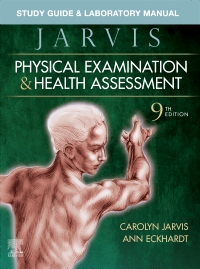

Study Guide & Laboratory Manual for Physical Examination & Health Assessment Elsevier E-Book on VitalSource, 9th Edition
Elsevier eBook on VitalSource
Now $42.29
Both a comprehensive lab manual and a practical workbook, the Study Guide & Laboratory Manual for Physical Examination & Health Assessment, 9th Edition gives you the tools you need to master physical examination and health assessment skills in the lab and in clinical practice. Corresponding to the bestselling Jarvis textbook, this guide features terminology reviews, application activities, clinical judgment questions, regional write-up sheets, and narrative summary forms, with answers to study questions at the back of the book to facilitate both learning and review. The 9th edition has been thoroughly updated with a fresh focus on the Next Generation NCLEX® (NGN), with case studies featuring new NGN question formats to prepare you not only for the skills laboratory, but for success on the NCLEX® and in interprofessional collaborative practice.
New Edition Expected Availability: 04-09-2027

Study Guide & Laboratory Manual for Jarvis' Physical Examination & Health Assessment - Elsevier E-Book on VitalSource
-
- NEW! Clinical judgment exercises equip you for success on the Next Generation NCLEX® (NGN), including questions with an increased focus on clinical judgment, robust single-episode case studies that employ the latest NGN question types, and unfolding case studies which reflect the language of the NCSBN Clinical Judgment Measurement Model
- NEW! Chapter 33 includes unfolding case studies for the NGN that present opportunities for you to practice prioritizing, decision-making, and using clinical judgment skills
- NEW! Increased emphasis on activities focused on higher cognitive levels (Applying and above)
- UPDATED! Critical Thinking Exercises offer suggested readings based on your participation in the skills lab and discussions with your instructor
- UPDATED! Content corresponds to the 9th edition of the Jarvis textbook and incorporates the latest research and evidence-based practice
-
- Authoritative review and guidance for laboratory experiences, personally written by the textbook authors, provide a seamlessly integrated study and clinical experience
- Consistent format includes Terminology Review, Study Guide, and Clinical Judgment Questions in each chapter
- Physical examination forms familiarize you with what you will encounter in clinical practice and offer practice in documenting the patient history and examination findings
- The only full-color, illustrated lab manual available for a nursing health assessment textbook with anatomy exercises that align with the main text
-
-
 Physical Examination and Health Assessment - Elsevier eBook on VitalSourceElsevier eBook on VitalSource
 -

-

-

-
-
UNIT I ASSESSMENT OF THE WHOLE PERSON
1 Evidence-Based Assessment
2 Cultural Assessment
3 The Interview
4 The Complete Health History
5 Mental Status Assessment
6 Substance Use Assessment
7 Family Violence and Human Trafficking
UNIT II APPROACH TO THE CLINICAL SETTING
8 Assessment Techniques and Safety in the Clinical Setting
9 General Survey and Measurement
10 Vital Signs
11 Pain Assessment
12 Nutrition Assessment
UNIT III PHYSICAL EXAMINATION
13 Skin, Hair, and Nails
14 Head, Face, Neck, and Regional Lymphatics
15 Eyes
16 Ears
17 Nose, Mouth, and Throat
18 Breasts, Axillae, and Regional Lymphatics
19 Thorax and Lungs
20 Heart and Neck Vessels
21 Peripheral Vascular System and Lymphatic System
22 Abdomen
23 Musculoskeletal System
24 Neurologic System
25 Male Genitourinary System
26 Anus, Rectum, and Prostate
27 Female Genitourinary System
UNIT IV INTEGRATION: PUTTING IT ALL TOGETHER
28 The Complete Health Assessment: Adult
29 The Complete Physical Assessment: Infant, Young Child, and Adolescent
30 Bedside Assessment and Electronic Documentation
31 Pregnancy
32 Functional Assessment of the Older Adult
UNIT V UNFOLDING CASE STUDIES
33 Next-Generation NCLEX® (NGN) Examination–Style Unfolding Case Studies -
-
Ways of Reading
- The appearance of the text and page layout can be modified according to the capabilities of the reading system (font family and font size, spaces between paragraphs, sentences, words, and letters, as well as color of background and text)
- This e-publication is accessible to the full extent that the file format and types of content allow, on a specific reading device, by default, without necessarily including any additions such as textual descriptions of images or enhanced navigation
- All content can be read as read aloud speech or dynamic braille
- Has alternative text descriptions for images
-
Conformance
- The publication contains a conformance statement that it meets the EPUB Accessibility 1.1, WCAG 2.1, Level AA standard. Please see https://bornaccessible.benetech.org/certified-publishers/ for further details of our compatibility testing.
- The certifier's credential is https://bornaccessible.benetech.org/certified-publishers/
- For detailed accessibility information, see Elsevier's website at https://www.elsevier.com/about/accessibility
- For queries regarding accessibility information, contact [email protected]
- The publication was certified on 06-02-2026
-
Navigation
- Table of contents to all chapters of the text via links
- Elements such as headings, tables, etc. for structured navigation
- Page list to go to pages from the print source version
-
Rich Content
- Information-rich images are described by extended descriptions
-
Hazards
- The publication contains no hazards
-
Product Content
- Content includes any type of illustrations.
- The primary content is text.
- Content includes a significant number of actionable (clickable) web links to external content, downloadable resources, supplementary material, etc.
- Content includes a significant number of actionable (clickable) cross-references, hyperlinked notes and annotations, or with other actionable links between largely textual elements (e.g., quiz/test questions, 'choose your own ending', etc.).
- Content includes figures, diagrams, charts and/or graphs, including other 'mechanical' (i.e. non-photographic) illustrations.
- Content includes a significant number of web links (printed URLs, QR codes etc.).
- Content includes text within images, including text-as-text embedded in diagrams, charts, or within images containing speech balloons, thought bubbles, captions, etc.
-
Legal Considerations
- No information is available
-
Additional Accessibility Information
- Content is enhanced with ARIA roles to optimize organization and facilitate navigation
- Page breaks included from the original print source
- For readers with color vision deficiency, use of color (e.g., in diagrams, graphics and charts, in prompts, or on buttons inviting a response) is not the sole means of graphical distinction or of conveying information
- The body text is presented with a contrast ratio of at least 4.5:1 (or 3:1 for large/heading text)
- Ultra-high contrast between text and background
- E-publication includes basic navigation (usually less detailed than TOC-based navigation)
- Where links, controls or buttons are included in the content, the purpose or functionality of each link, control or button is apparent from the associated text alone - or where it is unclear, separate link, control or button descriptions are provided
- All (or substantially all) textual matter is arranged in a single logical reading order (including text that is visually presented as separate from the main text flow, e.g., in boxouts, captions, tables, footnotes, endnotes, citations, etc.). Non-textual content is also linked from within this logical reading order. (Purely decorative non-text content can be ignored).
- Where interactive content is included in the product, controls are provided (e.g., for speed, pause and resume, reset) and labelled to make their use clear.
- The language of the text has been specified (e.g., via the HTML or XML lang attribute) to optimise text-to-speech (and other alternative renderings), both at the whole document level and, where appropriate, for individual words, phrases or passages in a different language.
-
Ways of Reading

 as described in our