ISBN:
9780323828031
Copyright:
2023
Publication Date:
03-03-2022
Page Count:
224
Imprint:
Mosby
List Price:
$46.99

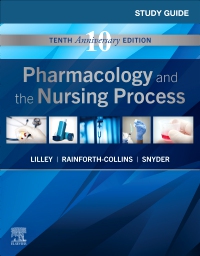
Study Guide for Pharmacology and the Nursing Process Elsevier eBook on VitalSource, 10th Edition
by Linda Lane Lilley, PhD, RN, Julie S. Snyder, MSN, RN, MEDSURG-BC and Shelly Rainforth Collins, PharmD, BCGP
Elsevier eBook on VitalSource
ISBN:
9780323828031
Copyright:
2023
Publication Date:
03-03-2022
Page Count:
224
Imprint:
Mosby
List Price:
$46.99
Was
$46.99
Now $42.29
Or $0.00 with a valid access code
Use this practical study guide to get more out of Lilley’s Pharmacology and the Nursing Process, 10th Edition textbook! With chapters corresponding to the chapters in the textbook, this workbook helps you review and understand the key terms, key concepts, and pharmacology that nurses need to know. Exercises include NCLEX-RN® examination-style review questions, critical thinking and application questions, and case studies. It provides the review and practice you need to master the nursing process and nursing pharmacology!
New Edition Expected Availability: 01-21-2026

Study Guide for Pharmacology and the Nursing Process - Elsevier E-Book on VitalSource
Elsevier eBook on VitalSource
ISBN: 9780443121197
-
- NEW! Expanded NCLEX® focus includes one to two additional NCLEX examination-style questions for each chapter, including additional alternate item format types
- NEW! Updated review questions reflect the updated content in the 10th edition of the Lilley textbook
-
- Application-based NCLEX® exam practice questions include at least one alternate item question per chapter
- Review questions in each chapter are divided into sections: Chapter Review and NCLEX® Examination Preparation, Matching, Critical Thinking and Application, and Case Study
- Focus on prioritization features prioritization exercises in which you must evaluate a clinical scenario and answer the question: What is the nurse’s best action?
- Overview of drug calculation concepts helps you correctly perform mathematical problems when calculating drug dosages, and includes practice problems and a practice quiz
- Sample drug labels are shown
- Learning strategies expand upon the unique, cartoon-illustrated study strategies in the Lilley textbook, and offer additional information and learning tips
- Answers for all questions are provided at the back of the book
-
-
 Pharmacology and the Nursing Process - Elsevier eBook on VitalSourceElsevier eBook on VitalSource
-
-
-
Ways of Reading
- The appearance of the text and page layout can be modified according to the capabilities of the reading system (font family and font size, spaces between paragraphs, sentences, words, and letters, as well as color of background and text)
- This e-publication is accessible to the full extent that the file format and types of content allow, on a specific reading device, by default, without necessarily including any additions such as textual descriptions of images or enhanced navigation
- No information about nonvisual reading is available
-
Conformance
- For detailed accessibility information, see Elsevier's website at https://www.elsevier.com/about/accessibility
- For queries regarding accessibility information, contact [email protected]
- The publication was certified on 03-11-2025
-
Navigation
- Table of contents to all chapters of the text via links
-
Rich Content
- No information is available
-
Hazards
- No information is available
-
Product Content
- No information is available
-
Legal Considerations
- No information is available
-
Additional Accessibility Information
- For readers with color vision deficiency, use of color (e.g., in diagrams, graphics and charts, in prompts, or on buttons inviting a response) is not the sole means of graphical distinction or of conveying information
- E-publication includes basic navigation (usually less detailed than TOC-based navigation)
- Where links, controls or buttons are included in the content, the purpose or functionality of each link, control or button is apparent from the associated text alone - or where it is unclear, separate link, control or button descriptions are provided
- All (or substantially all) textual matter is arranged in a single logical reading order (including text that is visually presented as separate from the main text flow, e.g., in boxouts, captions, tables, footnotes, endnotes, citations, etc.). Non-textual content is also linked from within this logical reading order. (Purely decorative non-text content can be ignored).
- The language of the text has been specified (e.g., via the HTML or XML lang attribute) to optimise text-to-speech (and other alternative renderings), both at the whole document level and, where appropriate, for individual words, phrases or passages in a different language.
-
Ways of Reading
Was
$46.99
Now $42.29
Or $0.00 with a valid access code

 as described in our