ISBN:
9780323827997
Copyright:
2023
Publication Date:
03-30-2022
Page Count:
960
Imprint:
Mosby
List Price:
$106.99

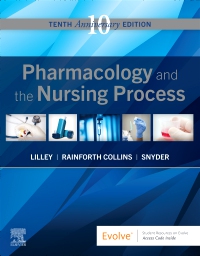
Pharmacology and the Nursing Process - Elsevier eBook on VitalSource, 10th Edition
by Linda Lane Lilley, PhD, RN, Shelly Rainforth Collins, PharmD, BCGP and Julie S. Snyder, MSN, RN, MEDSURG-BC
Elsevier eBook on VitalSource
ISBN:
9780323827997
Copyright:
2023
Publication Date:
03-30-2022
Page Count:
960
Imprint:
Mosby
List Price:
$106.99
Was
$106.99
Now $96.29
Or $0.00 with a valid access code
Gain the pharmacology knowledge and skills you need to administer medications safely! Pharmacology and the Nursing Process, 10th Edition provides practical, easy-to-use pharmacology information, emphasizing the application of the nursing process and prioritization throughout the book. Coverage begins with pharmacology basics, then discusses drugs by body systems and drug functions. Hundreds of full-color illustrations show how drugs work in the body and depict key steps in medication administration. Written by pharmacology experts Linda Lane Lilley, Shelly Rainforth Collins, and Julie S. Snyder, this bestselling textbook makes it easy to understand and apply pharmacology concepts and provide safe, quality nursing care.
New Edition Expected Availability: 02-02-2026

Pharmacology and the Nursing Process - Elsevier E-Book on VitalSource
Elsevier eBook on VitalSource
ISBN: 9780443121920
-
- NEW! Updated drug content reflects the latest FDA drug approvals, withdrawals, and therapeutic uses, and includes updated nursing content
-
- Focus on need-to-know information includes discussions of what nurses may encounter during drug administration in a variety of health care settings, providing accounts of real-life medication errors and tips for avoiding those errors
- The Nursing Process is applied to each category of drugs, ensuring that you administer medications accurately and safely, and includes the steps of assessment, human need statements, planning, implementation, and evaluation
- Emphasis on drug classes describes key similarities and differences among the drugs in each class, making it easier to understand how individual drugs work in the body
- Consistent presentation for each drug group includes the mechanism of action, indications, contraindications, adverse effects, interactions, and dosages, concluding with drug profiles of individual drugs in the class or group
- High-alert icons identify medications that pose a greater risk to patient safety
- Focus on prioritization includes prioritized nursing diagnoses along with a corresponding prioritization of goals and outcomes, to help you learn to connect nursing diagnoses with goals and outcomes
- Ease of readability makes difficult content more understandable
- Photo atlas features more than 100 drawings and photographs showing drug administration techniques
- Dosages tables summarize generic and trade names, pharmacologic class, normal dosage ranges, and indications for the drugs
- Learning features at the beginning of each chapter include objectives and key terms, and at the end of each chapter, key points, critical thinking questions, review questions, and a list of resources available on the Evolve website
- QSEN coverage includes the use of human need theory with human need statements, case studies featuring collaboration and teamwork content, Preventing Medication Errors boxes, and a discussion of the QSEN initiative as it relates to the safety and quality of patient care
-
-
 Lilley Pharmacology and the Nursing Process - Sherpath for PharmacologySherpath Book-Organized
 -
 Sherpath Vantage for Lilley Pharmacology and the Nursing ProcessSherpath Vantage
 -
 Elsevier Adaptive Quizzing for Pharmacology and the Nursing ProcessElsevier Adaptive Quizzing - Next Generation
 -
 Study Guide for Pharmacology and the Nursing Process Elsevier eBook on VitalSourceElsevier eBook on VitalSource
 -

-
-
PART 1: PHARMACOLOGY BASICS
1. The Nursing Process and Drug Therapy
2. Pharmacologic Principles
3. Lifespan Considerations
4. Cultural, Legal, and Ethical Considerations
5. Medication Errors: Preventing and Responding
6. Patient Education and Drug Therapy
7. Over-the-Counter Drugs and Herbal and Dietary Supplements
8. Gene Therapy and Pharmacogenomics
9. Photo Atlas of Drug Administration
PART 2: DRUGS AFFECTING THE CENTRAL NERVOUS SYSTEM
10. Analgesic Drugs
11. General and Local Anesthetics
12. Central Nervous System Depressants and Muscle Relaxants
13. Central Nervous System Stimulants and Related Drugs
14. Antiepileptic Drugs
15. Antiparkinson Drugs
16. Psychotherapeutic Drugs
17. Substance Use Disorder
PART 3: DRUGS AFFECTING THE AUTONOMIC NERVOUS SYSTEM
18. Adrenergic Drugs
19. Adrenergic-Blocking Drugs
20. Cholinergic Drugs
21. Cholinergic-Blocking Drugs
PART 4: DRUGS AFFECTING THE CARDIOVASCULAR AND RENAL SYSTEMS
22. Antihypertensive Drugs
23. Antianginal Drugs
24. Heart Failure Drugs
25. Antidysrhythmic Drugs
26. Coagulation Modifier Drugs
27. Antilipemic Drugs
28. Diuretic Drugs
29. Fluids and Electrolytes
PART 5: DRUGS AFFECTING THE ENDOCRINE AND REPRODUCTIVE SYSTEMS
30. Pituitary Drugs
31. Thyroid and Antithyroid Drugs
32. Antidiabetic Drugs
33. Adrenal Drugs
34. Women’s Health Drugs
35. Men’s Health Drugs
PART 6: DRUGS AFFECTING THE RESPIRATORY SYSTEM
36. Antihistamines, Decongestants, Antitussives, and Expectorants
37. Respiratory Drugs
PART 7: ANTIINFECTIVE AND ANTIINFLAMMATORY DRUGS
38. Antibiotics Part 1
39. Antibiotics Part 2
40. Antiviral Drugs
41. Antitubercular Drugs
42. Antifungal Drugs
43. Antimalarial, Antiprotozoal, and Anthelmintic Drugs
44. Antiinflammatory and Antigout Drugs
PART 8: CHEMOTHERAPEUTIC DRUGS AND BIOLOGIC AND IMMUNE MODIFIERS
45. Antineoplastic Drugs Part 1: Cancer Overview and Cell Cycle–Specific Drugs
46. Antineoplastic Drugs Part 2: Cell Cycle–Nonspecific Drugs and Miscellaneous Drugs
47. Biologic Response–Modifying and Antirheumatic Drugs
48. Immunosuppressant Drugs
49. Immunizing Drugs
PART 9: DRUGS AFFECTING THE GASTROINTESTINAL SYSTEM AND NUTRITION
50. Acid-Controlling Drugs
51. Bowel Disorder Drugs
52. Antiemetic and Antinausea Drugs
53. Vitamins and Minerals
54. Anemia Drugs
55. Nutritional Supplements
PART 10: DERMATOLOGIC, OPHTHALMIC, AND OTIC DRUGS
56. Dermatologic Drugs
57. Ophthalmic Drugs
58. Otic Drugs -
-
Ways of Reading
- The appearance of the text and page layout can be modified according to the capabilities of the reading system (font family and font size, spaces between paragraphs, sentences, words, and letters, as well as color of background and text)
- This e-publication is accessible to the full extent that the file format and types of content allow, on a specific reading device, by default, without necessarily including any additions such as textual descriptions of images or enhanced navigation
- All content can be read as read aloud speech or dynamic braille
- Has alternative text descriptions for images
-
Conformance
- The publication contains a conformance statement that it meets the EPUB Accessibility 1.1, WCAG 2.1, Level AA standard. Please see https://bornaccessible.benetech.org/certified-publishers/ for further details of our compatibility testing.
- The certifier's credential is https://bornaccessible.benetech.org/certified-publishers/
- For detailed accessibility information, see Elsevier's website at https://www.elsevier.com/about/accessibility
- For queries regarding accessibility information, contact [email protected]
- The publication was certified on 24-03-2026
-
Navigation
- Table of contents to all chapters of the text via links
- Index with links to referenced entries
- Elements such as headings, tables, etc. for structured navigation
- Page list to go to pages from the print source version
-
Rich Content
- Math formulas in accessible format (MathML)
- Information-rich images are described by extended descriptions
-
Hazards
- The publication contains no hazards
-
Product Content
- Content includes any type of illustrations.
- The primary content is text.
- Content includes maps and/or other cartographic content.
- Content includes a significant number of actionable (clickable) web links to external content, downloadable resources, supplementary material, etc.
- Content includes a significant number of actionable (clickable) cross-references, hyperlinked notes and annotations, or with other actionable links between largely textual elements (e.g., quiz/test questions, 'choose your own ending', etc.).
- Content includes photographs, whether in a plate section / insert or not.
- Content includes figures, diagrams, charts and/or graphs, including other 'mechanical' (i.e. non-photographic) illustrations.
- Content includes images displayed in a specific order for the purpose of graphic storytelling or giving information (e.g. graphic novels, comics and manga). May include text integrated into the image (as speech and thought bubbles, textual 'sound' effects, captions etc.).
- Content includes text within images, including text-as-text embedded in diagrams, charts, or within images containing speech balloons, thought bubbles, captions, etc.
- Content includes visual content that is purely decorative and is not necessary to understanding of the content.
- Content includes mathematical notations, formulae.
- At least some text - including text within other images - is 'text as an image' (i.e., a picture of text).
-
Legal Considerations
- No information is available
-
Additional Accessibility Information
- Content is enhanced with ARIA roles to optimize organization and facilitate navigation
- Page breaks included from the original print source
- For readers with color vision deficiency, use of color (e.g., in diagrams, graphics and charts, in prompts, or on buttons inviting a response) is not the sole means of graphical distinction or of conveying information
- The body text is presented with a contrast ratio of at least 4.5:1 (or 3:1 for large/heading text)
- Ultra-high contrast between text and background
- E-publication includes basic navigation (usually less detailed than TOC-based navigation)
- Where links, controls or buttons are included in the content, the purpose or functionality of each link, control or button is apparent from the associated text alone - or where it is unclear, separate link, control or button descriptions are provided
- All (or substantially all) textual matter is arranged in a single logical reading order (including text that is visually presented as separate from the main text flow, e.g., in boxouts, captions, tables, footnotes, endnotes, citations, etc.). Non-textual content is also linked from within this logical reading order. (Purely decorative non-text content can be ignored).
- Content provides explanations for unusual words, abbreviations, acronyms, idioms, jargon in an accessible form, such as glossaries, scripted pop-ups.
- Where interactive content is included in the product, controls are provided (e.g., for speed, pause and resume, reset) and labelled to make their use clear.
- The language of the text has been specified (e.g., via the HTML or XML lang attribute) to optimise text-to-speech (and other alternative renderings), both at the whole document level and, where appropriate, for individual words, phrases or passages in a different language.
-
Ways of Reading
Was
$106.99
Now $96.29
Or $0.00 with a valid access code

 as described in our