ISBN:
9780323829441
Copyright:
2027
Publication Date:
07-10-2026
Page Count:
376
Imprint:
Elsevier
List Price:
$38.99

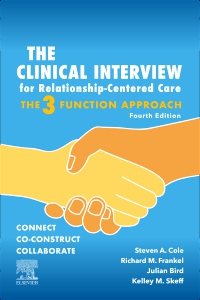
The Clinical Interview for Relationship-Centered Care: The Three Function Approach - Elsevier E-Book on VitalSource, 4th Edition
by Steven A. Cole, MD, MA, Richard M. Frankel, PhD, MD (Hon) and Kelley M. Skeff, MD, PhD
Elsevier eBook on VitalSource
ISBN:
9780323829441
Copyright:
2027
Publication Date:
07-10-2026
Page Count:
376
Imprint:
Elsevier
List Price:
$38.99
Was
$38.99
Now $27.29
Or $0.00 with a valid access code
The interview is the cornerstone of accurate diagnosis and effective care. The Clinical Interview for Relationship-Centered Care (formerly The Medical Interview: The Three Function Approach) provides practical, real-world guidance from a relationship-centered, clinical perspective. The fully revised 4th Edition equips you to communicate effectively using the Three Function Approach—Connect, Co-construct, and Collaborate—helping you hone foundational interviewing skills as well as advanced skills for challenging situations. Ideal for early learners as well as experienced healthcare professionals, this highly readable text helps you learn and master straightforward concepts, microskills, and skill-sets you need to provide optimal care for every patient.
-
- NEW! Nora AI - an AI-powered learning assistant exclusive to Elsevier ebooks on VitalSource's Bookshelf® platform - offers built-in AI learning support that provides personalized answers based on content from the Elsevier ebook
- Describes three core functions of the clinical interview—connect, co-construct the illness narrative, and collaborate for care—with updated evidence-base to facilitate relationship-centered care throughout day-to-day practice
- Introduces three “meta-skills”—connect to self in context, connect with values, and connect non-verbally—higher-order skills to facilitate learning and clinical implementation
- Provides a new biopsychosocial tool, “the three pillars,” for co-constructing the clinical narrative: chronology of the present illness, ecology of the illness, and affirmation of strengths and resources
- Includes a new section on Professional Identity Formation, with research and clinical perspectives, and related chapters on Mindfulness, Use of Self, and Approach to Patient/Family and Student Concerns—all designed to help clinicians and educators understand transformative role transitions that mature during a practice lifetime
- Integrates Motivational Interviewing and Health Coaching with new chapters on Brief Action Planning (BAP), BAP-MI (Advanced Skills), and the Spirit of Motivational Interviewing
- Adds chapters on advanced topics and applications such as using digital technology (computers and virtual visits), presentation and documentation, language and cultural barriers, health literacy, elderly patients, mitigating burnout, team-based care, and applications across health systems
- Addresses challenges of chronic and life-limiting illness with new chapters on Optimizing Three Function Presence Over Time, Sharing Difficult News While Exploring Hope, and Collaborating for Care in Discussing Limitations of Treatment
-
SECTION 1 Overview: Organization, Background, and Rationale
1. Organization of the Text
2. Background: Interviews Are Everywhere: A Compressed History of the Clinical Interview
3. Rationale: A Unified Model of the Clinical Interview for Relationship-Centered Care
SECTION 2 The Three Functions
4. Function One: Connect
5. Function Two: Co-construct the Narrative
6. Function Three: Collaborate for Care (Part I)
7. Function Three: Collaborate for Care (Part II)—Brief Action Planning
SECTION 3 Professional Identity Formation
8. The Three Function Approach to Professional Identity Formation in Healthcare Education and Clinical Care
9. Mindfulness: A Central Quality for Clinical Presence in the Three Function Approach
10. Use of the Self in Clinical Care
11. The Three Function Approach to Patient/Family and Student Concerns
SECTION 4 Structure of the Interview
12. Overview and Opening: Invest in the Beginning
13. History of the Present Illness: Three Pillars
14. Past Medical History
15. Family History
16. Patient Profile and Social History
17. Review of Systems
18. Closing the Interview: Summarize With Affirmations of Connection and Continuity
SECTION 5 Digital Technology, Documentation, and Presentation
19. The Three Function Approach to Computer Use and Virtual Visits
20. Documentation and Presentation
SECTION 6 Advanced Applications
21. The Three Function Approach to Nonverbal Communication
22. Using Motivational Interviewing and Brief Action Planning for Adopting and Maintaining Positive Health Behaviors
23. BAP-MI: A Novel Stepped-Care Integration of Brief Action Planning and Motivational Interviewing to Optimize Outcomes
24. What Is the Spirit of Motivational Interviewing and Why Is It Relevant to the Three Function Approach?
25. BAP-MI in the Three Function Approach: A Stepped-Care Model for Teaching, Learning, and Using Motivational Interviewing and Coaching in Health Care
26. Cultural Considerations in the Care of the Patient: The Three Function Approach
27. Health Literacy and the Three Function Approach
28. Interviewing Older Adults: The Three Function Approach
29. The Three Function Approach to the Family Interview
30. The Three Function Approach to Interviewing Patients With Unhealthy Substance Use
31. The Three Function Approach to Interviewing the Patient Experiencing Psychosis
SECTION 7 Chronic and Life-Limiting Illness
32. Optimizing Three Function Presence Over Time: Addressing Stresses and Challenges of Chronic Illness
33. Clinical Interviewing and Chronic Illness: A Three Function Approach
34. Sharing Difficult News While Exploring Hope: The Prepare-Share-Care (PCS) Application of the Three Function Model
35. Collaborating for Care in Discussing Limitations of Treatment
SECTION 8 The Three Function Approach in Systems and Society
36. The Three Function Approach to Team-Based Care
37. Acceptance and Cultural Humility in Health Care: Toward Healing and Solutions Through a Three Function Understanding
38. Mitigating Burnout Using the Three Function Approach to Relationship-Centered Care: Application in Practice
39. Self, System, and Society: Skills and Mindsets That Help Systems Flourish
Appendix
A. Patient Care Triangles
B. Tables of Skills -
-
Ways of Reading
- The appearance of the text and page layout can be modified according to the capabilities of the reading system (font family and font size, spaces between paragraphs, sentences, words, and letters, as well as color of background and text)
- This e-publication is accessible to the full extent that the file format and types of content allow, on a specific reading device, by default, without necessarily including any additions such as textual descriptions of images or enhanced navigation
- All content can be read as read aloud speech or dynamic braille
- Has alternative text descriptions for images
-
Conformance
- The certifier's credential is https://bornaccessible.benetech.org/certified-publishers/
- For detailed accessibility information, see Elsevier's website at https://www.elsevier.com/about/accessibility
- For queries regarding accessibility information, contact [email protected]
- The publication was certified on 20-06-2026
-
Navigation
- Table of contents to all chapters of the text via links
- Index with links to referenced entries
- Elements such as headings, tables, etc. for structured navigation
- Page list to go to pages from the print source version
-
Rich Content
- Information-rich images are described by extended descriptions
-
Hazards
- The publication contains no hazards
-
Product Content
- Content includes any type of illustrations.
- The primary content is text.
- Content includes a significant number of actionable (clickable) web links to external content, downloadable resources, supplementary material, etc.
- Content includes a significant number of actionable (clickable) cross-references, hyperlinked notes and annotations, or with other actionable links between largely textual elements (e.g., quiz/test questions, 'choose your own ending', etc.).
- Content includes photographs, whether in a plate section / insert or not.
- Content includes figures, diagrams, charts and/or graphs, including other 'mechanical' (i.e. non-photographic) illustrations.
- Content includes text within images, including text-as-text embedded in diagrams, charts, or within images containing speech balloons, thought bubbles, captions, etc.
- At least some text - including text within other images - is 'text as an image' (i.e., a picture of text).
-
Legal Considerations
- No information is available
-
Additional Accessibility Information
- Content is enhanced with ARIA roles to optimize organization and facilitate navigation
- Page breaks included from the original print source
- For readers with color vision deficiency, use of color (e.g., in diagrams, graphics and charts, in prompts, or on buttons inviting a response) is not the sole means of graphical distinction or of conveying information
- The body text is presented with a contrast ratio of at least 4.5:1 (or 3:1 for large/heading text)
- Ultra-high contrast between text and background
- E-publication includes basic navigation (usually less detailed than TOC-based navigation)
- Where links, controls or buttons are included in the content, the purpose or functionality of each link, control or button is apparent from the associated text alone - or where it is unclear, separate link, control or button descriptions are provided
- All (or substantially all) textual matter is arranged in a single logical reading order (including text that is visually presented as separate from the main text flow, e.g., in boxouts, captions, tables, footnotes, endnotes, citations, etc.). Non-textual content is also linked from within this logical reading order. (Purely decorative non-text content can be ignored).
- Content provides explanations for unusual words, abbreviations, acronyms, idioms, jargon in an accessible form, such as glossaries, scripted pop-ups.
- Where interactive content is included in the product, controls are provided (e.g., for speed, pause and resume, reset) and labelled to make their use clear.
- The language of the text has been specified (e.g., via the HTML or XML lang attribute) to optimise text-to-speech (and other alternative renderings), both at the whole document level and, where appropriate, for individual words, phrases or passages in a different language.
-
Ways of Reading

Was
$38.99
Now $27.29
Or $0.00 with a valid access code

 as described in our