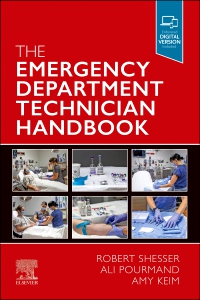
Provides quick, convenient access to practical guidance and everyday answers in an easy-to-read outline format
Discusses key topics such as patient flow and assessment in the ED, triage, and point-of-care testing
Advises on best practices for wound care, including cleansing, dressing, and splinting a wound as well as how to set up a suture tray and advanced wound care techniques
Covers essential imaging-based procedures, including the use of ultrasound-guided IV
Features a companion video library with a range of clips depicting how to perform procedures and patient examinations in real time
Enhanced eBook version included with purchase. Your enhanced eBook allows you to access all of the text, figures, videos, and references from the book on a variety of devices
1. The Role of the Hospital Emergency Department and the Specialty of Emergency Medicine 2. Emergency Department Organization and Flow 3. Medical Terminology 4. Teamwork and Communication 5. Initial Emergency Department Patient Assessment 6. Triage 7. Point-of-Care Testing 8. The Electrocardiogram and Cardiac Monitoring 9. Cardiologic Emergencies 10. Respiratory System Emergencies 11. Abdominal and Genitourinary Problems 12. Endocrinologic Emergencies 13. Ear, Nose, and Throat and Ophthalmologic Emergencies 14. Stroke and Neurologic Emergencies 15. Vascular Access 16. Ultrasound-Guided IV Access 17. Wound Management 18. Musculoskeletal Injuries 19. Orthopedic Immobilization Techniques 20. The Major Trauma Patient 21. Behavioral Health and Toxicologic Emergencies 22. Medical Ethics, the Law, and Cultural Competency 23. Patient Transport 24. Pediatrics 25. Documentation 26. Disasters and Mass Casualty Events 27. Infection Control in the Emergency Department 28. Case Studies in Emergency Triage 29. Obstetrics and Gynecology in the Emergency Department
Robert Shesser, M.D. MPH, Professor and Chair, Department of Emergency Medicine, George Washington University School of Medicine, Washington, District of Columbia, USA, Ali Pourmand, MD, MPH, Professor of Emergency Medicine, George Washington University School of Medicine, Washington, District of Columbia, USA and Amy Keim, PA-C, Clinical Associate Professor of Emergency Medicine, George Washington University School of Medicine, Washington, District of Columbia, USA
We use cookies which are necessary to make our site work. We may also use additional cookies to analyse, improve and personalise our content and your digital experience. For more information, see our Cookie Policy and the list of Google Ad-Tech Vendors.
You may choose not to allow some types of cookies. However, blocking some types may impact your experience of our site and the services we are able to offer. See the different category headings below to find out more or change your settings.
You may also be able to exercise your privacy choices as described in our Privacy Policy
Manage Consent Preferences
Strictly Necessary Cookies
Always active
These cookies are necessary for the website to function and cannot be switched off in our systems. They are usually only set in response to actions made by you which amount to a request for services, such as setting your privacy preferences, logging in or filling in forms. You can set your browser to block or alert you about these cookies, but some parts of the site will not then work.
Functional Cookies
These cookies enable the website to provide enhanced functionality and personalisation. They may be set by us or by third party providers whose services we have added to our pages. If you do not allow these cookies then some or all of these services may not function properly.
Performance Cookies
These cookies allow us to count visits and traffic sources so we can measure and improve the performance of our site. They help us to know which pages are the most and least popular and see how visitors move around the site.
Targeting Cookies
These cookies may be set through our site by our advertising partners. They may be used by those companies to build a profile of your interests and show you relevant adverts on other sites. If you do not allow these cookies, you will experience less targeted advertising.
