
ISBN:
9780323831000
Copyright:
2024
Publication Date:
06-06-2023
Page Count:
352
Imprint:
Elsevier
List Price:
$82.99

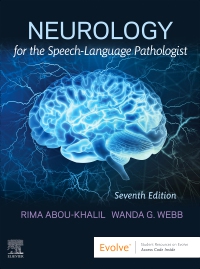
Neurology for the Speech-Language Pathologist - Elsevier eBook on VitalSource, 7th Edition
by Rima Abou-Khalil, Ph.D., CCC-SLP and Wanda Webb, PhD, CCC-SLP
Elsevier eBook on VitalSource
ISBN:
9780323831000
Copyright:
2024
Publication Date:
06-06-2023
Page Count:
352
Imprint:
Elsevier
List Price:
$82.99
Was
$82.99
Now $73.03
Or $0.00 with a valid access code
The concise, easy-to-understand Neurology for the Speech-Language Pathologist, 7th Edition provides you with a practical guide for the study and understanding of neurology as it relates to human communication and the study of speech-language pathology (SLP). Correlated with clinical syndromes and diseases seen in SLP, it gives you a solid understanding of the nervous system, including development of the nervous system, organization of the brain, protective mechanisms, descending motor and ascending sensory pathways, and cranial nerves.
-
- Case studies and clinical applications provide students with realistic diagnostic and therapeutic applications
- Complex information is clearly presented in a concise, easy-to-understand manner
- Clinical emphasis throughout makes this text valuable as students move into professional practice and prepare for the Praxis exam
- Evolve companion website has vocabulary flashcards and study questions with answers so students can assess their knowledge
- Key terms in each chapter and an end-of-text glossary give students easy access to accurate, concise definitions
-
- NEW! Content on the networks of the brain
- NEW! Content on the reticular activating system, memory types, and altered mental status
- NEW! Section on prematurity
- NEW! Expanded discussion of RNA
- Revised content throughout provides students with the most up-to-date information they need to be an effective practitioner
- Updated references ensure content is current and applicable for today’s students
-
1. Introduction to Speech-Language Neurology
2. Organization of the Nervous System I
3. Organization of the Nervous System II
4. Neuronal Function in the Nervous System
5. Neurosensory Organization
6. Neuromotor Control of Speech
7. The Cranial Nerves
8. Clinical Speech Syndromes of the Motor Systems
9. Central Language Mechanisms and Learning
10. Adult Disorders of Language
11. Pediatrics: The Developing Brain
12. Pediatric Clinical Speech Syndromes
13. Pediatric Disorders of Language
Appendix A: Medical Conditions Related to Communication Disorders
Appendix B: Bedside Neurologic Examination
Appendix C: Screening Neurologic Examination for Speech- Language Pathology -
-
Ways of Reading
- The appearance of the text and page layout can be modified according to the capabilities of the reading system (font family and font size, spaces between paragraphs, sentences, words, and letters, as well as color of background and text)
- This e-publication is accessible to the full extent that the file format and types of content allow, on a specific reading device, by default, without necessarily including any additions such as textual descriptions of images or enhanced navigation
- No information about nonvisual reading is available
-
Conformance
- For detailed accessibility information, see Elsevier's website at https://www.elsevier.com/about/accessibility
- For queries regarding accessibility information, contact [email protected]
- The publication was certified on 03-11-2025
-
Navigation
- Table of contents to all chapters of the text via links
-
Rich Content
- No information is available
-
Hazards
- No information is available
-
Product Content
- No information is available
-
Legal Considerations
- No information is available
-
Additional Accessibility Information
- For readers with color vision deficiency, use of color (e.g., in diagrams, graphics and charts, in prompts, or on buttons inviting a response) is not the sole means of graphical distinction or of conveying information
- E-publication includes basic navigation (usually less detailed than TOC-based navigation)
- Where links, controls or buttons are included in the content, the purpose or functionality of each link, control or button is apparent from the associated text alone - or where it is unclear, separate link, control or button descriptions are provided
- All (or substantially all) textual matter is arranged in a single logical reading order (including text that is visually presented as separate from the main text flow, e.g., in boxouts, captions, tables, footnotes, endnotes, citations, etc.). Non-textual content is also linked from within this logical reading order. (Purely decorative non-text content can be ignored).
- The language of the text has been specified (e.g., via the HTML or XML lang attribute) to optimise text-to-speech (and other alternative renderings), both at the whole document level and, where appropriate, for individual words, phrases or passages in a different language.
-
Ways of Reading

Was
$82.99
Now $73.03
Or $0.00 with a valid access code

 as described in our