ISBN:
9780323872829
Copyright:
2024
Publication Date:
11-17-2023
Page Count:
880
Imprint:
Elsevier
List Price:
$91.99

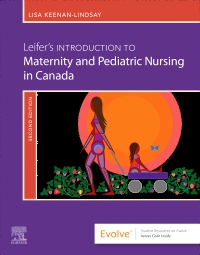
Leifer's Introduction to Maternity & Pediatric Nursing in Canada - Elsevier eBook on VitalSource, 2nd Edition
by Lisa Keenan-Lindsay, RN, MN, PNC(C) and Gloria Leifer, MA, RN, CNE
Elsevier eBook on VitalSource
ISBN:
9780323872829
Copyright:
2024
Publication Date:
11-17-2023
Page Count:
880
Imprint:
Elsevier
List Price:
$91.99
Was
$91.99
Now $82.79
Or $0.00 with a valid access code
Gain a solid foundation in Canadian maternity and pediatric nursing! Written in a clear, concise, user-friendly style, Leifer’s Introduction to Maternity and Pediatric Nursing in Canada, 2nd Edition, includes Canadian statistics, terminology, references, guidelines, resources, Canadian nursing best practices, assessments, and more! It’s organized by developmental stages and includes discussions of pediatric disorders by body system from simple-to-complex and health-to-illness. With a rich focus on family health, this text contains review questions for certification exams, case studies, and numerous other helpful features to give you the tools you need to successfully care for patients within the Canadian social and institutional context.
-
- Up-to-date, comprehensive inclusion of Canadian content, including statistics, research, references and resources, guidelines, assessment and screening tools, and more from across Canada!
- NEW! End-of-chapter Get Ready for the Certification Examination section includes review questions, ordered from easiest to most difficult, for students preparing for the REx-PN® and CRNRE® exams
- More case studies with open-ended questions stimulate critical thinking in applying concepts discussed in the chapter
- NEW! Enhanced and updated art programme visually reinforces key concepts
-
- NEW! Nora AI - an AI-powered learning assistant exclusive to Elsevier ebooks on VitalSource's Bookshelf® platform - offers built-in AI learning support that provides personalized answers based on content from the Elsevier ebook
- Uniquely Canadian content includes Canadian statistics, terminology, references and resources, guidelines from the Society of Obstetricians and Gynaecologist’s of Canada (SOGC), the Canadian Paediatric Society (CPS), and the Public Health Agency of Canada, Canadian nursing best practice guidelines, assessments, and more!
- Canadian cultural considerations content related to diverse populations, including the 2SLGBTQI+ community, racialized populations, Indigenous Peoples, and more, is threaded throughout all applicable chapters
- Labour information is based on Canadian guidelines and the five Ps of labour.
- Inclusion of Canadian medications, dosages, and metric measurements
- Coverage of Canadian ethical and legal standards, and provincial and territorial legislation
- Logical organization of content by simple-to-complex and health-to-illness makes it easy to locate and access information
- Health Promotion Considerations boxes focus on preventive strategies for achieving prenatal wellness, health during pregnancy, postpartum health, newborn health, and pediatric illness prevention and wellness — including Canadian immunization schedules for all ages
- Unfolding case studies with open-ended critical thinking questions assess application of content to clinical practice, following one family through conception and the birth process
- Nursing care plans provide expected outcomes, interventions, and rationales for nursing interventions
- Comprehensive coverage of more than 35 skills, outlined in step-by-step format, cover a wide range of maternal and pediatric nursing interventions
- Focus on health promotion and illness prevention addresses women’s health issues and the growth and development of child and parent
- Cultural considerations concerning competent, emotional, and cultural care and trauma care are included
- Safety Alerts emphasize protecting patients, family, health care providers, and the public from accidents, medication errors, and the spread of disease
- Nursing Tips throughout the text provide pertinent information applicable in the clinical setting
- Health promotion coverage includes application of the social determinants of health, greater emphasis on community nursing, primary health care, and family-centred care approach
- Baby-friendly initiatives are incorporated throughout the text
- Critical thinking questions apply concepts learned in the chapter to practical situations
- Safety coverage includes maternity and pediatric care in the home and community
-
UNIT I AN OVERVIEW OF PERINATAL AND PEDIATRIC NURSING
1. Overview of Perinatal and Pediatric Nursing in Canada
UNIT II REPRODUCTIVE HEALTH
2. The Nurse’s Role in Reproductive Health Care
UNIT III MATERNAL–NEWBORN NURSING
3. Fetal Development
4. Prenatal Care and Adaptations to Pregnancy
5. Nursing Care of Patients with Complications During Pregnancy
6. Nursing Care of the Family During Labour and Birth
7. Pain Management During Labour and Birth
8. Nursing Care of Patients with Complications During Labour and Birth
9. Nursing Care of the Postpartum Person and Family After Birth
10. Nursing Care of Patients with Complications After Birth
11. The Term Newborn
12. High-Risk Newborns
UNIT IV THE GROWING CHILD AND FAMILY
13. Pediatric Health Promotion
14. The Infant
15. The Toddler
16. The Preschool Child
17. The School-Age Child
18. The Adolescent
UNIT V ADAPTING CARE TO THE PEDIATRIC PATIENT
19. The Child’s Experience of Hospitalization
20. Health Care Adaptations for the Child and Family
21. Complementary and Alternative Health Modalities in Pediatric Nursing
22. Chronic Conditions and Palliative Care: Caring for the Child and Family
UNIT VI THE CHILD NEEDING NURSING CARE
23. The Child with an Eye, Ear, or Neurological Condition
24. The Child with a Musculoskeletal Condition
25. The Child with a Respiratory Condition
26. The Child with a Cardiovascular Condition
27. The Child with a Condition of the Blood, Blood-Forming Organs, or Lymphatic System
28. The Child with a Gastrointestinal Condition
29. The Child with a Genitourinary Condition
30. The Child with a Skin Condition
31. The Child with an Endocrine or Metabolic Condition
32. Childhood Communicable Diseases
33. The Child with an Emotional or Behavioural Condition
APPENDICES - AVAILABLE ON EVOLVE
A. Normal Vital Signs and Temperature Equivalents of Infants and Children
B. Pediatric Laboratory Values Reference
C. Canada’s Food Guide -
-
Ways of Reading
- The appearance of the text and page layout can be modified according to the capabilities of the reading system (font family and font size, spaces between paragraphs, sentences, words, and letters, as well as color of background and text)
- This e-publication is accessible to the full extent that the file format and types of content allow, on a specific reading device, by default, without necessarily including any additions such as textual descriptions of images or enhanced navigation
- No information about nonvisual reading is available
-
Conformance
- No information is available
-
Navigation
- Table of contents to all chapters of the text via links
- Page list to go to pages from the print source version
-
Rich Content
- No information is available
-
Hazards
- No information is available
-
Product Content
- No information is available
-
Legal Considerations
- No information is available
-
Additional Accessibility Information
- Content is enhanced with ARIA roles to optimize organization and facilitate navigation
- Page breaks included from the original print source
- For readers with color vision deficiency, use of color (e.g., in diagrams, graphics and charts, in prompts, or on buttons inviting a response) is not the sole means of graphical distinction or of conveying information
- E-publication includes basic navigation (usually less detailed than TOC-based navigation)
- Where links, controls or buttons are included in the content, the purpose or functionality of each link, control or button is apparent from the associated text alone - or where it is unclear, separate link, control or button descriptions are provided
- All (or substantially all) textual matter is arranged in a single logical reading order (including text that is visually presented as separate from the main text flow, e.g., in boxouts, captions, tables, footnotes, endnotes, citations, etc.). Non-textual content is also linked from within this logical reading order. (Purely decorative non-text content can be ignored).
- The language of the text has been specified (e.g., via the HTML or XML lang attribute) to optimise text-to-speech (and other alternative renderings), both at the whole document level and, where appropriate, for individual words, phrases or passages in a different language.
-
Ways of Reading


Was
$91.99
Now $82.79
Or $0.00 with a valid access code

 as described in our