ISBN:
9780323875141
Copyright:
2022
Publication Date:
10-25-2021
Page Count:
336
Imprint:
Mosby
List Price:
$37.99

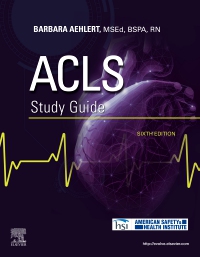
ACLS Study Guide - Elsevier eBook on VitalSource, 6th Edition
by Barbara J. Aehlert, MSEd, BSPA, RN
Elsevier eBook on VitalSource
ISBN:
9780323875141
Copyright:
2022
Publication Date:
10-25-2021
Page Count:
336
Imprint:
Mosby
List Price:
$37.99
Was
$37.99
Now $34.19
Or $0.00 with a valid access code
Build the knowledge and skills you need to provide emergency cardiovascular care! ACLS Study Guide, 6th Edition provides a comprehensive, easy-to-understand overview of advanced cardiovascular life support. With case studies and hundreds of full-color photos and illustrations, this guide covers everything from airway management to cardiac arrest rhythms and electrophysiology, tachycardias and bradycardias, acute coronary syndromes, and acute ischemic stroke. Discussions of the newest ECC guidelines and ACLS treatment algorithms help you manage common cardiac conditions. Written by noted EMS educator Barbara Aehlert, ACLS Study Guide is ideal for use with the American Safety & Health Institute ACLS certification course.
-
- NEW! Updated content includes the latest guidelines from the American Heart Association Guidelines for Cardiopulmonary Resuscitation and Emergency Cardiovascular Care and the International Consensus on Cardiopulmonary Resuscitation and Emergency Cardiovascular Care Science with Treatment Recommendations.
- NEW! 20 new illustrations are added to the book’s hundreds of illustrations.
-
- Easy-to-understand approach simplifies your study of advanced cardiac life support, thanks to Barbara Aehlert’s unique, conversational writing style.
- Case studies describe real-world examples of common clinical situations, helping you master skills in cardiac rhythm interpretation, medication administration, and other essential interventions.
- Evidence-based practice recommendations are provided for emergency medical treatment.
- ACLS Pearl boxes offer brief explanations of complex topics and useful tips for clinical practice.
- Keeping It Simple boxes provide clear and concise summaries of key points along with memory aids.
- End-of-chapter quizzes include answers and rationales, helping you remember the most important information.
-
-
 Evolve Resources for ACLS Study GuideResources
 -
 ACLS Study GuidePaperback
-
-
-  Emergency Cardiovascular Care
- Airway Management
- Cardiac Anatomy & Electrophysiology
- Cardiac Arrest Rhythms
- Tachycardias
- Bradycardias
- Acute Coronary Syndromes
- Acute Ischemic Stroke
- Post Test
Glossary
-
-
Ways of Reading
- The appearance of the text and page layout can be modified according to the capabilities of the reading system (font family and font size, spaces between paragraphs, sentences, words, and letters, as well as color of background and text)
- This e-publication is accessible to the full extent that the file format and types of content allow, on a specific reading device, by default, without necessarily including any additions such as textual descriptions of images or enhanced navigation
- No information about nonvisual reading is available
-
Conformance
- For detailed accessibility information, see Elsevier's website at https://www.elsevier.com/about/accessibility
- For queries regarding accessibility information, contact [email protected]
- The publication was certified on 03-11-2025
-
Navigation
- Table of contents to all chapters of the text via links
-
Rich Content
- No information is available
-
Hazards
- No information is available
-
Product Content
- No information is available
-
Legal Considerations
- No information is available
-
Additional Accessibility Information
- For readers with color vision deficiency, use of color (e.g., in diagrams, graphics and charts, in prompts, or on buttons inviting a response) is not the sole means of graphical distinction or of conveying information
- E-publication includes basic navigation (usually less detailed than TOC-based navigation)
- Where links, controls or buttons are included in the content, the purpose or functionality of each link, control or button is apparent from the associated text alone - or where it is unclear, separate link, control or button descriptions are provided
- All (or substantially all) textual matter is arranged in a single logical reading order (including text that is visually presented as separate from the main text flow, e.g., in boxouts, captions, tables, footnotes, endnotes, citations, etc.). Non-textual content is also linked from within this logical reading order. (Purely decorative non-text content can be ignored).
- The language of the text has been specified (e.g., via the HTML or XML lang attribute) to optimise text-to-speech (and other alternative renderings), both at the whole document level and, where appropriate, for individual words, phrases or passages in a different language.
-
Ways of Reading
Was
$37.99
Now $34.19
Or $0.00 with a valid access code

 as described in our