
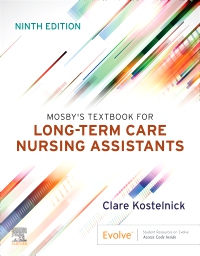

Mosby's Textbook for Long-Term Care Nursing Assistants - Elsevier eBook on VitalSource, 9th Edition
Elsevier eBook on VitalSource
Now $61.59
**Selected for Doody’s Core Titles® 2024 with "Essential Purchase" designation in Long Term Care**
Gain the knowledge and skills you need to provide safe, compassionate long-term care! Mosby's Textbook for Long-Term Care Nursing Assistants, 9th Edition prepares you to succeed as a professional caregiver for residents in long-term care settings. More than 100 step-by-step procedures include clear instructions for performing skills such as bedmaking, measuring vital signs, and collecting specimens. Not only does the book cover the functions and limitations of the nursing assistant’s role, but its delegation guidelines outline the information you need to collect from the nurse and care plan before performing and then documenting a procedure. Written by Clare Kostelnick, an experienced nurse and instructor, this text also helps you prepare for success on the Nursing Assistant certification exam.
-
-
-
- Concise long-term care content is presented at a 6th-grade reading level to make understanding easier for readers of all levels and abilities
- More than 100 procedures are divided into pre-procedure, procedure, and post-procedure sections for easier learning, and a NATCEP® icon indicates skills that are covered in certification exams
- Color illustrations and photographs depict key ideas, concepts, and procedure steps
- Featured boxes highlight principles of care with Teamwork and Time Management, Quality of Life, Residents with Dementia, Time to Reflect, Promoting Safety and Comfort, Focus on Rehabilitation, Focus on Communication, and Delegation Guidelines
- Procedure icons in the headings identify content for which a related procedure is included
- Play icons in the Procedure boxes alert you to related video clips on the Evolve website
- Key Terms and Key Abbreviations at the beginning of each chapter introduce important words and commonly used abbreviations, and a separate glossary for each is included at the end of the book
- Chapter Review Questions help you evaluate your comprehension
- Review Question Answers are included at end of the text to allow for self-evaluation
-
- NEW! Updated photographs and illustrations show the latest equipment and supplies used in caring for long-term care residents
- NEW! Basic Emergency Care chapter has new, vital information on controlling bleeding and the Stop the Bleed program, as well as a description of equipment used in medical emergencies
- NEW! Preventing Infection chapter includes updates on PPE and changes to procedures related to COVID-19
- NEW! Mental Health Problems chapter adds information on dealing with individuals experiencing emotional pain and suicide prevention, as well as expanded information on types of depression
- NEW! Nutrition chapter adds new information on residents experiencing dysphagia, including current guidelines from the International Dysphagia Diet Standardisation Initiative (IDDSI)
-
1. The Nursing Assistant Working in Long-Term Care
2. Resident Rights, Ethics, and Laws
3. Work Ethics
4. Communicating with the Health Team
5. Assisting with the Nursing Process
6. Understanding the Resident
7. Culture and Religion
8. Body Structure and Function
9. The Older Person
10. Sexuality
11. Safety
12. Preventing Falls
13. Restraint Alternatives and Safe Restraint Use
14. Preventing Infection
15. Body Mechanics and Safe Resident Handling, Moving, and Transfers
16. The Resident’s Unit
17. Bedmaking
18. Hygiene
19. Grooming
20. Nutrition and Fluids
21. Nutritional Support and IV Therapy
22. Urinary Elimination
23. Bowel Elimination
24. Exercise and Activity
25. Comfort, Rest, and Sleep
26. Oxygen Needs and Respiratory Therapies
27. Measuring Vital Signs
28. Assisting With the Physical Examination
29. Collecting and Testing Specimens
30. Admissions, Transfers, and Discharges
31. Wound Care
32. Pressure Injuries
33. Hearing, Speech, and Vision Problems
34. Cancer, Immune System, and Skin Disorders
35. Nervous System and Musculoskeletal Disorders
36. Cardiovascular and Respiratory System Disorders
37. Digestive and Endocrine System Disorders
38. Urinary and Reproductive System Disorders
39. Mental Health Problems
40. Confusion and Dementia
41. Developmental Disabilities
42. Rehabilitation and Restorative Nursing Care
43. Assisted Living
44. Basic Emergency Care
45. End-of-Life Care
46. Getting a Job — Career Management -
-
Ways of Reading
- The appearance of the text and page layout can be modified according to the capabilities of the reading system (font family and font size, spaces between paragraphs, sentences, words, and letters, as well as color of background and text)
- This e-publication is accessible to the full extent that the file format and types of content allow, on a specific reading device, by default, without necessarily including any additions such as textual descriptions of images or enhanced navigation
- All content can be read as read aloud speech or dynamic braille
- Has alternative text descriptions for images
-
Conformance
- The publication contains a conformance statement that it meets the EPUB Accessibility 1.1, WCAG 2.1, Level AA standard. Please see https://bornaccessible.benetech.org/certified-publishers/ for further details of our compatibility testing.
- The certifier's credential is https://bornaccessible.benetech.org/certified-publishers/
- For detailed accessibility information, see Elsevier's website at https://www.elsevier.com/about/accessibility
- For queries regarding accessibility information, contact [email protected]
- The publication was certified on 24-03-2026
-
Navigation
- Table of contents to all chapters of the text via links
- Index with links to referenced entries
- Elements such as headings, tables, etc. for structured navigation
- Page list to go to pages from the print source version
-
Rich Content
- Math formulas in accessible format (MathML)
- Chemical formulas in accessible format (MathML)
- Information-rich images are described by extended descriptions
-
Hazards
- The publication contains no hazards
-
Product Content
- Content includes any type of illustrations.
- The primary content is text.
- Content includes maps and/or other cartographic content.
- Content includes a significant number of actionable (clickable) web links to external content, downloadable resources, supplementary material, etc.
- Content includes a significant number of actionable (clickable) cross-references, hyperlinked notes and annotations, or with other actionable links between largely textual elements (e.g., quiz/test questions, 'choose your own ending', etc.).
- Content includes photographs, whether in a plate section / insert or not.
- Content includes figures, diagrams, charts and/or graphs, including other 'mechanical' (i.e. non-photographic) illustrations.
- Content is enhanced with additional images or graphical content such as supplementary photographs that are not included in a primary or 'unenhanced' version.
- Content includes images displayed in a specific order for the purpose of graphic storytelling or giving information (e.g. graphic novels, comics and manga). May include text integrated into the image (as speech and thought bubbles, textual 'sound' effects, captions etc.).
- Content includes text within images, including text-as-text embedded in diagrams, charts, or within images containing speech balloons, thought bubbles, captions, etc.
- Content includes visual content that is purely decorative and is not necessary to understanding of the content.
- Content includes mathematical notations, formulae.
- At least some text - including text within other images - is 'text as an image' (i.e., a picture of text).
- Product includes actionable (clickable) links to external interactive content.
-
Legal Considerations
- No information is available
-
Additional Accessibility Information
- Content is enhanced with ARIA roles to optimize organization and facilitate navigation
- Page breaks included from the original print source
- For readers with color vision deficiency, use of color (e.g., in diagrams, graphics and charts, in prompts, or on buttons inviting a response) is not the sole means of graphical distinction or of conveying information
- The body text is presented with a contrast ratio of at least 4.5:1 (or 3:1 for large/heading text)
- Ultra-high contrast between text and background
- E-publication includes basic navigation (usually less detailed than TOC-based navigation)
- Where links, controls or buttons are included in the content, the purpose or functionality of each link, control or button is apparent from the associated text alone - or where it is unclear, separate link, control or button descriptions are provided
- All (or substantially all) textual matter is arranged in a single logical reading order (including text that is visually presented as separate from the main text flow, e.g., in boxouts, captions, tables, footnotes, endnotes, citations, etc.). Non-textual content is also linked from within this logical reading order. (Purely decorative non-text content can be ignored).
- Where interactive content is included in the product, controls are provided (e.g., for speed, pause and resume, reset) and labelled to make their use clear.
- The language of the text has been specified (e.g., via the HTML or XML lang attribute) to optimise text-to-speech (and other alternative renderings), both at the whole document level and, where appropriate, for individual words, phrases or passages in a different language.
-
Ways of Reading



 as described in our