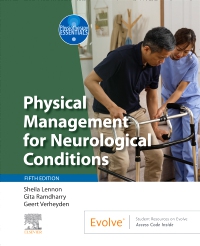

Physical Management for Neurological Conditions - Elsevier eBook on VitalSource, 5th Edition
Elsevier eBook on VitalSource
Now $43.19
Physical Management for Neurological Conditions comprehensively covers the essentials of neurorehabilitation starting with thirteen guiding principles, and a new chapter on clinical reasoning and assessment. It discusses the physical management of common neurological conditions such as stroke, traumatic brain injury, spinal cord injury, multiple sclerosis and Parkinson’s followed by less common conditions such as inherited neurological conditions, motor neuron disease, polyneuropathies and muscle disorders.
Produced by a team of international editors and experts, this fifth edition is the most up-to-date evidence-based textbook available for undergraduate students and qualified health professionals alike, focusing on selecting appropriate evidence-based tools rather than subscribing to any specific treatment approaches. It is a core physiotherapy textbook designed to provide students with everything they need to pass the neurological component of their degree.
-
- Fully updated to provide comprehensive information on optimal physical management within movement limitations suitable for any health care context or environment
- Using international case studies to apply theory to clinical practice
- Easy to navigate and understand – for students, new graduates and therapists returning to practice or changing scope of practice
-
Section 1 Background Knowledge
1. Guiding Principles in Neurological Rehabilitation
2. Clinical Reasoning in Neurological Physiotherapy: Assessment and Treatment Principles
3. Common Impairments and the Impact on Activity
4. Observation and Analysis of Movement
5. Measurement Tools
6. Goal Setting in Rehabilitation
Section 2 Management of Specific Conditions
7. Stroke
8. Traumatic Brain Injury
9. Spinal Cord Injury
10. Multiple Sclerosis
11. Parkinson’s
12. Inherited Neurological Conditions
13. Motor Neurone Disease
14. Polyneuropathies
15. Neuromuscular Disorders
16. Functional Motor Disorders
17. Vestibular Rehabilitation
Section 3 Specific Management
18 Respiratory Management
19. Self-Management
20. Neurorehabilitation Technologies
21. Falls and Their Management
22. Physical Activity and Exercise in Neurological Rehabilitation
23. Pain Management
24. Clinical Neuropsychology in Rehabilitation
25. Selected Topics in Physical Management for Neurological Conditions -
-
Ways of Reading
- The appearance of the text and page layout can be modified according to the capabilities of the reading system (font family and font size, spaces between paragraphs, sentences, words, and letters, as well as color of background and text)
- This e-publication is accessible to the full extent that the file format and types of content allow, on a specific reading device, by default, without necessarily including any additions such as textual descriptions of images or enhanced navigation
- No information about nonvisual reading is available
-
Conformance
- No information is available
-
Navigation
- Table of contents to all chapters of the text via links
- Page list to go to pages from the print source version
-
Rich Content
- No information is available
-
Hazards
- No information is available
-
Product Content
- No information is available
-
Legal Considerations
- No information is available
-
Additional Accessibility Information
- Content is enhanced with ARIA roles to optimize organization and facilitate navigation
- Page breaks included from the original print source
- For readers with color vision deficiency, use of color (e.g., in diagrams, graphics and charts, in prompts, or on buttons inviting a response) is not the sole means of graphical distinction or of conveying information
- E-publication includes basic navigation (usually less detailed than TOC-based navigation)
- Where links, controls or buttons are included in the content, the purpose or functionality of each link, control or button is apparent from the associated text alone - or where it is unclear, separate link, control or button descriptions are provided
- All (or substantially all) textual matter is arranged in a single logical reading order (including text that is visually presented as separate from the main text flow, e.g., in boxouts, captions, tables, footnotes, endnotes, citations, etc.). Non-textual content is also linked from within this logical reading order. (Purely decorative non-text content can be ignored).
- The language of the text has been specified (e.g., via the HTML or XML lang attribute) to optimise text-to-speech (and other alternative renderings), both at the whole document level and, where appropriate, for individual words, phrases or passages in a different language.
-
Ways of Reading


 as described in our