ISBN:
9780323883245
Copyright:
2025
Publication Date:
05-02-2024
Page Count:
368
Imprint:
Elsevier
List Price:
$79.99

The Netter Collection of Medical Illustrations: Respiratory System, Volume 3 - Elsevier E-Book on VitalSource, 3rd Edition
by David A. Kaminsky, MD
Elsevier eBook on VitalSource
ISBN:
9780323883245
Copyright:
2025
Publication Date:
05-02-2024
Page Count:
368
Imprint:
Elsevier
List Price:
$79.99
Not Yet Available
Most review copies are eBooks – how fast!
A review copy request is most likely to be fulfilled as an eBook on VitalSource rather than a print product, unless no eBook is available. eBooks become available in as little as a few hours. Print products will take between 7 and 10 days to arrive. To request a print copy, please contact us through the Evolve Support Center for further assistance or contact your Elsevier Sales Rep.
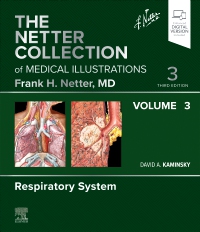
Offering a concise, highly visual approach to the basic science and clinical pathology of the respiratory system, this updated volume in The Netter Collection of Medical Illustrations (the CIBA "Green Books") contains unparalleled didactic illustrations reflecting the latest medical knowledge. Revised by Dr. David A. Kaminsky, Respiratory System, Volume 3 integrates core concepts of anatomy, physiology, and other basic sciences with common clinical correlates across health, medical, and surgical disciplines. Classic Netter art, updated and new illustrations, and modern imaging continue to bring medical concepts to life and make this timeless work an essential resource for students, clinicians, and educators.
-
- Provides a complete overview of the respiratory system through multidisciplinary coverage from physiology and biochemistry to adult and pediatric medicine and surgery
- Allows you to access rare illustrations in one convenient source from the only Netter work devoted specifically to the respiratory system
- Covers timely topics like COVID-19 and secondary infection/diseases of the respiratory system, RSV, pneumonia, pulmonary hypertension, COPD, asthma, environmental lung disease, sleep disorders, infections of the immunocompromised, neonatal breathing disorders, and drug-resistant tuberculosis
- Provides a concise overview of complex information by seamlessly integrating anatomical and physiological concepts using practical clinical scenarios
- Shares the expertise and knowledge of editor Dr. David A. Kaminsky, who contributes significant experience in asthma and general pulmonary and critical care medicine, and a team of world-class contributors
- Compiles Dr. Frank H. Netter’s master medical artistry—an aesthetic tribute and source of inspiration for medical professionals for over half a century—along with new art in the Netter tradition for each of the major body systems, making this volume a powerful and memorable tool for building foundational knowledge and educating patients or staff
- NEW! An eBook version is included with purchase. The eBook allows you to access all of the text, figures, and references, with the ability to search, make notes and highlights, and have content read aloud
-
SECTION 1 ANATOMY AND EMBRYOLOGY
SECTION 2 PHYSIOLOGY
SECTION 3 DIAGNOSTIC PROCEDURES
SECTION 4 DISEASES AND PATHOLOGY
SECTION 5 THERAPIES AND THERAPEUTIC PROCEDURES -
-
Ways of Reading
- The appearance of the text and page layout can be modified according to the capabilities of the reading system (font family and font size, spaces between paragraphs, sentences, words, and letters, as well as color of background and text)
- This e-publication is accessible to the full extent that the file format and types of content allow, on a specific reading device, by default, without necessarily including any additions such as textual descriptions of images or enhanced navigation
- No information about nonvisual reading is available
-
Conformance
- No information is available
-
Navigation
- Table of contents to all chapters of the text via links
- Page list to go to pages from the print source version
-
Rich Content
- No information is available
-
Hazards
- No information is available
-
Product Content
- No information is available
-
Legal Considerations
- No information is available
-
Additional Accessibility Information
- Content is enhanced with ARIA roles to optimize organization and facilitate navigation
- Page breaks included from the original print source
- For readers with color vision deficiency, use of color (e.g., in diagrams, graphics and charts, in prompts, or on buttons inviting a response) is not the sole means of graphical distinction or of conveying information
- E-publication includes basic navigation (usually less detailed than TOC-based navigation)
- Where links, controls or buttons are included in the content, the purpose or functionality of each link, control or button is apparent from the associated text alone - or where it is unclear, separate link, control or button descriptions are provided
- All (or substantially all) textual matter is arranged in a single logical reading order (including text that is visually presented as separate from the main text flow, e.g., in boxouts, captions, tables, footnotes, endnotes, citations, etc.). Non-textual content is also linked from within this logical reading order. (Purely decorative non-text content can be ignored).
- The language of the text has been specified (e.g., via the HTML or XML lang attribute) to optimise text-to-speech (and other alternative renderings), both at the whole document level and, where appropriate, for individual words, phrases or passages in a different language.
-
Ways of Reading

Not Yet Available
Most review copies are eBooks – how fast!
A review copy request is most likely to be fulfilled as an eBook on VitalSource rather than a print product, unless no eBook is available. eBooks become available in as little as a few hours. Print products will take between 7 and 10 days to arrive. To request a print copy, please contact us through the Evolve Support Center for further assistance or contact your Elsevier Sales Rep.

 as described in our