
ISBN:
9780323931755
Copyright:
2025
Publication Date:
02-14-2024
Page Count:
528
Imprint:
Elsevier
List Price:
$60.99

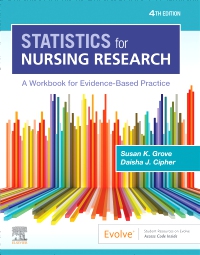
Statistics for Nursing Research - Elsevier eBook on VitalSource, 4th Edition
by Susan K. Grove, PhD, RN, ANP-BC, GNP-BC and Daisha J. Cipher, PhD
Elsevier eBook on VitalSource
ISBN:
9780323931755
Copyright:
2025
Publication Date:
02-14-2024
Page Count:
528
Imprint:
Elsevier
List Price:
$60.99
Was
$60.99
Now $53.67
Or $0.00 with a valid access code
Get the review and practice you need to critically appraise the statistical methods used in published research! Statistics for Nursing Research, 4th Edition helps you understand and interpret statistical methods, sampling and measurement techniques, and statistical analysis techniques. This unique and practical workbook is divided into two parts to differentiate between basic and advanced statistical methods, with dozens of hands-on exercises that will help you practice working with the statistical methods needed for building an evidence-based practice. This workbook is an indispensable resource for any nursing student or practicing nurse wishing to gain competency in conducting statistical analyses.
-
- Comprehensive coverage of basic statistical methods includes extensive practice with the most common techniques of sampling, measurement, and statistical analysis seen in nursing and health sciences literature
- Literature-based approach uses key excerpts from published studies to reinforce learning through practical application
- 38 sampling, measurement, and statistical analysis exercises provide a practical review of both basic and advanced statistical techniques
- Study Questions in each chapter help you examine a statistical technique and apply concepts to an actual literature appraisal
- Online submission of answers for Questions for Further Application allows you to complete exercises in a web-based format and then submit completed exercises to your instructor via email for grading
- Consistent format for all chapters enhances learning and enables quick review
-
- NEW! More than half of the research articles in Part 1 are new, ensuring that exercises are based on the most current, clinically applicable published studies
- NEW! Enhanced interactive online functionality of the Questions for Further Application for each chapter allows you to save your work and complete the exercises at a later time before submitting work to your instructor for grading
- NEW! Enhanced emphasis on diversity and inclusion features representation of diverse authors and research foci in selected published articles.
- NEW! Two new exercises are added to this edition: a unique Handling Missing Data exercise and a Calculating the Mann-Whitney U Test exercise
- NEW! VST eBook version of this title is a fully interactive eBook for the first time
- NEW! Supplemental video tutorials by Dr. Cipher on the Evolve website provide valuable reinforcement that is especially helpful for visual and auditory learners
-
PART 1: Understanding Statistical Methods
1. Identifying Levels of Measurement: Nominal, Ordinal, Interval, and Ratio
2. Identifying Probability and Nonprobability Sampling Methods in Studies
3. Understanding the Sampling Section of a Research Report: Population, Sampling Criteria, Sample Size, Refusal Rate, and Attrition Rate
4. Understanding Reliability of Measurement Methods
5. Understanding Validity of Measurement Methods
6. Understanding Frequencies and Percentages
7. Interpreting Line Graphs
8. Measures of Central Tendency: Mean, Median, and Mode
9. Measures of Dispersion: Range and Standard Deviation
10. Description of a Study Sample
11. Interpreting Scatterplots
12. Algorithm for Determining the Appropriateness of Inferential Statistical Techniques
13. Understanding Pearson Product-Moment Correlation Coefficient
14. Understanding Simple Linear Regression
15. Understanding Multiple Linear Regression
16. Understanding Independent Samples t-test
17. Understanding Paired or Dependent Samples t-test
18. Understanding Analysis of Variance (ANOVA) and Post Hoc Analyses
19. Understanding Pearson Chi Square
20. Understanding Spearman Rank-Order Correlation Coefficient
21. Understanding Mann-Whitney U Test
22. Understanding Wilcoxon Signed-Rank Test
PART 2: Conducting and Interpreting Statistical Analyses
23. Selecting Appropriate Analysis Techniques for Studies
24. Describing the Elements of Power Analysis: Power, Effect Size, Alpha, and Sample Size
25. Conducting Power Analysis
26. Determining the Normality of a Distribution
27. Calculating Descriptive Statistics
28. Handling Missing Data NEW!
29. Calculating Pearson Product-Moment Correlation Coefficient
30. Calculating Simple Linear Regression
31. Calculating Multiple Linear Regression
32. Calculating t-tests for Independent Samples
33. Calculating t-tests for Paired (Dependent) Samples
34. Calculating the Mann-Whitney U Test NEW!
35. Calculating Analysis of Variance (ANOVA) and Post Hoc Analyses Following ANOVA
36. Calculating Sensitivity and Specificity
37. Calculating Pearson Chi-Square
38. Calculating Odds Ratio and 95% Confidence Intervals -
-
Ways of Reading
- The appearance of the text and page layout can be modified according to the capabilities of the reading system (font family and font size, spaces between paragraphs, sentences, words, and letters, as well as color of background and text)
- This e-publication is accessible to the full extent that the file format and types of content allow, on a specific reading device, by default, without necessarily including any additions such as textual descriptions of images or enhanced navigation
- No information about nonvisual reading is available
-
Conformance
- For detailed accessibility information, see Elsevier's website at https://www.elsevier.com/about/accessibility
- For queries regarding accessibility information, contact [email protected]
- The publication was certified on 18-11-2025
-
Navigation
- Table of contents to all chapters of the text via links
-
Rich Content
- No information is available
-
Hazards
- No information is available
-
Product Content
- No information is available
-
Legal Considerations
- No information is available
-
Additional Accessibility Information
- For readers with color vision deficiency, use of color (e.g., in diagrams, graphics and charts, in prompts, or on buttons inviting a response) is not the sole means of graphical distinction or of conveying information
- E-publication includes basic navigation (usually less detailed than TOC-based navigation)
- Where links, controls or buttons are included in the content, the purpose or functionality of each link, control or button is apparent from the associated text alone - or where it is unclear, separate link, control or button descriptions are provided
- All (or substantially all) textual matter is arranged in a single logical reading order (including text that is visually presented as separate from the main text flow, e.g., in boxouts, captions, tables, footnotes, endnotes, citations, etc.). Non-textual content is also linked from within this logical reading order. (Purely decorative non-text content can be ignored).
- The language of the text has been specified (e.g., via the HTML or XML lang attribute) to optimise text-to-speech (and other alternative renderings), both at the whole document level and, where appropriate, for individual words, phrases or passages in a different language.
-
Ways of Reading

Was
$60.99
Now $53.67
Or $0.00 with a valid access code

 as described in our