ISBN:
9780323932165
Copyright:
2025
Publication Date:
05-14-2024
Page Count:
424
Imprint:
Elsevier
List Price:
$42.99

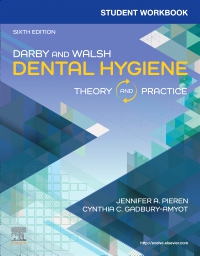
Student Workbook for Darby & Walsh Dental Hygiene - Elsevier E-Book on VitalSource, 6th Edition
by Jennifer A Pieren, RDH, BSAS, MS and Cynthia Gadbury-Amyot, MSDH, Ed.D
Elsevier eBook on VitalSource
ISBN:
9780323932165
Copyright:
2025
Publication Date:
05-14-2024
Page Count:
424
Imprint:
Elsevier
List Price:
$42.99
Most review copies are eBooks – how fast!
A review copy request is most likely to be fulfilled as an eBook on VitalSource rather than a print product, unless no eBook is available. eBooks become available in as little as a few hours. Print products will take between 7 and 10 days to arrive. To request a print copy, please contact us through the Evolve Support Center for further assistance or contact your Elsevier Sales Rep.
Give students the hands-on practice and reinforcement they need to master the concepts and skills covered in Darby & Walsh Dental Hygiene: Theory and Practice, 6th Edition. The chapters in this workbook directly correlate to the textbook chapters and provide ample review questions and exercises, competency skills evaluation sheets, case studies with questions, and information for the clinical externship and professional portfolio. Applicable chapters also contain a review of video procedures covered in the main text. It’s the essential practice and review your students need for success in both the classroom and the clinical setting.
-
- NEW and UPDATED! Content corresponds to the latest edition of the text, with an increased focus on new and emerging technologies, enhanced coverage of infection control, new chapters addressing telehealth and mental health, and much more.
-
- NEW and UPDATED! Content corresponds to the latest edition of the text, with an increased focus on new and emerging technologies, enhanced coverage of infection control, new chapters addressing telehealth and mental health, and much more.
- Patient case studies and video review questions provide opportunities for assimilation and application of concepts to prepare students for clinical patient encounters.
- Practice and review questions include short answer, fill-in-the-blank, and multiple choice to help students prepare for the NBDHE exam.
- Competency skill checklists offer clear guidelines for performing each dental hygiene skill.
- Perforated pages make it easy to detach forms and bring them along in clinical settings.
-
-
 Darby & Walsh Dental Hygiene - Elsevier eBook on VitalSourceElsevier eBook on VitalSource
 -
 Darby & Walsh Dental HygieneHardcover
 -

-
-
Part One—Conceptual Foundations
1. The Dental Hygiene Profession
2. Dental Hygiene Metaparadigm Concepts and Conceptual Models Applied to Practice
3. Evidence-Based Decision Making
4. Community Health
5. Sustainable Health Behavior Change
6. Inclusive Practices in Healthcare
7. Legal and Ethical Decision Making
8. Professional e-Portfolios
Part Two—Preparation for the Appointment
9. Dental Hygiene Patient Care Settings
10. Infection Prevention and Control
11. Preventing and Managing Medical Emergencies
12. Ergonomics and Work-Related Musculoskeletal Disorders
Part Three—Assessments
13. Personal, Dental, and Health Histories
14. Vital Signs
15. Pharmacologic History
16. Assessment of Head and Neck Examination
17. Hard Tissue Assessment and Dental Charting
18. Assessment of Dental Deposits and Stain
19. Dental Caries Management by Risk Assessment
20. Periodontal Assessment and Charting
21. Oral-Systemic Health Connection
Part Four—Critical Thinking in Dental Hygiene Practice
22. Dental Hygiene Diagnosis
23. Dental Hygiene Care Plan, Evaluation, and Documentation
Part Five—Implementation, Evaluation, and Documentation
24. Toothbrushing
25. Interdental and Supplemental Oral Self-Care Devices
26. Dentifrices
27. Antimicrobial Agents for Control of Periodontal Disease
28. Hand-Activated Instrumentation
29. Ultrasonic Instrumentation
30. Root Morphology and Instrumentation Implications
31. Dental Implants and Periimplant Care
32. Tooth Polishing and Whitening
33. Decision Making Related to Nonsurgical Periodontal Therapy
34. Acute Gingival and Periodontal Conditions
35. Pit and Fissure Sealants
36. Nutritional Counseling
37. Tobacco Cessation
38. Impressions for Study Casts and Custom-Made Oral Appliances
39. Restorative Therapy
40. Orthodontic Care
41. Fixed and Removable Dental Prostheses
Part Six—Pain and Anxiety Control
42. Dentinal Hypersensitivity
43. Local Anesthesia
44. Nitrous Oxide-Oxygen Sedation
Part Seven—Life Stages and Populations
45. Children and Adolescents
46. Pregnancy and Oral Health
47. The Older Adult
Part Eight—Dental Hygiene Care for the Medically Compromised
48. Cardiovascular Disease
49. Diabetes
50. Cancer
51. HIV and Oral Health
52. Palliative Oral Care
53. Autoimmune Diseases
54. Organ Transplantation and Renal Disease
55. Respiratory Diseases
56. Substance Use Disorders
57. Eating Disorders
58. Child Abuse and Neglect and Family Violence
Part Nine—Dental Hygiene Care for Disabilities and Special Needs
59. Disability and Healthcare
60. Intellectually and Developmentally Challenged
61. Orofacial Clefts
62. Neurologic Disabilities
Part Ten—Professional Development and Practice Management
63. Professional Development and Job Searching
64. Practice Management
65. Telehealth
66. Mental Health and Self-Care -
-
Ways of Reading
- The appearance of the text and page layout can be modified according to the capabilities of the reading system (font family and font size, spaces between paragraphs, sentences, words, and letters, as well as color of background and text)
- This e-publication is accessible to the full extent that the file format and types of content allow, on a specific reading device, by default, without necessarily including any additions such as textual descriptions of images or enhanced navigation
- All content can be read as read aloud speech or dynamic braille
- Has alternative text descriptions for images
-
Conformance
- The publication contains a conformance statement that it meets the EPUB Accessibility 1.1, WCAG 2.1, Level AA standard. Please see https://bornaccessible.benetech.org/certified-publishers/ for further details of our compatibility testing.
- The certifier's credential is https://bornaccessible.benetech.org/certified-publishers/
- For detailed accessibility information, see Elsevier's website at https://www.elsevier.com/about/accessibility
- For queries regarding accessibility information, contact [email protected]
- The publication was certified on 24-03-2026
-
Navigation
- Table of contents to all chapters of the text via links
- Elements such as headings, tables, etc. for structured navigation
- Page list to go to pages from the print source version
-
Rich Content
- Information-rich images are described by extended descriptions
-
Hazards
- The publication contains no hazards
-
Product Content
- Content includes any type of illustrations.
- The primary content is text.
- Content includes maps and/or other cartographic content.
- Content includes a significant number of actionable (clickable) web links to external content, downloadable resources, supplementary material, etc.
- Content includes photographs, whether in a plate section / insert or not.
- Content includes figures, diagrams, charts and/or graphs, including other 'mechanical' (i.e. non-photographic) illustrations.
- Content includes images displayed in a specific order for the purpose of graphic storytelling or giving information (e.g. graphic novels, comics and manga). May include text integrated into the image (as speech and thought bubbles, textual 'sound' effects, captions etc.).
- Content includes text within images, including text-as-text embedded in diagrams, charts, or within images containing speech balloons, thought bubbles, captions, etc.
- Content includes visual content that is purely decorative and is not necessary to understanding of the content.
- At least some text - including text within other images - is 'text as an image' (i.e., a picture of text).
-
Legal Considerations
- No information is available
-
Additional Accessibility Information
- Content is enhanced with ARIA roles to optimize organization and facilitate navigation
- Page breaks included from the original print source
- For readers with color vision deficiency, use of color (e.g., in diagrams, graphics and charts, in prompts, or on buttons inviting a response) is not the sole means of graphical distinction or of conveying information
- The body text is presented with a contrast ratio of at least 4.5:1 (or 3:1 for large/heading text)
- Ultra-high contrast between text and background
- E-publication includes basic navigation (usually less detailed than TOC-based navigation)
- Where links, controls or buttons are included in the content, the purpose or functionality of each link, control or button is apparent from the associated text alone - or where it is unclear, separate link, control or button descriptions are provided
- All (or substantially all) textual matter is arranged in a single logical reading order (including text that is visually presented as separate from the main text flow, e.g., in boxouts, captions, tables, footnotes, endnotes, citations, etc.). Non-textual content is also linked from within this logical reading order. (Purely decorative non-text content can be ignored).
- Where interactive content is included in the product, controls are provided (e.g., for speed, pause and resume, reset) and labelled to make their use clear.
- The language of the text has been specified (e.g., via the HTML or XML lang attribute) to optimise text-to-speech (and other alternative renderings), both at the whole document level and, where appropriate, for individual words, phrases or passages in a different language.
-
Ways of Reading
Most review copies are eBooks – how fast!
A review copy request is most likely to be fulfilled as an eBook on VitalSource rather than a print product, unless no eBook is available. eBooks become available in as little as a few hours. Print products will take between 7 and 10 days to arrive. To request a print copy, please contact us through the Evolve Support Center for further assistance or contact your Elsevier Sales Rep.

 as described in our