
ISBN:
9780323933698
Copyright:
2025
Publication Date:
12-29-2023
Page Count:
416
Imprint:
Elsevier
List Price:
$46.99

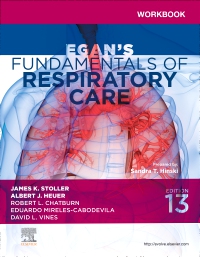
Workbook for Egan's Fundamentals of Respiratory Care - Elsevier eBook on VitalSource, 13th Edition
by Sandra T. Hinski, PHD, MS, RRT-NPS, James K. Stoller, MD, MS, FAARC, FCCP, Albert J. Heuer, PhD, MBA, RRT, RPFT, FAARC, David L. Vines, PhD, RRT, FAARC,FCCP, Robert L. Chatburn, MHHS, RRT-NPS,FAARC and Eduardo Mireles-Cabodevila, MD
Elsevier eBook on VitalSource
ISBN:
9780323933698
Copyright:
2025
Publication Date:
12-29-2023
Page Count:
416
Imprint:
Elsevier
List Price:
$46.99
Was
$46.99
Now $41.35
Or $0.00 with a valid access code
-
-
 Egan's Fundamentals of Respiratory Care - Elsevier eBook on VitalSourceElsevier eBook on VitalSource
 -
 Egan's Fundamentals of Respiratory CarePaperback
-
-
Section I. Foundations of Respiratory Care
1. Early History of Respiratory Care
2. The Profession of Respiratory Care
3. Quality, Patient Safety, and Communication
4. Principles of Infection Prevention and Control
5. Ethical and Legal Implications of Practice
6. Physical Principles of Respiratory Care
7. E-Medicine in Respiratory Care
8. Fundamentals of Respiratory Care Research
Section II. Applied Anatomy and Physiology
9. The Respiratory System
10. The Cardiovascular System
11. Ventilation
12. Gas Exchange and Transport
13. Solutions, Body Fluids, and Electrolytes
14. Acid-Base Balance
15. Regulation of Breathing
Section III. Assessment of Respiratory Disorders
16. Bedside Assessment of the Patient
17. Interpreting Clinical and Laboratory Data
18. Interpreting the Electrocardiogram
19. Analysis and Monitoring of Gas Exchange
20. Pulmonary Function Testing
21. Review of Thoracic Imaging
22. Flexible Bronchoscopy and the Respiratory Therapist
23. Nutrition Assessment
Section IV. Review of Cardiopulmonary Disease
24. Pneumonia
25. Obstructive Lung Disease. Chronic Obstructive Pulmonary Disease (COPD), Asthma,
and Related Diseases
26. Interstitial Lung Disease
27. Pleural Diseases
28. Pulmonary Vascular Disease
29. Acute Respiratory Distress Syndrome (ARDS)
30. Respiratory Management of Trauma, Obesity, Near Drowning, and Burns
31. Acute Heart Failure
32. Lung Cancer
33. Neuromuscular and Other Diseases of the Chest Wall
34. Disorders of Sleep
35. Neonatal and Pediatric Respiratory Disorders
Section V. Basic Therapeutics
36. Airway Pharmacology
37. Airway Management
38. Emergency Cardiovascular Life Support
39. Humidity and Bland Aerosol Therapy
40. Aerosol Drug Therapy
41. Storage and Delivery of Medical Gases
42. Medical Gas Therapy
43. Lung Expansion Therapy
44. Airway Clearance Therapy (ACT)
Section VI. Acute and Critical Care
45. Respiratory Failure and the Need for Ventilatory Support
46. Mechanical Ventilators
47. Physiology of Ventilatory Support
48. Patient-Ventilator Interactions
49. Initiating and Adjusting Invasive Ventilatory Support
50. Noninvasive Ventilation
51. Extracorporeal Life Support
52. Monitoring the Patient in the Intensive Care Unit
53. Discontinuing Ventilatory Support
54. Neonatal and Pediatric Respiratory Care
Section VII. Patient Education and Long-Term Care
55. Patient Education and Health Promotion
56. Cardiopulmonary Rehabilitation
57. Respiratory Care in Alternative Settings
58. Ethics and End of Life -
-
Ways of Reading
- The appearance of the text and page layout can be modified according to the capabilities of the reading system (font family and font size, spaces between paragraphs, sentences, words, and letters, as well as color of background and text)
- This e-publication is accessible to the full extent that the file format and types of content allow, on a specific reading device, by default, without necessarily including any additions such as textual descriptions of images or enhanced navigation
- All content can be read as read aloud speech or dynamic braille
- Has alternative text descriptions for images
-
Conformance
- The publication contains a conformance statement that it meets the EPUB Accessibility 1.1, WCAG 2.1, Level AA standard. Please see https://bornaccessible.benetech.org/certified-publishers/ for further details of our compatibility testing.
- The certifier's credential is https://bornaccessible.benetech.org/certified-publishers/
- For detailed accessibility information, see Elsevier's website at https://www.elsevier.com/about/accessibility
- For queries regarding accessibility information, contact [email protected]
- The publication was certified on 24-03-2026
-
Navigation
- Table of contents to all chapters of the text via links
- Elements such as headings, tables, etc. for structured navigation
- Page list to go to pages from the print source version
-
Rich Content
- Information-rich images are described by extended descriptions
-
Hazards
- The publication contains no hazards
-
Product Content
- Content includes any type of illustrations.
- The primary content is text.
- Content includes a significant number of actionable (clickable) web links to external content, downloadable resources, supplementary material, etc.
- Content includes photographs, whether in a plate section / insert or not.
- Content includes figures, diagrams, charts and/or graphs, including other 'mechanical' (i.e. non-photographic) illustrations.
- Content includes images displayed in a specific order for the purpose of graphic storytelling or giving information (e.g. graphic novels, comics and manga). May include text integrated into the image (as speech and thought bubbles, textual 'sound' effects, captions etc.).
- Content includes text within images, including text-as-text embedded in diagrams, charts, or within images containing speech balloons, thought bubbles, captions, etc.
- Content includes chemical notations, formulae.
- At least some text - including text within other images - is 'text as an image' (i.e., a picture of text).
-
Legal Considerations
- No information is available
-
Additional Accessibility Information
- Content is enhanced with ARIA roles to optimize organization and facilitate navigation
- Page breaks included from the original print source
- For readers with color vision deficiency, use of color (e.g., in diagrams, graphics and charts, in prompts, or on buttons inviting a response) is not the sole means of graphical distinction or of conveying information
- The body text is presented with a contrast ratio of at least 4.5:1 (or 3:1 for large/heading text)
- Ultra-high contrast between text and background
- E-publication includes basic navigation (usually less detailed than TOC-based navigation)
- Where links, controls or buttons are included in the content, the purpose or functionality of each link, control or button is apparent from the associated text alone - or where it is unclear, separate link, control or button descriptions are provided
- All (or substantially all) textual matter is arranged in a single logical reading order (including text that is visually presented as separate from the main text flow, e.g., in boxouts, captions, tables, footnotes, endnotes, citations, etc.). Non-textual content is also linked from within this logical reading order. (Purely decorative non-text content can be ignored).
- Where interactive content is included in the product, controls are provided (e.g., for speed, pause and resume, reset) and labelled to make their use clear.
- The language of the text has been specified (e.g., via the HTML or XML lang attribute) to optimise text-to-speech (and other alternative renderings), both at the whole document level and, where appropriate, for individual words, phrases or passages in a different language.
-
Ways of Reading
Was
$46.99
Now $41.35
Or $0.00 with a valid access code

 as described in our