ISBN:
9780323935616
Copyright:
2024
Publication Date:
09-29-2023
Page Count:
186
Imprint:
Elsevier
List Price:
$43.99

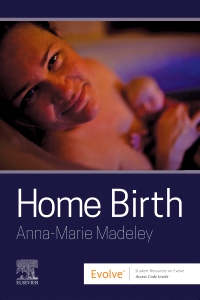
Home Birth - Elsevier E-Book on VitalSource, 1st Edition
by Anna-Marie Madeley, Registered Midwife, BSc (Hons) Midwifery, MSc Evidence Based Healthcare (Oxon), PGCertTHE, FHEA,
Elsevier eBook on VitalSource
ISBN:
9780323935616
Copyright:
2024
Publication Date:
09-29-2023
Page Count:
186
Imprint:
Elsevier
List Price:
$43.99
Most review copies are eBooks – how fast!
A review copy request is most likely to be fulfilled as an eBook on VitalSource rather than a print product, unless no eBook is available. eBooks become available in as little as a few hours. Print products will take between 7 and 10 days to arrive. To request a print copy, please contact us through the Evolve Support Center for further assistance or contact your Elsevier Sales Rep.
-
- Covers the whole scope of home birth practice, for each member the multidisciplinary team
- Written by leading experts from diverse backgrounds including midwives, paramedics, obstetricians and neonatal nurses from clinical practice, academia and education
- Presents balanced and unbiased contemporary evidence supporting birth at home
- Discusses effective care planning from developing a homebirth services, practical resources and skills, equipment planning and geographical considerations
- Covers important topics within midwifery including the rise of ‘freebirthing’, multidisciplinary team working and the care of women with complex biopsychosocial needs or from underrepresented communities
- Clearly identifies roles and responsibilities of the multidisciplinary team
- Suitable for midwifery students embarking on a home birth placement
-
-
 Home BirthPaperback
-
-
1. Homebirth – the evidence
2. Homebirth in undergraduate, postgraduate, and clinical education
3. Planning for homebirth
4. Home alone – choosing freebirth
5. First stage of labour at home
6. Second and third stages of labour at home
7. Considerations for labour and birth in water at home
8. Physiological breech birth at home
9. Postnatal care at home
10. Neonatal considerations for homebirth
11. Managing emergencies at home
12. Paramedic transfer and multidisciplinary working with ambulance services
13. Homebirth in the presence of complex needs
14. Reflective vignette -
-
Ways of Reading
- The appearance of the text and page layout can be modified according to the capabilities of the reading system (font family and font size, spaces between paragraphs, sentences, words, and letters, as well as color of background and text)
- This e-publication is accessible to the full extent that the file format and types of content allow, on a specific reading device, by default, without necessarily including any additions such as textual descriptions of images or enhanced navigation
- No information about nonvisual reading is available
-
Conformance
- No information is available
-
Navigation
- Table of contents to all chapters of the text via links
- Page list to go to pages from the print source version
-
Rich Content
- No information is available
-
Hazards
- No information is available
-
Product Content
- No information is available
-
Legal Considerations
- No information is available
-
Additional Accessibility Information
- Content is enhanced with ARIA roles to optimize organization and facilitate navigation
- Page breaks included from the original print source
- For readers with color vision deficiency, use of color (e.g., in diagrams, graphics and charts, in prompts, or on buttons inviting a response) is not the sole means of graphical distinction or of conveying information
- E-publication includes basic navigation (usually less detailed than TOC-based navigation)
- Where links, controls or buttons are included in the content, the purpose or functionality of each link, control or button is apparent from the associated text alone - or where it is unclear, separate link, control or button descriptions are provided
- All (or substantially all) textual matter is arranged in a single logical reading order (including text that is visually presented as separate from the main text flow, e.g., in boxouts, captions, tables, footnotes, endnotes, citations, etc.). Non-textual content is also linked from within this logical reading order. (Purely decorative non-text content can be ignored).
- The language of the text has been specified (e.g., via the HTML or XML lang attribute) to optimise text-to-speech (and other alternative renderings), both at the whole document level and, where appropriate, for individual words, phrases or passages in a different language.
-
Ways of Reading
Most review copies are eBooks – how fast!
A review copy request is most likely to be fulfilled as an eBook on VitalSource rather than a print product, unless no eBook is available. eBooks become available in as little as a few hours. Print products will take between 7 and 10 days to arrive. To request a print copy, please contact us through the Evolve Support Center for further assistance or contact your Elsevier Sales Rep.

 as described in our