
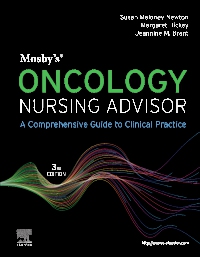

Mosby's Oncology Nursing Advisor - Elsevier E-Book on VitalSource, 3rd Edition
Elsevier eBook on VitalSource
Now $68.63
**Selected for Doody’s Core Titles® 2024 with "Essential Purchase" designation in Oncology**
Find oncology information fast with this concise, all-in-one clinical reference! Mosby's Oncology Nursing Advisor, 3rd Edition uses a streamlined format to provide quick access to the most essential information on oncology nursing care. Evidence-based guidelines include topics such as the major cancers, principles of cancer management, and principles of symptom management, as well as oncologic emergencies, palliative care, and nursing practice considerations. This edition includes new information on cancer treatments, genetic risk, chemotherapy guidelines, and more. Written by a team of oncology nursing experts led by Susan Maloney-Newton, this book is ideal for use in any oncology nursing setting.
-
- Detailed descriptions of more than 50 major cancer types provide essential information on incidence, etiology and risk factors, signs and symptoms, diagnostic workup, histology, staging, treatment, prognosis, and prevention.
- Coverage of cancer management principles outlines a wide range of treatment and pharmacologic modalities, including surgery, chemotherapy, radiation therapy, hormonal therapy, immunotherapy, and complementary and alternative therapies.
- Symptom management guidelines offer in-depth coverage of pathophysiology, signs and symptoms, assessment tools, lab and diagnostic tests, differential diagnoses, interventions, patient education, follow up care, and resources for more than 30 common symptoms associated with cancer and cancer treatments.
- Essential information on oncologic emergencies and emergent issues prepares readers to respond quickly to structural, urologic, metabolic, and hematologic emergencies.
- Section on palliative care and end-of-life issues offers helpful guidelines for dealing with topics related to survivorship, palliative care, the final hours of the cancer patient, and loss, grief, and bereavement.
-
- NEW! Updated content reflects the latest evidence-based information, including cancer biology, cancer treatment modalities, the latest chemotherapy guidelines, and a stronger emphasis on oral agents
- NEW! New content addresses the concept of "previvorship," the concept of coping with a documented genetically linked high cancer risk
- NEW! Enhanced content on health disparities, diversity and inclusion, and transgender considerations equips oncology nurses with essential information to promote health equity
- NEW! Key recommendations of the 2020-2030 Future of Nursing Report are integrated into the Nursing Practice Considerations section
- NEW! Content on the impact of the COVID pandemic includes delayed diagnosis and treatment and the impact of COVID sequelae on the health of patients with cancer
- NEW! Added content on palliative care is included in an expanded Pain chapter
- NEW! Full-color design and additional illustrations make it easier to use the book and to understand concepts
- NEW! Pulmonary Symptoms chapter now includes cough, dyspnea, and pleural effusion content
-
SECTION ONE: INTRODUCTION
Cancer Epidemiology: Implications for Prevention, Early Detection, and Treatment
Cancer Pathophysiology
Cancer Genetics / Genomics
SECTION TWO: MAJOR CANCERS
Breast Cancer
Central Nervous System Cancers
Gastrointestinal System Cancers
Genitourinary Cancers
Gynecologic Cancers
Head and Neck Cancers
Leukemias
Lung Cancers
Lymphomas
Multiple Myeloma
Myelofibrosis
Neuroendocrine Cancers
Sarcomas
Skin Cancers
SECTION THREE: PRINCIPLES OF CANCER MANAGEMENT
Surgical Therapy
Radiation Therapy
Tumor Treating Fields
Hematopoietic Stem Cell Transplantation
Chemotherapy
Targeted and Immunotherapy (Now a single chapter)
Hormonal Therapy
Oral Adherence
Complementary and Alternative Therapies
Clinical Trials
SECTION FOUR: PRINCIPLES OF SYMPTOM MANAGEMENT
Oncology Symptoms
SECTION FIVE Oncologic Emergencies
Structural Emergencies
Urologic Emergencies
Metabolic Emergencies
Hematologic Emergencies
SECTION SIX Palliative Care and End-of-Life Issues
Survivorship
Palliative Care
Final Hours
Loss, Grief, and Bereavement
SECTION SEVEN Nursing Practice Considerations
Communication
Socio-Cultural Considerations
Ethical Considerations
Quality and Safety
Evidence-Based Practice
Nurse Navigation
Patient Education -
-
Ways of Reading
- The appearance of the text and page layout can be modified according to the capabilities of the reading system (font family and font size, spaces between paragraphs, sentences, words, and letters, as well as color of background and text)
- This e-publication is accessible to the full extent that the file format and types of content allow, on a specific reading device, by default, without necessarily including any additions such as textual descriptions of images or enhanced navigation
- No information about nonvisual reading is available
-
Conformance
- For detailed accessibility information, see Elsevier's website at https://www.elsevier.com/about/accessibility
- For queries regarding accessibility information, contact [email protected]
- The publication was certified on 18-11-2025
-
Navigation
- Table of contents to all chapters of the text via links
-
Rich Content
- No information is available
-
Hazards
- No information is available
-
Product Content
- No information is available
-
Legal Considerations
- No information is available
-
Additional Accessibility Information
- For readers with color vision deficiency, use of color (e.g., in diagrams, graphics and charts, in prompts, or on buttons inviting a response) is not the sole means of graphical distinction or of conveying information
- E-publication includes basic navigation (usually less detailed than TOC-based navigation)
- Where links, controls or buttons are included in the content, the purpose or functionality of each link, control or button is apparent from the associated text alone - or where it is unclear, separate link, control or button descriptions are provided
- All (or substantially all) textual matter is arranged in a single logical reading order (including text that is visually presented as separate from the main text flow, e.g., in boxouts, captions, tables, footnotes, endnotes, citations, etc.). Non-textual content is also linked from within this logical reading order. (Purely decorative non-text content can be ignored).
- The language of the text has been specified (e.g., via the HTML or XML lang attribute) to optimise text-to-speech (and other alternative renderings), both at the whole document level and, where appropriate, for individual words, phrases or passages in a different language.
-
Ways of Reading


 as described in our