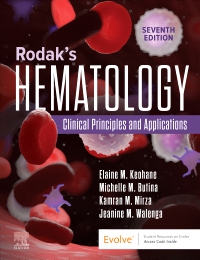

Rodak's Hematology - Elsevier eBook on VitalSource, 7th Edition
Elsevier eBook on VitalSource
**Selected for 2026 Doody's Core Titles in Laboratory Medicine**
Make sure your students are thoroughly prepared to work in a clinical laboratory. Rodak’s Hematology: Clinical Principles and Applications, 7th Edition uses hundreds of full-color photomicrographs to help students understand the essentials of hematology and hemostasis. This new edition details the parts and functions of the cell; shows how to accurately identify cells; covers normal hematopoiesis through diseases of erythroid, myeloid, lymphoid, and megakaryocytic origins; and simplifies hemostasis and thrombosis concepts and disorders. Easy to follow and understand, this book also covers key topics, including working in the hematology and hemostasis laboratory; complementary testing areas such as flow cytometry, cytogenetics, and molecular diagnostics; and laboratory testing of blood cells and body fluid cells.
-
New to this edition
- NEW! Chapter on Patient Safety in Hematology and Hemostasis
- NEW! Section on hematology and hemostasis in transgender populations
- UPDATED! White blood cell chapters are current with the 2022 World Health Organization (WHO) Classification of Haematolymphoid Tumours
- NEW! Changes in laboratory results associated with COVID-19 and other viral infections
- NEW! Content and figures on plasma transport, cell communication, and signal transduction
- NEW! Coverage of CRISPR technology for treatment of hemoglobinopathies and thalassemia
- UPDATED! Major revision of the Automated Blood Cell Analysis chapter
-
- NEW! Chapter on Patient Safety in Hematology and Hemostasis
- NEW! Section on hematology and hemostasis in transgender populations
- UPDATED! White blood cell chapters are current with the 2022 World Health Organization (WHO) Classification of Haematolymphoid Tumours
- NEW! Changes in laboratory results associated with COVID-19 and other viral infections
- NEW! Content and figures on plasma transport, cell communication, and signal transduction
- NEW! Coverage of CRISPR technology for treatment of hemoglobinopathies and thalassemia
- UPDATED! Major revision of the Automated Blood Cell Analysis chapter
- Content throughout the text reflects the latest information on hematology and hemostasis
- Hematology and hemostasis instruments are described, compared, and contrasted
- More than 700 full-color illustrations and photomicrographs make it easier for students to visualize hematology concepts and show what they’ll encounter in the laboratory
- Instructions for laboratory procedures include detailed figures and sources of errors
- Case studies in each chapter provide opportunities to apply hematology concepts to real-life scenarios
- Hematology and hemostasis reference intervals are listed on the inside front and back covers for quick reference
- Bulleted chapter summaries make it easy for students to review important points
- Learning objectives begin each chapter and indicate what students should achieve, with review questions appearing at the end
- Appendices provide easy access to a list of key formulas, abbreviations, and a detailed glossary to complement learning
-
-
 Evolve Resources for Rodak's HematologyResources
 -
 Rodak's HematologyPaperback
-
-
Part I. Introduction to Hematology
1. An Overview of Clinical Laboratory Hematology
2. Patient Safety in Hematology and Hemostasis
3. Quality Assurance in Hematology and Hemostasis Testing
Part II. Blood Cell Production, Structure, and Function
4. Cell Structure and Function
5. Hematopoiesis
6. Erythrocyte Production and Destruction
7. Erythrocyte Metabolism and Membrane Structure and Function
8. Hemoglobin Metabolism
9. Iron Kinetics and Laboratory Assessment
10. Leukocyte Development, Kinetics, and Functions
11. Platelet Production, Structure, and Function
Part III. Laboratory Evaluation of Blood Cells
12. Manual, Semiautomated, and Point-of-Care Testing in Hematology
13. Automated Blood Cell Analysis
14. Examination of the Peripheral Blood Film and Correlation With the Complete Blood Count
15. Bone Marrow Examination
Part IV. Erythrocyte Disorders
16. Anemias: Red Blood Cell Morphology and Approach to Diagnosis
17. Disorders of Iron Kinetics and Heme Metabolism
18. Anemias Caused by Defects of DNA Metabolism
19. Bone Marrow Failure
20. Introduction to Increased Destruction of Erythrocytes
21. Intrinsic Defects Leading to Increased Erythrocyte Destruction
22. Extrinsic Defects Leading to Increased Erythrocyte Destruction - Nonimmune Causes
23. Extrinsic Defects Leading to Increased Erythrocyte Destruction - Immune Causes
24. Hemoglobinopathies (Structural Defects in Hemoglobin)
25. Thalassemias
Part V. Leukocyte Disorders
26. Nonmalignant Leukocyte Disorders
27. Introduction to Hematologic Neoplasms
28. Flow Cytometric Analysis in Hematologic Disorders
29. Molecular Diagnostics in Hematopathology
30. Cytogenetics
31. Acute Leukemias
32. Myeloproliferative Neoplasms
33. Myelodysplastic Neoplasms
34. Mature Lymphoid Neoplasms
Part VI. Hemostasis and Thrombosis
35. Normal Hemostasis
36. Hemorrhagic Disorders and Laboratory Assessment
37. Qualitative Disorders of Platelets and Vasculature
38. Quantitative Disorders of Platelets: Thrombocytopenia and Thrombocytosis
39. Thrombotic Disorders and Laboratory Assessment
40. Antithrombotic Therapies and Laboratory Assessment
41. Laboratory Evaluation of Hemostasis
42. Hemostasis and Coagulation Instrumentation
Part VII. Hematology and Hemostasis in Selected Populations
43. Hematology and Hemostasis in the Pediatric, Pregnant, Geriatric, and Transgender Populations -
-
Ways of Reading
- The appearance of the text and page layout can be modified according to the capabilities of the reading system (font family and font size, spaces between paragraphs, sentences, words, and letters, as well as color of background and text)
- This e-publication is accessible to the full extent that the file format and types of content allow, on a specific reading device, by default, without necessarily including any additions such as textual descriptions of images or enhanced navigation
- All content can be read as read aloud speech or dynamic braille
- Has alternative text descriptions for images
-
Conformance
- The publication contains a conformance statement that it meets the EPUB Accessibility 1.1, WCAG 2.1, Level AA standard. Please see https://bornaccessible.benetech.org/certified-publishers/ for further details of our compatibility testing.
- The certifier's credential is https://bornaccessible.benetech.org/certified-publishers/
- For detailed accessibility information, see Elsevier's website at https://www.elsevier.com/about/accessibility
- For queries regarding accessibility information, contact [email protected]
- The publication was certified on 05-02-2026
-
Navigation
- Table of contents to all chapters of the text via links
- Index with links to referenced entries
- Elements such as headings, tables, etc. for structured navigation
- Page list to go to pages from the print source version
-
Rich Content
- Math formulas in accessible format (MathML)
- Chemical formulas in accessible format (MathML)
- Information-rich images are described by extended descriptions
-
Hazards
- The publication contains no hazards
-
Product Content
- Content includes any type of illustrations.
- The primary content is text.
- Content includes a significant number of actionable (clickable) web links to external content, downloadable resources, supplementary material, etc.
- Content includes a significant number of actionable (clickable) cross-references, hyperlinked notes and annotations, or with other actionable links between largely textual elements (e.g., quiz/test questions, 'choose your own ending', etc.).
- Content includes additional textual content such as an interview, feature article, essay, bibliography, quiz/test, other background material, or text that is not included in a primary or 'unenhanced' version.
- Content includes photographs, whether in a plate section / insert or not.
- Content includes figures, diagrams, charts and/or graphs, including other 'mechanical' (i.e. non-photographic) illustrations.
- Content includes images displayed in a specific order for the purpose of graphic storytelling or giving information (e.g. graphic novels, comics and manga). May include text integrated into the image (as speech and thought bubbles, textual 'sound' effects, captions etc.).
- Content includes text within images, including text-as-text embedded in diagrams, charts, or within images containing speech balloons, thought bubbles, captions, etc.
- Content includes chemical notations, formulae.
- Content includes mathematical notations, formulae.
- At least some text - including text within other images - is 'text as an image' (i.e., a picture of text).
-
Legal Considerations
- No information is available
-
Additional Accessibility Information
- Content is enhanced with ARIA roles to optimize organization and facilitate navigation
- Page breaks included from the original print source
- For readers with color vision deficiency, use of color (e.g., in diagrams, graphics and charts, in prompts, or on buttons inviting a response) is not the sole means of graphical distinction or of conveying information
- The body text is presented with a contrast ratio of at least 4.5:1 (or 3:1 for large/heading text)
- Ultra-high contrast between text and background
- E-publication includes basic navigation (usually less detailed than TOC-based navigation)
- Where links, controls or buttons are included in the content, the purpose or functionality of each link, control or button is apparent from the associated text alone - or where it is unclear, separate link, control or button descriptions are provided
- All (or substantially all) textual matter is arranged in a single logical reading order (including text that is visually presented as separate from the main text flow, e.g., in boxouts, captions, tables, footnotes, endnotes, citations, etc.). Non-textual content is also linked from within this logical reading order. (Purely decorative non-text content can be ignored).
- Content provides explanations for unusual words, abbreviations, acronyms, idioms, jargon in an accessible form, such as glossaries, scripted pop-ups.
- Where interactive content is included in the product, controls are provided (e.g., for speed, pause and resume, reset) and labelled to make their use clear.
- The language of the text has been specified (e.g., via the HTML or XML lang attribute) to optimise text-to-speech (and other alternative renderings), both at the whole document level and, where appropriate, for individual words, phrases or passages in a different language.
-
Ways of Reading

 as described in our