ISBN:
9780443105364
Copyright:
2026
Publication Date:
03-03-2025
Page Count:
368
Imprint:
Elsevier
List Price:
$104.99

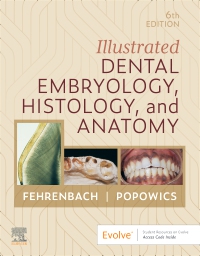
Illustrated Dental Embryology, Histology, and Anatomy Elsevier eBook on VitalSource, 6th Edition
by Margaret J. Fehrenbach, RDH, MS and Tracy Popowics, PhD
Elsevier eBook on VitalSource
ISBN:
9780443105364
Copyright:
2026
Publication Date:
03-03-2025
Page Count:
368
Imprint:
Elsevier
List Price:
$104.99
Most review copies are eBooks – how fast!
A review copy request is most likely to be fulfilled as an eBook on VitalSource rather than a print product, unless no eBook is available. eBooks become available in as little as a few hours. Print products will take between 7 and 10 days to arrive. To request a print copy, please contact us through the Evolve Support Center for further assistance or contact your Elsevier Sales Rep.
Give students a clear picture of oral biology and the formation and study of dental structures. Illustrated Dental Embryology, Histology, and Anatomy, Sixth Edition, is the ideal introduction to one of the most foundational areas in the dental professions — understanding the development, cellular makeup, and physical anatomy of the head and neck regions. Written in a clear, reader-friendly style, this text makes it easy for students to understand both basic science and clinical applications, putting the content into the context of everyday dental practice. New to this edition is evidence-based research on processes of soft tissue regeneration, repair, and aging; challenging factors of inflammation and immune response; newer dental hard tissue remineralization and restorative treatments; and the latest orthodontic concerns. Plus, high-quality color renderings and clinical histographs and photomicrographs throughout the book truly bring the material to life.
-
- NEW! Evidence-based research thoroughly discusses processes of soft tissue regeneration, repair, and aging; challenging factors of inflammation and immune response; newer dental hard tissue remineralization and restorative treatments; and the latest orthodontic concerns
- NEW! Updated clinical and microscopic photographs with exacting companion diagrams throughout help bring key concepts to life
- NEW! Stronger emphasis on patient diversity facilitates more effective clinical practice
- NEW! Quick-reference tables provide instant access to essential information
- NEW! Discussions of the latest periodontal topics include biologic width, gingival phenotype, esthetic discussion, and the use of biologics such as platelet-rich fibrin
- NEW! Expanded coverage of new insights includes programmed cell death, the future of stem cells, environmental toxicity, cytokine involvement, dry mouth and hypersensitivity treatments, and cone-beam CT diagnostics
- Comprehensive coverage includes all the content needed for an introduction to the developmental, histologic, and anatomic foundations for the orofacial region
- Helpful learning features in each chapter include key terms accompanied by phonetic pronunciations and a glossary
- Clinical Considerations discussions relate common atypical to abnormal findings to everyday clinical general practice, as well as dental specialty practice
- Learning tools on the companion Evolve website include the latest formatted chapter quizzes and review lists for upcoming competency examinations, plus additional core concepts discussions and fun gaming experiences
- Expert authors share their expertise and offer valuable insights and guidance
-
-

-
 Student Workbook for Illustrated Dental Embryology, Histology and Anatomy Elsevier eBook on VitalsourceElsevier eBook on VitalSource
 -

-

-
-
UNIT 1: Orofacial Structures
1. Face and Neck Regions
2. Oral Cavity and Pharynx
UNIT 2: Dental Embryology
3. Prenatal Development
4. Face and Neck Development
5. Orofacial Development
6. Tooth Development and Eruption
UNIT 3: Dental Histology
7. Basic Cell Properties and Processes
8. Basic Tissue Properties and Processes
9. Oral Mucosa
10. Gingival and Dentogingival Junctional Tissue
11. Head and Neck Structures
12. Enamel
13. Dentin and Pulp
14. Periodontium: Cementum, Alveolar Process, and Periodontal Ligament
UNIT 4: Dental Anatomy
15. Overview of Dentitions
16. Permanent Anterior Teeth
17. Permanent Posterior Teeth
18. Primary Dentition
19. Temporomandibular Joint
20. Occlusion
Appendix
A. Units of Measure
B. Tooth Measurements
C. Tooth Development -
-
Ways of Reading
- The appearance of the text and page layout can be modified according to the capabilities of the reading system (font family and font size, spaces between paragraphs, sentences, words, and letters, as well as color of background and text)
- This e-publication is accessible to the full extent that the file format and types of content allow, on a specific reading device, by default, without necessarily including any additions such as textual descriptions of images or enhanced navigation
- All content can be read as read aloud speech or dynamic braille
- Has alternative text descriptions for images
-
Conformance
- The publication contains a conformance statement that it meets the EPUB Accessibility 1.1, WCAG 2.1, Level AA standard. Please see https://bornaccessible.benetech.org/certified-publishers/ for further details of our compatibility testing.
- The certifier's credential is https://bornaccessible.benetech.org/certified-publishers/
- For detailed accessibility information, see Elsevier's website at https://www.elsevier.com/about/accessibility
- For queries regarding accessibility information, contact [email protected]
- The publication was certified on 05-02-2026
-
Navigation
- Table of contents to all chapters of the text via links
- Index with links to referenced entries
- Elements such as headings, tables, etc. for structured navigation
- Page list to go to pages from the print source version
-
Rich Content
- Information-rich images are described by extended descriptions
-
Hazards
- The publication contains no hazards
-
Product Content
- Content includes any type of illustrations.
- The primary content is text.
- Content includes a significant number of actionable (clickable) web links to external content, downloadable resources, supplementary material, etc.
- Content includes a significant number of actionable (clickable) cross-references, hyperlinked notes and annotations, or with other actionable links between largely textual elements (e.g., quiz/test questions, 'choose your own ending', etc.).
- Content includes additional textual content such as an interview, feature article, essay, bibliography, quiz/test, other background material, or text that is not included in a primary or 'unenhanced' version.
- Content includes supplementary text as promotional content such as, for example, a teaser chapter.
- Content includes photographs, whether in a plate section / insert or not.
- Content includes figures, diagrams, charts and/or graphs, including other 'mechanical' (i.e. non-photographic) illustrations.
- Content includes images displayed in a specific order for the purpose of graphic storytelling or giving information (e.g. graphic novels, comics and manga). May include text integrated into the image (as speech and thought bubbles, textual 'sound' effects, captions etc.).
- Content includes text within images, including text-as-text embedded in diagrams, charts, or within images containing speech balloons, thought bubbles, captions, etc.
- Content includes chemical notations, formulae.
- At least some text - including text within other images - is 'text as an image' (i.e., a picture of text).
-
Legal Considerations
- No information is available
-
Additional Accessibility Information
- Content is enhanced with ARIA roles to optimize organization and facilitate navigation
- Page breaks included from the original print source
- For readers with color vision deficiency, use of color (e.g., in diagrams, graphics and charts, in prompts, or on buttons inviting a response) is not the sole means of graphical distinction or of conveying information
- The body text is presented with a contrast ratio of at least 4.5:1 (or 3:1 for large/heading text)
- Ultra-high contrast between text and background
- E-publication includes basic navigation (usually less detailed than TOC-based navigation)
- Where links, controls or buttons are included in the content, the purpose or functionality of each link, control or button is apparent from the associated text alone - or where it is unclear, separate link, control or button descriptions are provided
- All (or substantially all) textual matter is arranged in a single logical reading order (including text that is visually presented as separate from the main text flow, e.g., in boxouts, captions, tables, footnotes, endnotes, citations, etc.). Non-textual content is also linked from within this logical reading order. (Purely decorative non-text content can be ignored).
- Content provides explanations for unusual words, abbreviations, acronyms, idioms, jargon in an accessible form, such as glossaries, scripted pop-ups.
- Where interactive content is included in the product, controls are provided (e.g., for speed, pause and resume, reset) and labelled to make their use clear.
- The language of the text has been specified (e.g., via the HTML or XML lang attribute) to optimise text-to-speech (and other alternative renderings), both at the whole document level and, where appropriate, for individual words, phrases or passages in a different language.
-
Ways of Reading
Most review copies are eBooks – how fast!
A review copy request is most likely to be fulfilled as an eBook on VitalSource rather than a print product, unless no eBook is available. eBooks become available in as little as a few hours. Print products will take between 7 and 10 days to arrive. To request a print copy, please contact us through the Evolve Support Center for further assistance or contact your Elsevier Sales Rep.

 as described in our