ISBN:
9780443107450
Copyright:
2025
Publication Date:
12-20-2023
Page Count:
624
Imprint:
Elsevier
List Price:
$84.99

Mims' Medical Microbiology Elsevier eBook on VitalSource, 7th Edition
by Richard Goering, BA MSc PhD, Hazel M. Dockrell, BA (Mod) PhD, Mark Zuckerman, BSc(Hons), MBBS, MRCP, MSc, FRCPath and Peter L. Chiodini, BSc, MBBS, PhD, FRCP, FRCPath, FFTM, RCPS(Glas)
Elsevier eBook on VitalSource
ISBN:
9780443107450
Copyright:
2025
Publication Date:
12-20-2023
Page Count:
624
Imprint:
Elsevier
List Price:
$84.99
Most review copies are eBooks – how fast!
A review copy request is most likely to be fulfilled as an eBook on VitalSource rather than a print product, unless no eBook is available. eBooks become available in as little as a few hours. Print products will take between 7 and 10 days to arrive. To request a print copy, please contact us through the Evolve Support Center for further assistance or contact your Elsevier Sales Rep.
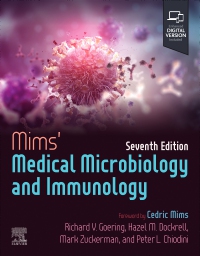
MIMS’ Medical Microbiology and Immunology, Seventh Edition is loved internationally for its thorough yet easy-to-follow coverage of microbiology, infectious diseases, and immunology as a dynamic interplay between microbes and host. Covering the fundamentals of these closely linked disciplines, MIMS’ takes a systems approach to elaborate on epidemiology, clinical presentation, pathogenesis, and diagnostic approaches, as well as treatment and infection control considerations, supplemented by case-based examples. Complex scientific and clinical concepts are explained clearly and simply with the help of illustrations and a range of accompanying online content. Students will come away with a deep understanding of topics and processes, and will return to this book for reference time and again.
-
- Clear writing and easy-to-understand explanations – perfect for students learning to grasp the fundamentals of both microbiology and immunology
- User-friendly format with colour coding, key concept boxes, and dynamic illustrations for easy navigation
- Organised by body system – goes beyond the ‘bug parade’ to help you understand clinical context
- Pathogen Parade (electronic supplement) – a quick cross-referenced glossary of viruses, bacteria, parasites, and fungi
- Vaccine Parade (electronic supplement) – quick-reference coverage of the most commonly used vaccines in current clinical practice
- Clinical cases and multiple-choice self-assessments (electronic supplement) support learning
-
SECTION 1 THE ADVERSARIES – PATHOGENS
1. Pathogens as parasites
2. The bacteria
3. The viruses
4. The fungi
5. The protozoa
6. The helminths
7. The arthropods
8. Prions
9. The host–parasite relationship
SECTION 2 THE ADVERSARIES – HOST DEFENCES
10. The innate defences of the body
11. Adaptive immune responses bring specificity
12. Cooperation leads to effective immune responses
SECTION 3 THE CONFLICTS
13. Background to the infectious diseases
14. Entry, exit and transmission
15. Immune defences in action
16. Spread and replication
17. Parasite survival strategies and persistent infections
18. Pathologic consequences of infection
SECTION 4 CLINICAL MANIFESTATION AND DIAGNOSIS OF INFECTIONS BY BODY SYSTEM
19. Upper respiratory tract infections
20. Lower respiratory tract infections
21. Urinary tract infections
22. Sexually transmitted infections
23. Gastrointestinal tract infections
24. Obstetric and perinatal infections
25. Central nervous system infections
26. Infections of the eye
27. Infections of the skin, soft tissue, muscle and associated systems
28. Vector-borne infections
29. Multisystem zoonoses
30. Fever of unknown origin
31. Infections in the compromised host
SECTION 5 DIAGNOSIS AND CONTROL
32. Diagnosis of infection and assessment of host defence mechanisms
33. Epidemiology and control of infectious diseases
34. Attacking the enemy: antimicrobial agents and chemotherapy
35. Protecting the host: vaccination
36. Specific and non-specific-immunotherapy
37. Infection control -
-
Ways of Reading
- The appearance of the text and page layout can be modified according to the capabilities of the reading system (font family and font size, spaces between paragraphs, sentences, words, and letters, as well as color of background and text)
- This e-publication is accessible to the full extent that the file format and types of content allow, on a specific reading device, by default, without necessarily including any additions such as textual descriptions of images or enhanced navigation
- No information about nonvisual reading is available
-
Conformance
- No information is available
-
Navigation
- Table of contents to all chapters of the text via links
- Page list to go to pages from the print source version
-
Rich Content
- No information is available
-
Hazards
- No information is available
-
Product Content
- No information is available
-
Legal Considerations
- No information is available
-
Additional Accessibility Information
- Content is enhanced with ARIA roles to optimize organization and facilitate navigation
- Page breaks included from the original print source
- For readers with color vision deficiency, use of color (e.g., in diagrams, graphics and charts, in prompts, or on buttons inviting a response) is not the sole means of graphical distinction or of conveying information
- E-publication includes basic navigation (usually less detailed than TOC-based navigation)
- Where links, controls or buttons are included in the content, the purpose or functionality of each link, control or button is apparent from the associated text alone - or where it is unclear, separate link, control or button descriptions are provided
- All (or substantially all) textual matter is arranged in a single logical reading order (including text that is visually presented as separate from the main text flow, e.g., in boxouts, captions, tables, footnotes, endnotes, citations, etc.). Non-textual content is also linked from within this logical reading order. (Purely decorative non-text content can be ignored).
- The language of the text has been specified (e.g., via the HTML or XML lang attribute) to optimise text-to-speech (and other alternative renderings), both at the whole document level and, where appropriate, for individual words, phrases or passages in a different language.
-
Ways of Reading


Most review copies are eBooks – how fast!
A review copy request is most likely to be fulfilled as an eBook on VitalSource rather than a print product, unless no eBook is available. eBooks become available in as little as a few hours. Print products will take between 7 and 10 days to arrive. To request a print copy, please contact us through the Evolve Support Center for further assistance or contact your Elsevier Sales Rep.

 as described in our