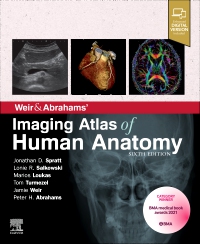

Weir & Abrahams' Imaging Atlas of Human Anatomy - Elsevier eBook on VitalSource, 6th Edition
Elsevier eBook on VitalSource
Now $61.19
BMA Book Awards - Winner of Basic and Clinical Sciences category!
Imaging is ever more integral to anatomy education and throughout modern medicine. Building on the success of previous editions, this fully revised sixth edition provides a superb foundation for understanding applied human anatomy, offering a complete view of the structures and relationships within the whole body, using the very latest imaging techniques.
All relevant imaging modalities are included, from plain radiographs to more advanced imaging of ultrasound, CT, MRI, functional imaging and angiography. Coverage is further enhanced by a carefully selected range of BONUS electronic content, including clinical photos and cases, ultrasound videos, labelled radiograph ‘slidelines’, cross-sectional imaging stacks and test-yourself materials. Uniquely, key syllabus image sets are now highlighted throughout to aid efficient study, as well as the most common, clinically important anatomical variants that you should be aware of.
This superb package is ideally suited to the needs of medical students, as well as radiologists, radiographers and surgeons in training. It will also prove invaluable to the range of other students and professionals who require a clear, accurate, view of anatomy in current practice.
-
- Fully revised legends and labels and new high-quality images–featuring the latest imaging techniques and modalities as seen in clinical practice
- Covers the full variety of relevant modern imaging–including cross-sectional views in CT and MRI, angiography, ultrasound, fetal anatomy, plain film anatomy, nuclear medicine imaging and more – with better resolution to ensure the clearest anatomical views
- Core syllabus image sets now highlighted throughout–to help you focus on the most essential areas to excel on your course and in examinations
- Unique summaries of the most common, clinically important anatomical variants for each body region–reflects the fact that around 20% of human bodies have at least one clinically significant variant
- New orientation drawings–to help you understand the different views and the 3D anatomy of 2D images, as well as the conventions between cross-sectional modalities
- Ideal as a stand-alone resource or in conjunction with Abrahams’ and McMinn’s Clinical Atlas of Human Anatomy–where new links help put imaging in the context of the dissection room
- Now a more complete learning package than ever before, with superb BONUS electronic enhancements embedded within the accompanying eBook, including:
- Labelled image ‘stacks’–that allow you to review cross-sectional imaging as if using an imaging workstation
- Labelled image ‘slidelines’–showing features in a full range of body radiographs to enhance understanding of anatomy in this essential modality
- Self-test image ‘slideshows’ with multi-tier labelling–to aid learning and cater for beginner to more advanced experience levels
- Labelled ultrasound videos–bring images to life, reflecting this increasingly clinically practiced technique
- Questions and answers accompany each chapter–to test your understanding and aid exam preparation
- 34 pathology tutorials–based around nine key concepts and illustrated with hundreds of additional pathology images, to further develop your memory of anatomical structures and lead you through the essential relationships between normal and abnormal anatomy
- High-yield USMLE topics–clinical photos and cases for key topics, linked and highlighted in chapters
-
1. Brain and cranial nerves
2. Skull, orbits, paranasal sinuses and face
3. Neck
4. Vertebral column and spinal cord
5. Upper limb
6. Breast and axilla
7. Thorax: non cardiac
8. Thorax: cardiac
9. Abdomen and pelvis: cross-sectional
10. Abdomen and pelvis: non cross-sectional
11. Lower limb
12. Functional imaging -
-
Ways of Reading
- The appearance of the text and page layout can be modified according to the capabilities of the reading system (font family and font size, spaces between paragraphs, sentences, words, and letters, as well as color of background and text)
- This e-publication is accessible to the full extent that the file format and types of content allow, on a specific reading device, by default, without necessarily including any additions such as textual descriptions of images or enhanced navigation
- No information about nonvisual reading is available
-
Conformance
- No information is available
-
Navigation
- Table of contents to all chapters of the text via links
- Page list to go to pages from the print source version
-
Rich Content
- No information is available
-
Hazards
- No information is available
-
Product Content
- No information is available
-
Legal Considerations
- No information is available
-
Additional Accessibility Information
- Page breaks included from the original print source
- For readers with color vision deficiency, use of color (e.g., in diagrams, graphics and charts, in prompts, or on buttons inviting a response) is not the sole means of graphical distinction or of conveying information
- E-publication includes basic navigation (usually less detailed than TOC-based navigation)
- Where links, controls or buttons are included in the content, the purpose or functionality of each link, control or button is apparent from the associated text alone - or where it is unclear, separate link, control or button descriptions are provided
- All (or substantially all) textual matter is arranged in a single logical reading order (including text that is visually presented as separate from the main text flow, e.g., in boxouts, captions, tables, footnotes, endnotes, citations, etc.). Non-textual content is also linked from within this logical reading order. (Purely decorative non-text content can be ignored).
- The language of the text has been specified (e.g., via the HTML or XML lang attribute) to optimise text-to-speech (and other alternative renderings), both at the whole document level and, where appropriate, for individual words, phrases or passages in a different language.
-
Ways of Reading



 as described in our