
ISBN:
9780443113161
Copyright:
2024
Publication Date:
09-18-2023
Page Count:
1656
Imprint:
Elsevier
List Price:
$97.99

Buck's 2024 ICD-10-CM for Physicians - Elsevier E-Book on VitalSource, 1st Edition
by Elsevier
Elsevier eBook on VitalSource
ISBN:
9780443113161
Copyright:
2024
Publication Date:
09-18-2023
Page Count:
1656
Imprint:
Elsevier
List Price:
$97.99
Most review copies are eBooks – how fast!
A review copy request is most likely to be fulfilled as an eBook on VitalSource rather than a print product, unless no eBook is available. eBooks become available in as little as a few hours. Print products will take between 7 and 10 days to arrive. To request a print copy, please contact us through the Evolve Support Center for further assistance or contact your Elsevier Sales Rep.
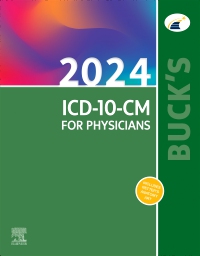
Selecting diagnosis codes is faster and easier with Buck's 2024 ICD-10-CM for Physicians. Designed by coders for coders, this full-color manual ensures students learn the most accurate billing and reimbursement codes for medical services provided in physicians’ offices and outpatient settings. As coders need extensive knowledge to code with ICD-10-CM, this edition makes it easier with colorful anatomy plates (including Netter’s Anatomy illustrations) to help coders understand anatomy and how it will affect their code choices. In addition, it comes with durable spiral binding, and includes a companion website with the latest coding updates.
Newer Edition Available

Buck's 2025 ICD-10-CM for Physicians - Elsevier E-Book on VitalSource
Elsevier eBook on VitalSource
ISBN: 9780443261534
-
- NEW! Updated 2024 Official Code set reflects the latest ICD-10 codes needed for diagnosis coding
- At-a-glance Guide to the 2024 ICD-10-CM Updates in the front of the book lists all new, revised, and deleted codes, providing quick lookup of the coding changes
- Official Guidelines for Coding and Reporting (OGCRs) are listed in full in the Introduction, at the beginning of each chapter, and integrated within the code set, providing easier reference to coding rules when they are needed most
- Unique! Full-color anatomy plates (including Netter’s Anatomy art) are included in a separate section for easy reference and cross-referenced within the Tabular List of Diseases and Injuries, to help users understand anatomy and how it may affect choosing codes
- Full-color design includes consistent color-coded symbols and text, providing easier access to codes and coding information
- American Hospital Association's Coding Clinic® citations include official ICD-10-CM coding advice relating to specific codes and their usage
- More than 190 illustrations provide visual orientation and enhance understanding of specific coding situations
- Items are included throughout the Tabular List to ensure accurate coding, providing additional information on common diseases and conditions
- Additional elements within specific codes define terms and add coding instructions relating to difficult terminology, diseases and conditions, or coding in a specific category
- Symbols and highlights draw attention to codes that may require special consideration before coding, including:
- New, revised, and deleted
- Unacceptable Principle Diagnosis
- Codes that call for the use of additional character(s)
- Includes, Excludes 1 and Excludes 2
- Use Additional
- Code First and Code Also
- Placeholder X symbol reminds users to assign placeholder X for codes less than 6 characters that require a 7th character
- Manifestation code symbol identifies conditions for which it is important to record both the etiology and the symptom of the disease
- HCC symbol indicates diagnoses in the Tabular List associated with Hierarchical Condition Categories
- Age and Sex edits from the Definition of Medicare Code Edits help to ensure accuracy by denoting codes that are used only with patients of a specific age or sex
-
- NEW! Updated 2024 Official Code set reflects the latest ICD-10 codes needed for diagnosis coding
-
Part 1: Fundamentals
1. Essentials of Anterior Abdominal Wall Anatomy for Abdominoplasty
2. Surface Abdominal Anatomy, Aesthetics, and Proportionality
3. History and Evolution in Abdominoplasties: Evolving to the TULUA Concept
4. Developments for a Safer Lipoabdominoplasty
5. From ELMA to TULUA
6. Abdominal Wall Laxity Correction With Plicatures
7. The Origins and Experience of the Transverse Plication During Abdominoplasty in Colombia, Its Uses, Evolution, and Scope
8. Neoumbilicoplasty
9. Complications and Prevention Pearls in Lipoabdominoplasty
10. TULUA Abdominoplasty, Animal Experiments
11. TULUA Paradigm Shifting: Detailed Description of the Concepts That Originated the Technique
Part 2: Surgical Techniques and TULUA Indications
12. TULUA: A Surgical Guide to the Basic Technique
13. TULUA Corrects and Prevents Primary or Secondary Upper Abdomen Redundancy
14. TULUA Hernio-Abdominoplasty: Hernia Management During Abdominoplasty
15. TULUA Abdominoplasty in Postbariatric Patients
16. Secondary TULUA Lipoabdominoplasty
17. How to Prevent and Solve Complications of Previous Abdominoplasties and Liposuction With TULUA
18. Avoiding Tissue Necrosis After Abdominoplasty in the Patient With Subcostal Scars Using TULUA Lipoabdominoplasty
19. TULUA Lipoabdominoplasty Resects More Tissue Than Conventional Methods While Still Maintaining a Low Scar Placement
20. TULUA with Additional Vertical Plicature: The Combination of Vertical and Transverse Plications Adds Advantages
21. TULUA-HD: High-definition Liposuction Combined With Transverse Plicature Abdominoplasty
22. TULUA With Abdominal Volumization Using Intramuscular Fat Grafting
23. Caldeira-Midi-TULUA Abdominoplasty: Incomplete Subumbilical Resection, and Neoumbilicoplasty During Lipoabdominoplasty
24. LIPO-MIT “Mini-TULUA”: Liposuction With Anatomical Definition, Infraumbilica Resection, Short Incision, and Transvers Plicature
25. TULUA-DIEP: Optimizing Abdominal Donor Site During Free Flap Breas Reconstruction Using Transverse Plication Abdominoplasty
26. TULUA-Hemi DIEP: Donor Abdominoplasty Following Flap Banking For Microsurgical Breast Reconstruction
27. Pregnancy After TULUA
28. Female External Genitalia in the Context of Transverse Plication TULUA Abdominoplasty
29. TULUA in a Kidney Transplant Patient: Case Report and Literature Review About Aesthetic Surgery in Transplanted Patients
Part 3: International Adaptations of TULUA
30. FLORIDA Abdominoplasty
31. LIMA Abdominoplasty: Liposculpture, Mixed Musculoaponeurotic Plication, and Abdominoplasty With Neoumbilicoplasty
32. Lipoabdominoplasty and Abdominal Wall Correction With the Crossbow Plication. (The Paranense Brazil Experience)
33. The India Experience With TULUA: A Subcontinent Introduction to the New Abdominoplasty Era
34. The Arabic Experience With TULUA: Personal Experiences and Specific Indications and Modifications to Introduce the TULUA Abdominoplasty Technique in the Middle East
35. The Buenos Aires Experience: Drainless, Awake, and Tumescent TULUA Abdominoplasty
36. The Paraguayan Experience Introducing TULUA: A Paradigm Change in Abdominoplasty
37. Teaching TULUA Abdominoplasty: Its Application in the “en bloc” Resection Technique
38. Usefulness and Implementation of the TULUA Technique in a Private Practice Service in Mar del Plata, Argentina
Part 4: Expert Opinion
39. TULUA: Expert Discussion About Its Principles, Questions to Solve, Safety Concerns, and Its Future
40. Cirque du Soleil and the TULUA Technique Antidotes to the Traditional Abdominoplasty
41. Abdominoplasty: State-of-the-Art
42. TULUA Abdominoplasty in Patients After Massive Weight Loss
43. TULUA and Oblique Flankplasty: A Marriage to Reshape the 360-Degree Torso
44. Male TULUA-HD Abdominoplasty: Emergency TULUA, Safety and Tips for Successful Outcomes
45. Vibration Amplification of Sound Energy at Resonance (VASER) Circumferential Liposuction and Lipoabdominoplasty: A New Frontier, Complementing and Challenging TULUA Abdominoplasty
46. TULUA-nha: Lipoabdominoplasty With Definition + TULUA
47. Mastering the Lipoabdominoplasty: Superior Pull-Down, Miniabdominoplasty, and TULUA Techniques
48. First Experiences With the TULUA Abdominoplasty Technique in Germany
49. TULUA Abdominoplasty: “How To” Obtain the Best Results and Avoid Complications
50. CALP-TULUA: Incorporating TULUA in Divine Proportion CALP Abdominoplasty -
-
Ways of Reading
- The appearance of the text and page layout can be modified according to the capabilities of the reading system (font family and font size, spaces between paragraphs, sentences, words, and letters, as well as color of background and text)
- This e-publication is accessible to the full extent that the file format and types of content allow, on a specific reading device, by default, without necessarily including any additions such as textual descriptions of images or enhanced navigation
- No information about nonvisual reading is available
-
Conformance
- No information is available
-
Navigation
- Table of contents to all chapters of the text via links
- Page list to go to pages from the print source version
-
Rich Content
- No information is available
-
Hazards
- No information is available
-
Product Content
- No information is available
-
Legal Considerations
- No information is available
-
Additional Accessibility Information
- Content is enhanced with ARIA roles to optimize organization and facilitate navigation
- Page breaks included from the original print source
- For readers with color vision deficiency, use of color (e.g., in diagrams, graphics and charts, in prompts, or on buttons inviting a response) is not the sole means of graphical distinction or of conveying information
- E-publication includes basic navigation (usually less detailed than TOC-based navigation)
- Where links, controls or buttons are included in the content, the purpose or functionality of each link, control or button is apparent from the associated text alone - or where it is unclear, separate link, control or button descriptions are provided
- All (or substantially all) textual matter is arranged in a single logical reading order (including text that is visually presented as separate from the main text flow, e.g., in boxouts, captions, tables, footnotes, endnotes, citations, etc.). Non-textual content is also linked from within this logical reading order. (Purely decorative non-text content can be ignored).
- The language of the text has been specified (e.g., via the HTML or XML lang attribute) to optimise text-to-speech (and other alternative renderings), both at the whole document level and, where appropriate, for individual words, phrases or passages in a different language.
-
Ways of Reading
Most review copies are eBooks – how fast!
A review copy request is most likely to be fulfilled as an eBook on VitalSource rather than a print product, unless no eBook is available. eBooks become available in as little as a few hours. Print products will take between 7 and 10 days to arrive. To request a print copy, please contact us through the Evolve Support Center for further assistance or contact your Elsevier Sales Rep.

 as described in our