
ISBN:
9780443116407
Copyright:
2026
Publication Date:
03-25-2025
Page Count:
848
Imprint:
Saunders
List Price:
$109.99

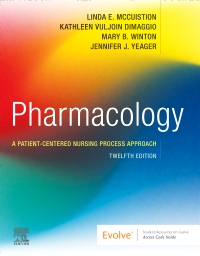
Pharmacology - Elsevier eBook on VitalSource, 12th Edition
by Linda E. McCuistion, PhD, MSN, RN, Kathleen Vuljoin DiMaggio, MSN, RN, Mary B. Winton, PhD, MSN, RN and Jennifer J. Yeager, PhD, MSN, RN
Elsevier eBook on VitalSource
ISBN:
9780443116407
Copyright:
2026
Publication Date:
03-25-2025
Page Count:
848
Imprint:
Saunders
List Price:
$109.99
Was
$109.99
Now $96.79
Or $0.00 with a valid access code
**Selected for 2025 Doody’s Core Titles® in Pharmacology**
Gain a solid understanding of nursing pharmacology and patient-centered medication safety! Pharmacology: A Patient-Centered Nursing Process Approach, 12th Edition, makes it easy to learn the principles of nursing pharmacology and drug dosage calculation. A clear guide to pharmacotherapy and safe drug administration, this popular book uses drug prototypes to provide need-to-know information about key drugs, including dosage, side effects, interactions, and more. Nursing Process/Clinical Judgment summaries enhance your skills in applying clinical judgment skills for safe patient care. Written by a team of nursing experts led by Linda McCuistion, this time-tested textbook provides the nursing pharmacology knowledge you need to succeed on the Next-Generation NCLEX® Exam and administer drugs safely.
Gain a solid understanding of nursing pharmacology and patient-centered medication safety! Pharmacology: A Patient-Centered Nursing Process Approach, 12th Edition, makes it easy to learn the principles of nursing pharmacology and drug dosage calculation. A clear guide to pharmacotherapy and safe drug administration, this popular book uses drug prototypes to provide need-to-know information about key drugs, including dosage, side effects, interactions, and more. Nursing Process/Clinical Judgment summaries enhance your skills in applying clinical judgment skills for safe patient care. Written by a team of nursing experts led by Linda McCuistion, this time-tested textbook provides the nursing pharmacology knowledge you need to succeed on the Next-Generation NCLEX® Exam and administer drugs safely.
-
-
 Sherpath Vantage for McCuistion PharmacologySherpath Vantage
 -
 Sherpath for McCuistion PharmacologySherpath Book-Organized
 -
 Study Guide for PharmacologyPaperback
 -
 Study Guide for Pharmacology - Elsevier E-Book on VitalSourceElsevier eBook on VitalSource
 -
 Evolve Resources for PharmacologyResources
-
-
- NEW! The latest FDA drug approvals, withdrawals, and drug uses are included throughout
- NEW! Content updates reflect the most current evidence-based care and the 2021 AACN Essentials
- NEW! Updated Women’s Health chapter features new content and safety highlights
- NEW! Study and practice questions include the very latest formats for the Next-Generation NCLEX® Exam (NGN)
- NEW! Protein binding and half-life information is now listed in the Uses/Considerations columns in drug tables
- UNIQUE! Nursing Process/Clinical Judgment summaries highlight important nursing considerations and clinical judgment skills within the framework of the nursing process
- UNIQUE! Prototype Drug Charts provide easy access to key information for representative drugs, including dosages, contraindications, drug-lab-food interactions, pharmacokinetics, and more
- UNIQUE! An extensive Drug Calculations chapter presents six methods of dosage calculation, providing a helpful review and supplement to a dosage calculations textbook
- Safety and Quality chapter addresses medication errors, specific nursing measures to promote medication safety, U.S. National Patient Safety Goals, the 2021 AACN Essentials, and other safety issues and concerns
- NGN-Style Case Studies (single-episode and unfolding) provide practice opportunities with the very latest item types
- Application-level NCLEX®-Style Study Questions at the end of each chapter help prepare you for the growing pharmacology coverage on the NCLEX® Examination.
- Prioritization coverage helps you learn to prioritize nursing care by listing nursing interventions in the order of priority
- Clinical Judgment Case Studies (in chapters that do not include NGN-style case studies) challenge you to apply your knowledge and analytical skills to realistic patient scenarios. Answer guidelines are provided on the Evolve website
- Cultural content is integrated into Nursing Process boxes
-
UNIT I: Introduction to Pharmacology
1. Clinical Judgment Measurement Model and the Nursing Process
2. Drug Development and Ethical Considerations
3. Pharmacokinetics and Pharmacodynamics
4. Pharmacogenetics
5. Complementary and Alternative Therapies
6. Pediatric Considerations
7. Geriatric Considerations
8. Drugs in Substance Use Disorder
UNIT II: Pharmacotherapy and Drug Administration
9. Safety and Quality
10. Drug Administration
11. Drug Labels and Dosage Calculations
UNIT III: Maintenance of Homeostasis
12. Fluid Volume and Electrolytes
13. Vitamin and Mineral Replacement
14. Nutritional Support
UNIT IV: Autonomic Nervous System Drugs
15. Adrenergic Agonists and Antagonists
16. Cholinergic Agonists and Antagonists
NIT V: Central and Peripheral Nervous System Drugs
17. Stimulants
18. Depressants
19. Antiseizure Drugs
20. Drugs for Parkinsonism and Alzheimer’s Disease
21. Drugs for Neuromuscular Disorders and Muscle Spasms
UNIT VI: Mental and Behavioral Health Drugs
22. Antipsychotics and Anxiolytics
23. Antidepressants and Mood Stabilizers
UNIT VII: Pain and Inflammation Management Drugs
24. Antiinflammatories
25. Analgesics
UNIT VIII: Antimicrobial Drugs
26. Penicillins, Other Beta-Lactams, and Cephalosporins
27. Macrolides, Oxazolidinones, Lincosamides, Glycopeptides, Ketolides, and Lipopeptides
28. Tetracyclines, Glycylcyclines, Aminoglycosides, and Fluoroquinolones
29. Sulfonamides and Nitroimidazoles Antibiotics
30. Antituberculars, Antifungals, and Antivirals
31. Antimalarials, Anthelmintics, and Peptides
UNIT IX: Immunologic Drugs
32. HIV- and AIDS-Related Drugs
33. Transplant Drugs
34. Vaccines
UNIT X: Antineoplastics and Biologic Response Modifiers
35. Anticancer Drugs
36. Targeted Therapies to Treat Cancer
37. Biologic Response Modifiers
UNIT XI: Respiratory Drugs
38. Upper Respiratory Disorders
39. Lower Respiratory Disorders
UNIT XII: Cardiovascular Drugs
40. Cardiac Glycosides, Antianginals, and Antidysrhythmics
41. Diuretics
42. Antihypertensives
43. Anticoagulants, Antiplatelets, and Thrombolytics
44. Antihyperlipidemics and Drugs to Improve Peripheral Blood Flow
UNIT XIII: Gastrointestinal Drugs
45. Gastrointestinal Tract Disorders
46. Antiulcer Drugs
UNIT XIV: Eye, Ear, and Skin Drugs
47. Eye and Ear Disorders
48. Dermatologic Disorders
UNIT XV: Endocrine Drugs
49. Pituitary, Thyroid, Parathyroid, and Adrenal Disorders
50. Antidiabetics
UNIT XVI: Renal and Urologic Drugs
51. Urinary Disorders
UNIT XVII: Reproductive and Gender-Related Drugs
52. Pregnancy and Preterm Labor
53. Labor, Delivery, and Postpartum
54. Neonatal and Newborn
55. Women’s Reproductive Health
56. Men’s Reproductive Disorders
57. Sexually Transmitted Infections
UNIT XVIII: Emergency Drugs
58. Adult and Pediatric Emergency Drugs
Appendix
A: Answers to Review Questions
B: Solution Compatibility Chart -
-
Ways of Reading
- The appearance of the text and page layout can be modified according to the capabilities of the reading system (font family and font size, spaces between paragraphs, sentences, words, and letters, as well as color of background and text)
- This e-publication is accessible to the full extent that the file format and types of content allow, on a specific reading device, by default, without necessarily including any additions such as textual descriptions of images or enhanced navigation
- No information about nonvisual reading is available
-
Conformance
- For detailed accessibility information, see Elsevier's website at https://www.elsevier.com/about/accessibility
- For queries regarding accessibility information, contact [email protected]
- The publication was certified on 18-11-2025
-
Navigation
- Table of contents to all chapters of the text via links
-
Rich Content
- No information is available
-
Hazards
- No information is available
-
Product Content
- No information is available
-
Legal Considerations
- No information is available
-
Additional Accessibility Information
- For readers with color vision deficiency, use of color (e.g., in diagrams, graphics and charts, in prompts, or on buttons inviting a response) is not the sole means of graphical distinction or of conveying information
- E-publication includes basic navigation (usually less detailed than TOC-based navigation)
- Where links, controls or buttons are included in the content, the purpose or functionality of each link, control or button is apparent from the associated text alone - or where it is unclear, separate link, control or button descriptions are provided
- All (or substantially all) textual matter is arranged in a single logical reading order (including text that is visually presented as separate from the main text flow, e.g., in boxouts, captions, tables, footnotes, endnotes, citations, etc.). Non-textual content is also linked from within this logical reading order. (Purely decorative non-text content can be ignored).
- The language of the text has been specified (e.g., via the HTML or XML lang attribute) to optimise text-to-speech (and other alternative renderings), both at the whole document level and, where appropriate, for individual words, phrases or passages in a different language.
-
Ways of Reading
Was
$109.99
Now $96.79
Or $0.00 with a valid access code

 as described in our