ISBN:
9780443118814
Copyright:
2026
Publication Date:
03-28-2025
Page Count:
260
Imprint:
Elsevier
List Price:
$99.99
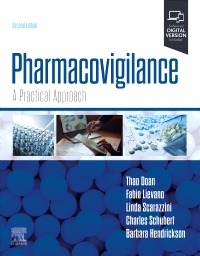
Pharmacovigilance, 2nd Edition
by Thao Doan, MD, Fabio Lievano, MD, PhD H.C., Linda Scarazzini, MD, Charles Schubert, MD, MPH and Barbara Hendrickson, MD
Paperback
ISBN:
9780443118814
Copyright:
2026
Publication Date:
03-28-2025
Page Count:
260
Imprint:
Elsevier
List Price:
$99.99
In Stock
Most review copies are eBooks – how fast!
A review copy request is most likely to be fulfilled as an eBook on VitalSource rather than a print product, unless no eBook is available. eBooks become available in as little as a few hours. Print products will take between 7 and 10 days to arrive. To request a print copy, please contact us through the Evolve Support Center for further assistance or contact your Elsevier Sales Rep.
Written by multidisciplinary experts in the fields of pharmaceutical and patient safety, Pharmacovigilance: A Practical Approach, Second Edition, provides a succinct, easy-to-digest overview of an increasingly critical area of medical safety. From cover to cover, this concise resource offers essential information for physicians and other health care professionals, clinical researchers, and regulators who need a comprehensive, up-to-date source of information on the principles and practice of pharmacovigilance.
-
- Presents vital, easy-to-read, cutting-edge information on patient safety, the pharmacology regulatory landscape, and the current and future use of digital technologies
- Provides up-to-date coverage of hot topics in the field, including pharmacodynamic and safety precision medicine, immunogenicity, vaccine hesitancy and safety, genetic toxicology, and adverse events
- Contains new chapters on pre-clinical safety assessment, pharmacogenetics, first-in human trials, product aggregate safety assessment, data monitoring committees, and more
- Offers new and expanded coverage of pharmacovigilance in early pre-clinical drug development through post-marketing surveillance, as well as a blueprint for training future pharmacovigilance professionals
- Includes real-world case studies to ensure content is relevant and applicable to everyday practice
- Discusses a range of topics across disciplines and how they relate to pharmacovigilance, including behavioral science, patient perspectives, and risk communication
- An eBook version is included with purchase. The eBook allows you to access all of the text, figures and references, with the ability to search, customize your content, make notes and highlights, and have content read aloud. Additional digital ancillary content may publish up to 6 weeks following the publication date
-
SECTION 1 THE REGULATORY ENVIRONMENT AND THE PHARMACOVIGILANCE QUALITY SYSTEM
1. Does Regulation Drive Science or Does Science Drive Regulation?
SECTION 2 PRECLINICAL SAFETY ASSESSMENT
2. Absorption, Distribution, Metabolism and Excretion, Pharmacokinetics, and Safety Pharmacology
3. Preclinical Safety Assessment : General and Genetic Toxicology
4. Pharmacogenetics
SECTION 3 FIRST-IN-HUMAN TRIALS
5. Safety Planning for First-in-Human Trials
6. Pharmacokinetic and Pharmacodynamic Considerations in Safety Evaluation
SECTION 4 SAFETY ASSESSMENT IN CLINICAL TRIALS
7. Safety Monitoring in Clinical Trials
8. Introduction to Quantitative Methods and Visual Analytics in Drug Safety Data in Clinical Trials
9. Product Aggregate Safety Assessment
10. Data Monitoring Committees
SECTION 5 SIGNAL AND RISK MANAGEMENT
11. Methods of Signal Detection and Signal Management
12. Causality Assessment
13. Examples of Adverse Drug Reactions: Drug-Induced Liver Injury, Renal, Skin, Immune-Mediated Events, and Major Adverse Cardiac Events
14. Internal Safety Advisory Groups
15. Benefit–Risk Management
SECTION 6 ROLE OF EPIDEMIOLOGY AND REALWORLD EVIDENCE
16. Role of Epidemiology and Pharmacoepidemiology in the Biopharmaceutical Industry
17. Real-World Pharmacoepidemiology Studies
SECTION 7 SPECIAL POPULATIONS AND SPECIAL TOPICS
18. Pharmacovigilance in Pregnancy
19. Pharmacovigilance in Pediatrics
20. Pharmacovigilance in the Elderly
21. Vaccine Pharmacovigilance
22. Application of Human Factors and Health Literacy in Pharmacovigilance
23. Medical Device Safety Oversight and Surveillance
SECTION 8 THE NEXT FRONTIER
24. Information Technology in Pharmacovigilance: Current State and Future Directions
25. The Future of Pharmacovigilance -
No accessibility information is available for this product.
In Stock
Most review copies are eBooks – how fast!
A review copy request is most likely to be fulfilled as an eBook on VitalSource rather than a print product, unless no eBook is available. eBooks become available in as little as a few hours. Print products will take between 7 and 10 days to arrive. To request a print copy, please contact us through the Evolve Support Center for further assistance or contact your Elsevier Sales Rep.

 as described in our