ISBN:
9780443121142
Copyright:
2025
Publication Date:
06-14-2024
Page Count:
472
Imprint:
Elsevier
List Price:
$138.99
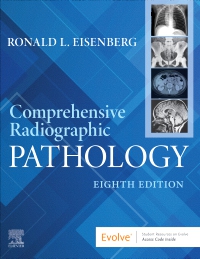
Comprehensive Radiographic Pathology, 8th Edition
by Ronald L. Eisenberg, MD, JD, FACR
Paperback
ISBN:
9780443121142
Copyright:
2025
Publication Date:
06-14-2024
Page Count:
472
Imprint:
Elsevier
List Price:
$138.99
In Stock
Most review copies are eBooks – how fast!
A review copy request is most likely to be fulfilled as an eBook on VitalSource rather than a print product, unless no eBook is available. eBooks become available in as little as a few hours. Print products will take between 7 and 10 days to arrive. To request a print copy, please contact us through the Evolve Support Center for further assistance or contact your Elsevier Sales Rep.
Provide your students with the pathology knowledge needed to produce quality radiographic images! A fully illustrated, easy-to-follow guide, Comprehensive Radiographic Pathology, 8th Edition describes the pathologies that can be diagnosed with medical imaging. The book provides an understanding of the principles of pathology and explains how to recognize the radiographic appearance of specific diseases and conditions. By mastering the suggested imaging techniques, students will learn to produce the high-resolution images that lead to accurate diagnoses. A complete teaching text and reference, this book will help students become competent professionals and valued contributors to the diagnostic team.
-
- NEW! Updated Radiographer Notes are included at the beginning of each chapter
- NEW! 30 new images are added, including CT scans pertaining to guidelines on detection of lung cancer
- NEW! Coverage of A.I. (artificial intelligence) and personalized medicine is added to this edition
- NEW! Coverage of COVID as pertaining to chest X-rays is added to this edition
-
- NEW! Updated Radiographer Notes provide helpful suggestions for producing optimal radiographs of each organ system, and include information on positioning and exposure factor adjustments for patients with specific conditions or handling requirements
- NEW! 30 new images are added, including CT scans pertaining to guidelines on detection of lung cancer
- NEW! Coverage of A.I. (artificial intelligence) and personalized medicine is added to this edition
- NEW! Coverage of COVID as pertaining to chest X-rays is added to this edition
- Hundreds of high-quality illustrations cover all modalities, clearly demonstrating the clinical manifestations of different disease processes and providing a standard for the high-quality images needed in radiography practice
- Discussion of widely used imaging modalities includes the advantages and limitations of ultrasound, computed tomography (CT), magnetic resonance imaging (MRI), nuclear medicine, single-photon emission computed tomography (SPECT), positron emission tomography (PET), and fusion imaging
- Recommended imaging procedures are provided for each pathologic condition, along with the sequence for choosing and performing alternative imaging studies if necessary.
- Systems-based approach makes it easy to locate information and study one area at a time, helping students build an understanding of pathology
- Thorough explanations provide an understanding of the pathologies that can be diagnosed with medical imaging
- Summary tables list the location and radiographic appearance of each disease as well as its treatment
- Review questions help students assess their comprehension of the material in each chapter, with an answer key at the back of the book
-
-
 Sherpath for Eisenberg: Comprehensive Radiographic PathologySherpath Book-Organized
 -
 Workbook for Comprehensive Radiographic Pathology Elsevier eBook on VitalSourceElsevier eBook on VitalSource
 -

-
 Workbook for Comprehensive Radiographic Pathology Elsevier eBook on VitalSourceElsevier eBook on VitalSource
 -

-
 Comprehensive Radiographic Pathology Elsevier eBook on VitalSourceElsevier eBook on VitalSource
-
-
1. Introduction to Pathology
2. Specialized Imaging Techniques
3. Respiratory System
4. Skeletal System
5. Gastrointestinal System
6. Urinary System
7. Cardiovascular System
8. Nervous System
9. Hematopoietic System
10. Endocrine System
11. Reproductive System
12. Miscellaneous Diseases -
No accessibility information is available for this product.
In Stock
Most review copies are eBooks – how fast!
A review copy request is most likely to be fulfilled as an eBook on VitalSource rather than a print product, unless no eBook is available. eBooks become available in as little as a few hours. Print products will take between 7 and 10 days to arrive. To request a print copy, please contact us through the Evolve Support Center for further assistance or contact your Elsevier Sales Rep.

 as described in our