
ISBN:
9780443121678
Copyright:
2026
Publication Date:
06-06-2025
Page Count:
1328
Imprint:
Elsevier
List Price:
$61.99

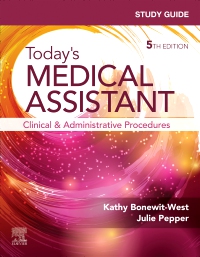
Study Guide for Today's Medical Assistant - Elsevier E-Book on VitalSource, 5th Edition
by Kathy Bonewit-West, BS, MEd and Julie Pepper, BS, CMA (AAMA)
Elsevier eBook on VitalSource
ISBN:
9780443121678
Copyright:
2026
Publication Date:
06-06-2025
Page Count:
1328
Imprint:
Elsevier
List Price:
$61.99
Was
$61.99
Now $54.55
Or $0.00 with a valid access code
Get the most out of your Today's Medical Assistant: Clinical and Administrative Procedures textbook with this practical study guide! With chapters corresponding to those in the textbook, this review provides the extra practice you need to master the clinical and administrative procedures performed by medical assistants. Each chapter includes a wide range of exercises, performance checklists, and a guide to the amount of practice you need to attain competency. Written by the textbook’s author, this review tool provides everything you need to master all of today’s important medical assisting skills!
-
-
 Today's Medical AssistantPaperback
 -
 Today's Medical Assistant - Elsevier eBook on VitalSourceElsevier eBook on VitalSource
-
-
- NEW! Content alignment to 2022 CAAHEP Medical Assisting educational competencies helps you review and perform today’s tasks at a level of accuracy and speed required of the entry-level practitioner
- NEW review content includes exercises on telemedicine, vaccinations, COVID-19 protocols, Cologuard, eating disorders, managing reimbursements, and professionalism
- NEW coverage of gloving and masking procedures helps to protect against COVID-19 and other infectious diseases
- Variety of practice exercises includes matching, true/false, key terms, word parts, short-answer questions, crossword puzzles, critical thinking exercises, and more
- Chapter pretests and posttests help you to measure your mastery of the content
- Laboratory assignment sheets call out each chapter’s procedures and include performance checklists to help organize your study time
- Practice for Competency sections include worksheets with a guide to performing each clinical skill
- Critical thinking activities help you develop the judgment needed for real-life medical office situations
- Perforated pages allow on-the-go review and make it easy to submit assignments
-
1. The Health Care System
2. The Professional Medical Assistant
3. Ethics and Law for the Medical Office
4. Interacting with Patients
5. Introduction to Anatomy and Physiology
6. Integumentary System
7. Skeletal System
8. Muscular System
9. Nervous System
10. The Senses
11. Endocrine System
12. Circulatory System
13. Respiratory System
14. Digestive System
15. Urinary System
16. Reproductive System
17. Medical Asepsis and the OSHA Standard
18. Sterilization and Disinfection
19. Vital Signs
20. The Physical Examination
21. Eye and Ear Assessment and Procedures
22. Physical Agents to Promote Tissue Healing
23. The Gynecologic Examination and Prenatal Care
24. The Pediatric Examination
25. Minor Office Surgery
26. Administration of Medication
27. Cardiopulmonary Procedures
28. Specialty Tests and Procedures
29. Introduction to the Clinical Laboratory
30. Urinalysis
31. Phlebotomy
32. Hematology
33. Blood Chemistry and Immunologic Testing
34. Medical Microbiology
35. Nutrition
36. Emergency Preparedness and Protective Practices
37. Emergency Medical Procedures and First Aid
38. The Medical Record
39. Patient Reception
40. Medical Office Computerization
41. Telephone Techniques
42. Scheduling Appointments
43. Medical Record Management
44. Written Communications and Mail
45. Managing Practice Finances
46. Medical Coding
47. Medical Insurance
48. Billing and Collections
49. The Medical Assistant as Office Manager
50. Obtaining Employment -
-
Ways of Reading
- The appearance of the text and page layout can be modified according to the capabilities of the reading system (font family and font size, spaces between paragraphs, sentences, words, and letters, as well as color of background and text)
- This e-publication is accessible to the full extent that the file format and types of content allow, on a specific reading device, by default, without necessarily including any additions such as textual descriptions of images or enhanced navigation
- No information about nonvisual reading is available
-
Conformance
- For detailed accessibility information, see Elsevier's website at https://www.elsevier.com/about/accessibility
- For queries regarding accessibility information, contact [email protected]
- The publication was certified on 18-11-2025
-
Navigation
- Table of contents to all chapters of the text via links
-
Rich Content
- No information is available
-
Hazards
- No information is available
-
Product Content
- No information is available
-
Legal Considerations
- No information is available
-
Additional Accessibility Information
- For readers with color vision deficiency, use of color (e.g., in diagrams, graphics and charts, in prompts, or on buttons inviting a response) is not the sole means of graphical distinction or of conveying information
- E-publication includes basic navigation (usually less detailed than TOC-based navigation)
- Where links, controls or buttons are included in the content, the purpose or functionality of each link, control or button is apparent from the associated text alone - or where it is unclear, separate link, control or button descriptions are provided
- All (or substantially all) textual matter is arranged in a single logical reading order (including text that is visually presented as separate from the main text flow, e.g., in boxouts, captions, tables, footnotes, endnotes, citations, etc.). Non-textual content is also linked from within this logical reading order. (Purely decorative non-text content can be ignored).
- The language of the text has been specified (e.g., via the HTML or XML lang attribute) to optimise text-to-speech (and other alternative renderings), both at the whole document level and, where appropriate, for individual words, phrases or passages in a different language.
-
Ways of Reading
Was
$61.99
Now $54.55
Or $0.00 with a valid access code

 as described in our