ISBN:
9780443124969
Copyright:
2026
Publication Date:
08-27-2025
Page Count:
750
Imprint:
Elsevier
List Price:
$65.99

Cardiac Catheterization Handbook Elsevier eBook on VitalSource, 8th Edition
by Paul Sorajja, MD, FACC, FAHA, FSCAI and Michael J. Lim, MD, FACC, FSCAI
Elsevier eBook on VitalSource
ISBN:
9780443124969
Copyright:
2026
Publication Date:
08-27-2025
Page Count:
750
Imprint:
Elsevier
List Price:
$65.99
Most review copies are eBooks – how fast!
A review copy request is most likely to be fulfilled as an eBook on VitalSource rather than a print product, unless no eBook is available. eBooks become available in as little as a few hours. Print products will take between 7 and 10 days to arrive. To request a print copy, please contact us through the Evolve Support Center for further assistance or contact your Elsevier Sales Rep.
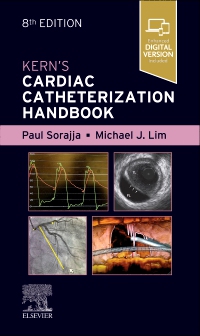
Clearly written, highly illustrated, and designed for quick reference, Kern's Cardiac Catheterization Handbook, 8th Edition, is the resource of choice for every member of the cardiac cath team. Widely regarded as the “bible” of cardiac catheterization, this portable, accessible primer provides a straightforward, practical explanation of the lab and its complex procedures for cardiac fellows, residents, nurses, and all cath lab personnel. Initial chapters assist the novice with descriptions of how procedures flow, what steps to learn first, and other essential information. Later chapters are devoted to special techniques, high-risk procedures, research techniques, percutaneous coronary interventions, and optimization of outcomes—all with a focus on treatment protocols for every procedure.
-
- Provides clear instructions on what to expect, what to avoid, and how to manage complications for every procedure you’ll encounter—including coverage of new techniques and technologies that affect virtually all aspects of familiar procedures
- Covers all the newest catheterization techniques for vascular closure and expansion of large-bore access procedures, including TAVR, ECMO, mitraclip, and TMVR
- Discusses key topics such as intracardiac echocardiography and intraprocedural imaging, management of complications with algorithms that expedite the approach to these patients, adjunctive hemodynamic support, and maintaining quality in the laboratory
- Emphasizes indications and contraindications for procedures in the context of a multidisciplinary heart team approach
- Includes numerous clear illustrations and a newly expanded video library to enhance your understanding of the material
-
-
 Kern's Cardiac Catheterization HandbookPaperback
-
-
1. The Cardiac Catheterization Laboratory
2. Arterial and Venous Access
3. Coronary Angiography and Ventriculography
4. Invasive Hemodynamics
5. Peripheral Artery Disease and Angiography
6. Interventional Cardiology Procedures
7. The Electrophysiology Laboratory and Electrophysiologic Procedures
8. High-Risk Cardiac Catheterization
9. Special Techniques
10. Intravascular Imaging
11. Optimizing Quality in the Cardiac Catheterization Laboratory
Appendices
A. Invasive Cardiovascular Examination and Procedures
B. Heart Diagrams
C. Functional Anatomy of the Heart
D. Tables of Units, Calculations, and Conversions
E. Radiologic Configuration of Prosthetic Heart Valves
F. Basic Electrocardiography
G. Methods for Common Drugs -
-
Ways of Reading
- The appearance of the text and page layout can be modified according to the capabilities of the reading system (font family and font size, spaces between paragraphs, sentences, words, and letters, as well as color of background and text)
- This e-publication is accessible to the full extent that the file format and types of content allow, on a specific reading device, by default, without necessarily including any additions such as textual descriptions of images or enhanced navigation
- No information about nonvisual reading is available
-
Conformance
- No information is available
-
Navigation
- Table of contents to all chapters of the text via links
- Page list to go to pages from the print source version
-
Rich Content
- No information is available
-
Hazards
- No information is available
-
Product Content
- No information is available
-
Legal Considerations
- No information is available
-
Additional Accessibility Information
- Content is enhanced with ARIA roles to optimize organization and facilitate navigation
- Page breaks included from the original print source
- For readers with color vision deficiency, use of color (e.g., in diagrams, graphics and charts, in prompts, or on buttons inviting a response) is not the sole means of graphical distinction or of conveying information
- E-publication includes basic navigation (usually less detailed than TOC-based navigation)
- Where links, controls or buttons are included in the content, the purpose or functionality of each link, control or button is apparent from the associated text alone - or where it is unclear, separate link, control or button descriptions are provided
- All (or substantially all) textual matter is arranged in a single logical reading order (including text that is visually presented as separate from the main text flow, e.g., in boxouts, captions, tables, footnotes, endnotes, citations, etc.). Non-textual content is also linked from within this logical reading order. (Purely decorative non-text content can be ignored).
- The language of the text has been specified (e.g., via the HTML or XML lang attribute) to optimise text-to-speech (and other alternative renderings), both at the whole document level and, where appropriate, for individual words, phrases or passages in a different language.
-
Ways of Reading
Most review copies are eBooks – how fast!
A review copy request is most likely to be fulfilled as an eBook on VitalSource rather than a print product, unless no eBook is available. eBooks become available in as little as a few hours. Print products will take between 7 and 10 days to arrive. To request a print copy, please contact us through the Evolve Support Center for further assistance or contact your Elsevier Sales Rep.

 as described in our