
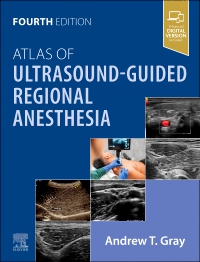
Atlas of Ultrasound-Guided Regional Anesthesia, 4th Edition
Hardcover
-
- Helps ensure correct needle placement with numerous 3-D and long-axis views that clearly depict surrounding structures
- Contains nine new chapters: Ultra High Frequency (UHF) Ultrasound; PENG Block; iPACK Block; External Oblique Intercoastal (EOI) Block; Serratus Anterior Plane Block; Erector Spinae Plane (ESP) Block; Suprazygomatic Maxillary Nerve Block; Ultrasound-Guided Percutaneous Cryoneurolysis for Acute Pain; Artificial Intelligence (AI) in Ultrasound-Guided Regional Anesthesia
- Includes numerous high-quality anatomy illustrations, photographs demonstrating patient positioning, and ultrasound images demonstrating anatomy and needle placement
- Features an expanded video collection with step-by-step guidance of ultrasound-guided techniques, including video flips for PENG, rectus sheath, maxillary nerve, sciatic nerve blocks, and more
- Includes newly revised, board-style review questions to help test your knowledge and prepare you for the ABA exam
- An eBook version is included with purchase. The eBook allows you to access all of the text, figures, and references, with the ability to search, customize your content, make notes and highlights, and have content read aloud. Additional digital ancillary content may publish up to 6 weeks following the publication date
-
SECTION 1 Introduction to Ultrasound Imaging
1. Ultrasound
2. Speed of Sound
3. Attenuation
4. Reflection
5. Beam Width (Slice Thickness)
6. Anisotropy
7. Spatial Compound Imaging
8. Doppler Imaging
9. Ultrasound Transducers
10. Transducer Manipulation
11. Needle Imaging
12. Approach and Techniques
13. Sonographic Signs of Successful Injections
14. Continuous Peripheral Nerve Blocks
15. Three-Dimensional Ultrasound
16. Ultra-High Frequency Ultrasound
SECTION 2 Structures
17. Anatomic Structures
18. Skin and Subcutaneous Tissue
19. Peripheral Nerves
20. Muscle
21. Tendons and Ligaments
22. Arteries
23. Veins
24. Bone
25. Pleura
26. Peritoneum
SECTION 3 Upper Extremity Blocks
27. Interscalene and Superior Trunk Blocks
28. Supraclavicular Block
29. Suprascapular Nerve Block (Anterior Approach, above the Clavicle)
30. Infraclavicular Block
31. Axillary Block
32. Musculocutaneous Nerve Block
33. Forearm Blocks
34. Radial Nerve Block
35. Median Nerve Block
36. Ulnar Nerve Block
SECTION 4 Lower Extremity Blocks
37. Lateral Femoral Cutaneous Nerve Block
38. Fascia Iliaca Block
39. Femoral Nerve Block
40. Adductor Canal Block
41. Obturator Nerve Block
42. Sciatic Nerve Block
43. Popliteal Block
44. Posterior Femoral Cutaneous Nerve Block
45. Pericapsular Nerve Group (PENG) Block for Hip Analgesia
46. Infiltration of Local Anesthetic between the Popliteal Artery and Capsule of Knee (iPACK) Block
47. Ankle Blocks
48. Saphenous Nerve Block in the Leg
49. Deep Peroneal Nerve Block
50. Superficial Peroneal Nerve Block
51. Sural Nerve Block
52. Tibial Nerve Block
SECTION 5 Trunk Blocks
53. Intercostal Nerve Block
54. External Oblique Intercostal Plane Block
55. Serratus Anterior Plane Block
56. Pectoral Nerve Block (The PECS Block)
57. Transversus Thoracis Muscular Plane Block (Parasternal Block)
58. Rectus Sheath Block
59. Ilioinguinal and Iliohypogastric Nerve Blocks
60. Transversus Abdominis Plane Block
61. Erector Spinae Plane Block
62. Thoracic Paravertebral Block
63. Neuraxial Block
64. Caudal Epidural Block
SECTION 6 Head and Neck Blocks
65. Supraorbital Nerve Block
66. Mental Nerve Block
67. Suprazygomatic Maxillary Nerve Block
68. Superior Laryngeal Nerve Block
69. Transtracheal Block
70. Greater Occipital Nerve Block
71. Cervical Plexus Block
72. Stellate Ganglion Block (Cervicothoracic Sympathetic Ganglion Block)
SECTION 7 Safety Issues and New Technology
73. Safety: Practical Techniques to Prevent Complications During Ultrasound-Guided Nerve Blocks
74. Ultrasound-Guided Percutaneous Cryoneurolysis for Acute Pain
75. Artificial Intelligence in Ultrasound-Guided Regional Anesthesia -
No accessibility information is available for this product.

 as described in our