ISBN:
9780443261336
Copyright:
2026
Publication Date:
05-19-2025
Page Count:
1025
Imprint:
Elsevier
List Price:
$99.99
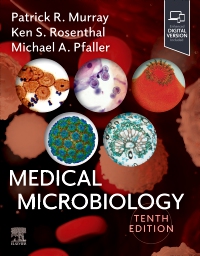
Medical Microbiology, 10th Edition
by Patrick R. Murray, PhD, F(AAM), F(IDSA), Ken S. Rosenthal, PhD and Michael A. Pfaller, MD, F(CAP), F(AAM), F(IDSA)
Paperback
ISBN:
9780443261336
Copyright:
2026
Publication Date:
05-19-2025
Page Count:
1025
Imprint:
Elsevier
List Price:
$99.99
In Stock
Most review copies are eBooks – how fast!
A review copy request is most likely to be fulfilled as an eBook on VitalSource rather than a print product, unless no eBook is available. eBooks become available in as little as a few hours. Print products will take between 7 and 10 days to arrive. To request a print copy, please contact us through the Evolve Support Center for further assistance or contact your Elsevier Sales Rep.
Comprehensive, clinically oriented, and practical, Medical Microbiology, Tenth Edition, remains the go-to text for foundational coverage of key interrelated concepts in medical microbiology, immunology, and infectious diseases. Clear and engaging coverage of the microbial world and its interface with our bodies and the environment provides the foundation to understand these roles in individual and public health and disease—helping you master the essentials of microbiology to effectively prepare you for coursework, exams, and your future career.
-
- Focuses on helping the scientist-, health professional- and clinician-in-training develop a current, complete, and deeper understanding of bacteriology, immunology, virology, mycology, and parasitology, and answer the question: What information do I need to know that will help me understand how to treat an infected patient?
- Contains a new section of eight chapters on Infectious Diseases by Organ System for optimized clinical context
- Includes clinical photographs and cases to correlate basic science with examples of clinical syndromes
- Provides quick reference for efficient study with excellent illustrations, chapter summaries, key information organized in convenient tables, and review questions
- Offers additional learning resources online, including over 200 self-assessment questions, microscopic images of the microbes, and more
-
-
 Medical Microbiology - Elsevier E-Book on VitalSourceElsevier eBook on VitalSource
-
-
SECTION 1: Introduction
1. Introduction to Medical Microbiology
2. Human Microbiome in Health and Disease
3. Infection Prevention and Control
SECTION 2: General Principles of Laboratory Diagnosis
4. Traditional Diagnostic Methods
5. Molecular and Proteomic Diagnostic Methods
SECTION 3: Basic Concepts in the Immune Response
6. Elements of Host Protective Responses
7. Innate Host Responses
8. Antigen-Specific Immune Responses
9. Immune Responses to Infectious Agents
10. Antimicrobial Vaccines
SECTION 4: Bacteriology
11. Bacterial Classification, Structure, and Replication
12. Bacterial Metabolism and Genetics
13. Mechanisms of Bacterial Pathogenesis
14. Role of Bacteria in Disease
15. Laboratory Diagnosis of Bacterial Diseases
16. Antibacterial Agents
17. Staphylococcus and Related Gram-Positive Cocci
18. Streptococcus and Enterococcus
19. Bacillus
20. Listeria and Related Gram-Positive Bacteria
21. Mycobacterium and Related Acid-Fast Bacteria
22. Neisseria and Related Bacteria
23. Haemophilus and Related Bacteria
24. Enterobacterales
25. Vibrio and Related Bacteria
26. Pseudomonas and Related Bacteria
27. Campylobacter and Helicobacter
28. Miscellaneous Gram-Negative Rods
29. Clostridium and Clostridioides
30. Non–Spore-Forming Anaerobic Bacteria
31. Treponema, Borrelia, and Leptospira
32. Mycoplasma
33. Rickettsia, Ehrlichia, and Related Bacteria
34. Chlamydia
SECTION 5: Virology
35. Viral Classification, Structure, and Replication
36. Mechanisms of Viral Pathogenesis
37. Role of Viruses in Disease
38. Laboratory Diagnosis of Viral Diseases
39. Antiviral Agents and Infection Control
40. Papillomaviruses and Polyomaviruses
41. Adenoviruses
42. Human Herpesviruses
43. Poxviruses
44. Parvoviruses
45. Picornaviruses
46. Coronaviruses
47. Noroviruses and Small RNA Enteric Viruses
48. Paramyxoviruses
49. Orthomyxoviruses
50. Rhabdoviruses, Filoviruses, and Bornaviruses
51. Reoviruses
52. Togaviruses, Flaviviruses, and Rubivirus (Matonaviridae)
53. Bunyavirales: Bunyaviridae and Arenaviridae
54. Retroviruses
55. Hepatitis Viruses
56. Prion Diseases
SECTION 6: Mycology
57. Fungal Classification, Structure, and Replication
58. Pathogenesis of Fungal Disease
59. Role of Fungi in Disease
60. Laboratory Diagnosis of Fungal Disease
61. Antifungal Agents
62. Superficial and Cutaneous Mycoses
63. Subcutaneous Mycoses
64. Systemic Mycoses Caused by Dimorphic Fungi
65. Opportunistic Mycoses
66. Fungal and Fungal-Like Infections of Unusual or Uncertain Etiology
SECTION 7: Parasitology
67. Parasitic Classification, Structure, and Replication
68. Pathogenesis of Parasitic Diseases
69. Role of Parasites in Disease
70. Laboratory Diagnosis of Parasitic Disease
71. Antiparasitic Agents
72. Intestinal and Urogenital Protozoa
73. Blood and Tissue Protozoa
74. Nematodes
75. Trematodes
76. Cestodes
77. Arthropods
SECTION 8: Infectious Diseases by Organ System
78. Sepsis and Cardiovascular Infections
79. Ear, Nose and Throat Infections
80. Lower Respiratory Tract Infections
81. Eye, Brain and Nervous System Infections
82. Genitourinary Tract Infections
83. Gastrointestinal Infections
84. Musculoskeletal, Skin, and Soft Tissue Infections
85. Hematopoietic and Lymphatic System Infections -
No accessibility information is available for this product.
In Stock
Most review copies are eBooks – how fast!
A review copy request is most likely to be fulfilled as an eBook on VitalSource rather than a print product, unless no eBook is available. eBooks become available in as little as a few hours. Print products will take between 7 and 10 days to arrive. To request a print copy, please contact us through the Evolve Support Center for further assistance or contact your Elsevier Sales Rep.

 as described in our