ISBN:
9780443261657
Copyright:
2025
Publication Date:
04-29-2024
Page Count:
256
Imprint:
Elsevier
List Price:
$32.99

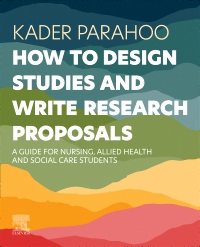
How to Design Studies and Write Research Proposals - Elsevier E-Book on VitalSource, 1st Edition
by Kader Parahoo
Elsevier eBook on VitalSource
ISBN:
9780443261657
Copyright:
2025
Publication Date:
04-29-2024
Page Count:
256
Imprint:
Elsevier
List Price:
$32.99
Most review copies are eBooks – how fast!
A review copy request is most likely to be fulfilled as an eBook on VitalSource rather than a print product, unless no eBook is available. eBooks become available in as little as a few hours. Print products will take between 7 and 10 days to arrive. To request a print copy, please contact us through the Evolve Support Center for further assistance or contact your Elsevier Sales Rep.
If you’re writing a research proposal for the first time, this is the book for you.
It’s the only text on the market that guides you through the entire process, from designing a research study to submitting a successful proposal. It covers everything from formulating the research question to selecting the research methodology, collecting data, and navigating ethics, all supported with plenty of practical tips, real life examples and checklists for honing your proposal.
How to Design Studies and Write Research Proposals is written by nursing research expert Professor Kader Parahoo, whose work is loved by students for its accessible writing style and practical approach.
It’s the only text on the market that guides you through the entire process, from designing a research study to submitting a successful proposal. It covers everything from formulating the research question to selecting the research methodology, collecting data, and navigating ethics, all supported with plenty of practical tips, real life examples and checklists for honing your proposal.
How to Design Studies and Write Research Proposals is written by nursing research expert Professor Kader Parahoo, whose work is loved by students for its accessible writing style and practical approach.
-
- Takes readers through all the steps of the research process from developing research questions to research impact
- Deals with quantitative, qualitative and mixed methods studies
- Provides examples of real proposals, most of which are freely accessible online
- Makes reference to research studies and research proposals from a wide range of countries
- Provides examples from the fields of nursing, allied health sciences and social work
- Provides detailed checklists of items to include in proposals, at the end of each chapter
- Provides useful references and links that readers can access to further explore issues raised in the text
- Written in a language and style that makes research easier to understand
-
1. How to Develop Research Questions for Proposals
2. Background and Literature Review in Research Proposals
3. Conceptual Frameworks in Research Proposals
4. Selecting Research Designs for Descriptive and Correlational Studies
5. Selecting Experimental Designs
6. Selecting Qualitative Designs
7. Selecting Mixed Methods Designs
8. Quantitative Data Collection and Analysis
9. Qualitative Data Collection and Analysis
10. Quantitative and Qualitative Observation in Proposals
11. Samples and Sampling in Quantitative Studies and Proposals
12. Samples and Sampling in Qualitative Studies and Proposals
13. Ethical Issues in Study Design and Proposals
14. Research Impact in Proposals
15. Involving Users, Patients and the Public in Research
16. Timeline, Costings, and Research Team
17. Tips for Successful Research Proposals -
-
Ways of Reading
- The appearance of the text and page layout can be modified according to the capabilities of the reading system (font family and font size, spaces between paragraphs, sentences, words, and letters, as well as color of background and text)
- This e-publication is accessible to the full extent that the file format and types of content allow, on a specific reading device, by default, without necessarily including any additions such as textual descriptions of images or enhanced navigation
- No information about nonvisual reading is available
-
Conformance
- No information is available
-
Navigation
- Table of contents to all chapters of the text via links
- Page list to go to pages from the print source version
-
Rich Content
- No information is available
-
Hazards
- No information is available
-
Product Content
- No information is available
-
Legal Considerations
- No information is available
-
Additional Accessibility Information
- Content is enhanced with ARIA roles to optimize organization and facilitate navigation
- Page breaks included from the original print source
- For readers with color vision deficiency, use of color (e.g., in diagrams, graphics and charts, in prompts, or on buttons inviting a response) is not the sole means of graphical distinction or of conveying information
- E-publication includes basic navigation (usually less detailed than TOC-based navigation)
- Where links, controls or buttons are included in the content, the purpose or functionality of each link, control or button is apparent from the associated text alone - or where it is unclear, separate link, control or button descriptions are provided
- All (or substantially all) textual matter is arranged in a single logical reading order (including text that is visually presented as separate from the main text flow, e.g., in boxouts, captions, tables, footnotes, endnotes, citations, etc.). Non-textual content is also linked from within this logical reading order. (Purely decorative non-text content can be ignored).
- The language of the text has been specified (e.g., via the HTML or XML lang attribute) to optimise text-to-speech (and other alternative renderings), both at the whole document level and, where appropriate, for individual words, phrases or passages in a different language.
-
Ways of Reading
Most review copies are eBooks – how fast!
A review copy request is most likely to be fulfilled as an eBook on VitalSource rather than a print product, unless no eBook is available. eBooks become available in as little as a few hours. Print products will take between 7 and 10 days to arrive. To request a print copy, please contact us through the Evolve Support Center for further assistance or contact your Elsevier Sales Rep.

 as described in our