ISBN:
9780443264504
Copyright:
2027
Publication Date:
03-17-2026
Page Count:
400
Imprint:
Elsevier
List Price:
$88.99

Workbook and Lab Manual for Sonography - Elsevier E-Book on VitalSource, 6th Edition
by Reva Curry and Marilyn Prince
Elsevier eBook on VitalSource
ISBN:
9780443264504
Copyright:
2027
Publication Date:
03-17-2026
Page Count:
400
Imprint:
Elsevier
List Price:
$88.99
Most review copies are eBooks – how fast!
A review copy request is most likely to be fulfilled as an eBook on VitalSource rather than a print product, unless no eBook is available. eBooks become available in as little as a few hours. Print products will take between 7 and 10 days to arrive. To request a print copy, please contact us through the Evolve Support Center for further assistance or contact your Elsevier Sales Rep.
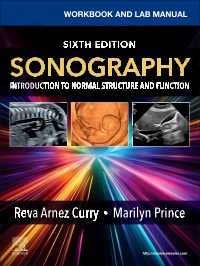
Strengthen your students’ ability to identify sonographic pathology and abnormalities! Workbook and Lab Manual for Sonography: Introduction to Normal Structure and Function, 6th Edition, complements the textbook by reinforcing key visual concepts and providing essential review tools for students learning ultrasound anatomy and physiology. Featuring updated content aligned with the latest ARDMS standards and AIUM guidelines, along with new line drawings and unlabeled images for hands-on practice, this manual effectively prepares students for recognizing pathology in advanced sonography courses.
-
- NEW! Updated content reflects the latest ARDMS standards and AIUM guidelines
- NEW! Updated line drawings accompany new sonograms
-
- NEW! Updated content reflects the latest ARDMS standards and AIUM guidelines
- NEW! Updated line drawings accompany new sonograms
- Unlabeled line drawings and sonograms from every chapter challenge students to identify structures in the images, reinforcing what they should be noticing on the scan
- Direct correlation with each chapter from the main text enables immediate, thorough review of material
- Review questions test students' knowledge of the information presented in the text
-
-
 Sonography - Elsevier E-Book on VitalSourceElsevier eBook on VitalSource
 -
 SonographyHardcover
 -
 Workbook and Lab Manual for SonographyPaperback
-
-
SECTION I: CLINICAL APPLICATIONS
Chapter 1 Before, During, and After the Ultrasound Exam
Chapter 2 Ultrasound Instrumentation
Chapter 3 General Patient Care
Chapter 4 Introduction to Ergonomics and Sonographer Safety
SECTION II: SONOGRAPHIC APPROACH TO UNDERSTANDING ANATOMY
Chapter 5 Interdependent Body Systems
Chapter 6 Anatomy Layering and Sectional Anatomy
Chapter 7 Embryology
Chapter 8 Introduction to Laboratory Values
SECTION III: ABDOMINAL SONOGRAPHY
Chapter 9 The Abdominal Aorta
Chapter 10 The Inferior Vena Cava
Chapter 11 The Portal Venous System
Chapter 12 The Liver
Chapter 13 The Biliary System
Chapter 14 The Pancreas
Chapter 15 The Urinary and Adrenal Systems
Chapter 16 Abdominal Vasculature
Chapter 17 The Spleen
Chapter 18 The Gastrointestinal System
SECTION IV: PELVIC SONOGRAPHY
Chapter 19 The Male Pelvis
Chapter 20 The Female Pelvis
SECTION V: OBSTETRIC AND NEONATAL SONOGRAPHY
Chapter 21 First Trimester Obstetrics (0 to 12 Weeks)
Chapter 22 Second and Third Trimester Obstetrics (13 to 42 Weeks)
Chapter 23 High-Risk Obstetrics
Chapter 24 Fetal Echocardiography
Chapter 25 The Neonatal Brain
SECTION VI: SMALL PARTS SONOGRAPHY
Chapter 26 The Thyroid and Parathyroid Glands
Chapter 27 Breast Sonography
Chapter 28 Scrotal and Penile Sonography
SECTION VII: SPECIALTY SONOGRAPHY
Chapter 29 Pediatric Echocardiography
Chapter 30 Adult Echocardiography
Chapter 31 Vascular Technology
SECTION VIII: ADVANCES IN SONOGRAPHY
Chapter 32 3D/4D/5D Sonography
Chapter 33 Interventional and Intraoperative Ultrasound
Chapter 34 Musculoskeletal Sonography
Chapter 35 Pediatric Sonography
Appendix -
-
Ways of Reading
- The appearance of the text and page layout can be modified according to the capabilities of the reading system (font family and font size, spaces between paragraphs, sentences, words, and letters, as well as color of background and text)
- This e-publication is accessible to the full extent that the file format and types of content allow, on a specific reading device, by default, without necessarily including any additions such as textual descriptions of images or enhanced navigation
- All content can be read as read aloud speech or dynamic braille
- Has alternative text descriptions for images
-
Conformance
- The certifier's credential is https://bornaccessible.benetech.org/certified-publishers/
- For detailed accessibility information, see Elsevier's website at https://www.elsevier.com/about/accessibility
- For queries regarding accessibility information, contact [email protected]
- The publication was certified on 16-03-2026
-
Navigation
- Table of contents to all chapters of the text via links
- Index with links to referenced entries
- Elements such as headings, tables, etc. for structured navigation
- Page list to go to pages from the print source version
-
Rich Content
- Math formulas in accessible format (MathML)
- Information-rich images are described by extended descriptions
-
Hazards
- The publication contains no hazards
-
Product Content
- Content includes any type of illustrations.
- The primary content is text.
- Content includes maps and/or other cartographic content.
- Content includes a significant number of actionable (clickable) web links to external content, downloadable resources, supplementary material, etc.
- Content includes a significant number of actionable (clickable) cross-references, hyperlinked notes and annotations, or with other actionable links between largely textual elements (e.g., quiz/test questions, 'choose your own ending', etc.).
- Content includes photographs, whether in a plate section / insert or not.
- Content includes figures, diagrams, charts and/or graphs, including other 'mechanical' (i.e. non-photographic) illustrations.
- Content includes a significant number of web links (printed URLs, QR codes etc.).
- Content includes text within images, including text-as-text embedded in diagrams, charts, or within images containing speech balloons, thought bubbles, captions, etc.
- Content includes mathematical notations, formulae.
- At least some text - including text within other images - is 'text as an image' (i.e., a picture of text).
-
Legal Considerations
- No information is available
-
Additional Accessibility Information
- Content is enhanced with ARIA roles to optimize organization and facilitate navigation
- Page breaks included from the original print source
- For readers with color vision deficiency, use of color (e.g., in diagrams, graphics and charts, in prompts, or on buttons inviting a response) is not the sole means of graphical distinction or of conveying information
- The body text is presented with a contrast ratio of at least 4.5:1 (or 3:1 for large/heading text)
- Text-to-speech has been optimized through provision of PLS lexicons, SSML or CSS Speech synthesis hints or other speech synthesis markup languages or hinting
- Ultra-high contrast between text and background
- E-publication includes basic navigation (usually less detailed than TOC-based navigation)
- Where links, controls or buttons are included in the content, the purpose or functionality of each link, control or button is apparent from the associated text alone - or where it is unclear, separate link, control or button descriptions are provided
- All (or substantially all) textual matter is arranged in a single logical reading order (including text that is visually presented as separate from the main text flow, e.g., in boxouts, captions, tables, footnotes, endnotes, citations, etc.). Non-textual content is also linked from within this logical reading order. (Purely decorative non-text content can be ignored).
- Where interactive content is included in the product, controls are provided (e.g., for speed, pause and resume, reset) and labelled to make their use clear.
- The language of the text has been specified (e.g., via the HTML or XML lang attribute) to optimise text-to-speech (and other alternative renderings), both at the whole document level and, where appropriate, for individual words, phrases or passages in a different language.
-
Ways of Reading
Most review copies are eBooks – how fast!
A review copy request is most likely to be fulfilled as an eBook on VitalSource rather than a print product, unless no eBook is available. eBooks become available in as little as a few hours. Print products will take between 7 and 10 days to arrive. To request a print copy, please contact us through the Evolve Support Center for further assistance or contact your Elsevier Sales Rep.

 as described in our