ISBN:
9780443279775
Copyright:
2027
Publication Date:
07-29-2026
Page Count:
350
Imprint:
Elsevier
List Price:
$101.99
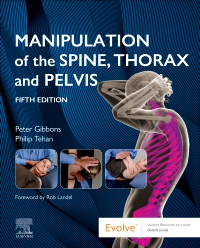
Manipulation of the Spine, Thorax and Pelvis, 5th Edition
by Peter Gibbons, MB, BS, DO, DM-Smed, MHSc and Philip Tehan, DO, DipPhysio, MHSc
Hardcover
ISBN:
9780443279775
Copyright:
2027
Publication Date:
07-29-2026
Page Count:
350
Imprint:
Elsevier
List Price:
$101.99
In Stock
Most review copies are eBooks – how fast!
A review copy request is most likely to be fulfilled as an eBook on VitalSource rather than a print product, unless no eBook is available. eBooks become available in as little as a few hours. Print products will take between 7 and 10 days to arrive. To request a print copy, please contact us through the Evolve Support Center for further assistance or contact your Elsevier Sales Rep.
Now reflecting the tremendous increase in knowledge and research evidence on the use of manipulative techniques in clinical practice, Manipulation of the Spine, Thorax and Pelvis, 5th Edition, helps your students acquire and refine their skills on the safe use of high-velocity low-amplitude (HVLA) thrust techniques. This highly regarded resource advocates an approach that uses minimal leverage to achieve cavitation in a safe, comfortable and effective manner—supported by up-to-date, high-quality images and videos. In one comprehensive volume, students will find essential information on all aspects of the delivery of manipulation techniques, including important issues surrounding patient consent and safety issues in the broader context of relative risk.
-
- Provides step-by-step coverage of 43 commonly used manipulation (HVLA) thrust techniques, supported by 293 photographs/drawings and 60 videos—all fully updated in light of recent research evidence
- Includes concise technique summaries for quick review, a troubleshooting section that addresses difficulties with technique application, and a comprehensive review of spinal kinematics and spinal positioning for manipulation techniques
- Contains a new chapter on the possible biological and psychological mechanisms relating to the efficacy of manipulation in clinical practice, and a new section on rib cage HVLA techniques
- Offers detailed information on kinematics and coupled motion of the spine, minimal leverage positioning for HVLA thrust techniques, safety and minimising risk in the application of manipulation, and current evidence relating to the use of manipulation in paediatric and pregnant patient populations
- Examines evidence relating to cavitation and the clinical effectiveness of spinal manipulation
- Encourages students to reflect on how they are performing manipulative techniques in order to improve their skills
- An eBook version is included with purchase. The eBook allows access to all of the text, figures, and references, with the ability to search, customize content, make notes and highlights, and have content read aloud
-
-

-
 Manipulation of the Spine, Thorax and Pelvis - Elsevier eBook on VitalSourceElsevier eBook on VitalSource
-
-
PART A HVLA Thrust Techniques – An Osteopathic Perspective
1. INTRODUCTION
2. OSTEOPATHIC HISTORY, PRINCIPLES AND PRACTICE
3. KINEMATICS AND COUPLED MOTION OF THE SPINE
4. MINIMAL LEVERAGE POSITIONING FOR HVLA THRUST TECHNIQUES
5. CAVITATION
6. MECHANISMS OF EFFECTIVENESS
7. SAFETY
8. EVIDENCE-INFORMED PRACTICE
9. CONSENT
PART B HVLA Thrust Techniques
10. CERVICAL AND CERVICOTHORACIC SPINE
11. THORACIC SPINE
12. RIB CAGE
13. LUMBAR AND THORACOLUMBAR SPINE
14. PELVIS
PART C
TECHNIQUE FAILURE AND ANALYSIS -
No accessibility information is available for this product.
In Stock
Most review copies are eBooks – how fast!
A review copy request is most likely to be fulfilled as an eBook on VitalSource rather than a print product, unless no eBook is available. eBooks become available in as little as a few hours. Print products will take between 7 and 10 days to arrive. To request a print copy, please contact us through the Evolve Support Center for further assistance or contact your Elsevier Sales Rep.

 as described in our