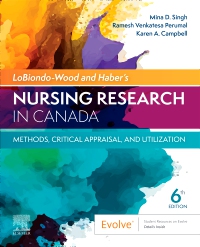
• Balanced but distinct coverage of both the qualitative and quantitative approaches to nursing research acquaints students with the processes behind research and evidence-based/evidence-informed practice. • Complete, high-quality research examples, including four sample critiques, demonstrate how to apply the judgement and reasoning principles outlined in the text to published quantitative and qualitative research studies. • Research Vignettes introduce students to real-world practitioners of nursing research and help bridge the gaps among clinical research, academia, and clinical practice. Vignettes cover timely topics facing Canadian nurses. • Effective learning aids in every chapter include Key Terms, Learning Outcomes, Research Hints, Evidence-Informed Practice Tips, Appraising the Evidence, Critiquing Criteria, Critique of a Research Study, Critical Thinking Decision Paths, Critical Thinking Challenges, Critical Judgement Questions, and Key Points.
• Research examples updated throughout to reflect the latest applicable high-quality literature, with an emphasis on Canadian-authored studies. • NOTE: Additional changes will be identified in a Summer 2023 planning call based on planning surveys completed in late June.
Part 1: Research Overview Research Vignette: Nursing research to improve immunization in Canada Chapter 1 The Role of Research in Nursing Chapter 2 Theoretical Frameworks Chapter 3 Critical Appraisal Strategies: Reading Research Chapter 4 Developing Research Questions, Hypotheses, and Clinical Questions Chapter 5 Finding and Appraising the Literature Chapter 6 Legal and Ethical Issues Part 2: Indigenous Peoples: Research, Knowledges, and Ways of Knowing Research Vignette: An Interview with Dr. Evelyn Voyageur Chapter 7 Indigenous Peoples: Research, Knowledges, and Ways of Knowing Part 3: Qualitative Research Research Vignette: Public Health Nursing and the Social Construction of Mothering Chapter 8 Introduction to Qualitative Research Chapter 9 Qualitative Approaches to Research Part 4: Quantitative Research Research Vignette: Why I Focus on Violence Against Women and Girls (VAWG) Chapter 10 Introduction to Quantitative Research Chapter 11 Experimental and Quasiexperimental Designs Chapter 12 Nonexperimental Designs Part 5: Processes Related to Research Research Vignette: Nursing Workforce Chapter 13 Sampling Chapter 14 Data-Collection Methods Chapter 15 Rigour in Research Chapter 16 Qualitative Data Analysis Chapter 17 Quantitative Data Analysis Chapter 18 Presenting the Findings Part 6: Critiquing Research Research Vignette: Rural and Remote Nursing Research Chapter 19 Critiquing Qualitative Research Chapter 20 Critiquing Quantitative Research Part 7: Application of Research: Evidence-Informed Practice Research Vignette: The influence of NP Program students in my current research portfolio: Exploring medical cannabis and applying it to clinical practice Chapter 21 Developing an Evidence-Informed Practice Research Vignette: Cancer Survivorship Program: Cancer, Work, Fear of Cancer Recurrence APPENDICES Appendix A. The rocks and hard places of MAiD: a qualitative study of nursing practice in the context of legislated assisted death Appendix B. Lanolin for the treatment of nipple pain in breastfeeding women: a randomized controlled trial Appendix C. Mâmawoh Kamâtowin ("Coming together to help each other in wellness"): Honouring Indigenous Nursing Knowledge Appendix D. How Does Simulation Impact Building Competency and Confidence in Recognition and Response to the Adult and Paediatric Deteriorating Patient Among Undergraduate Nursing Students? Appendix E. Prenatal Maternal Anxiety as a Risk Factor for Preterm Birth and the Effects of Heterogeneity on this Relationship: A Systematic Review and Meta-Analysis Glossary Answers and Rationales to the Critical Judgement Questions
Mina D. Singh, RN, RP, BSc, BScN, MEd, PhD, I-FCNEI, Professor, School of Nursing, Faculty of Health, York University, Toronto, Ontario, Canada, Geri LoBiondo-Wood, PhD, RN, FAAN, Professor Emerita, University of Texas Health Science Center Cizik School of Nursing, Houston, TX, USA, Judith Haber, PhD, RN, FAAN, Professor Emerita, NYU Rory Meyers College of Nursing, New York University, New York, NY, USA and Ramesh Venkatesa Perumal, RN, PhD, MSc(N), CCNE, CNCC®, Professor, School of Community and Health Studies, Centennial College; Assistant Professor, Faculty of Health, York University, Toronto, Ontario, Canada
We use cookies which are necessary to make our site work. We may also use additional cookies to analyse, improve and personalise our content and your digital experience. For more information, see our Cookie Policy and the list of Google Ad-Tech Vendors.
You may choose not to allow some types of cookies. However, blocking some types may impact your experience of our site and the services we are able to offer. See the different category headings below to find out more or change your settings.
You may also be able to exercise your privacy choices as described in our Privacy Policy
Manage Consent Preferences
Strictly Necessary Cookies
Always active
These cookies are necessary for the website to function and cannot be switched off in our systems. They are usually only set in response to actions made by you which amount to a request for services, such as setting your privacy preferences, logging in or filling in forms. You can set your browser to block or alert you about these cookies, but some parts of the site will not then work.
Functional Cookies
These cookies enable the website to provide enhanced functionality and personalisation. They may be set by us or by third party providers whose services we have added to our pages. If you do not allow these cookies then some or all of these services may not function properly.
Performance Cookies
These cookies allow us to count visits and traffic sources so we can measure and improve the performance of our site. They help us to know which pages are the most and least popular and see how visitors move around the site.
Targeting Cookies
These cookies may be set through our site by our advertising partners. They may be used by those companies to build a profile of your interests and show you relevant adverts on other sites. If you do not allow these cookies, you will experience less targeted advertising.
