ISBN:
9780443280634
Copyright:
2027
Publication Date:
03-01-2026
Page Count:
400
Imprint:
Mosby
List Price:
$56.99

Mosby’s® Pocket Guide to Fetal Monitoring - Elsevier E-Book on VitalSource, 10th Edition
by Lisa A. Miller, CNM, JD, David A. Miller and Rebecca L. Cypher, MSN, PNNP
Elsevier eBook on VitalSource
ISBN:
9780443280634
Copyright:
2027
Publication Date:
03-01-2026
Page Count:
400
Imprint:
Mosby
List Price:
$56.99
Most review copies are eBooks – how fast!
A review copy request is most likely to be fulfilled as an eBook on VitalSource rather than a print product, unless no eBook is available. eBooks become available in as little as a few hours. Print products will take between 7 and 10 days to arrive. To request a print copy, please contact us through the Evolve Support Center for further assistance or contact your Elsevier Sales Rep.
**Selected for 2026 Doody's Core Titles in Perinatal**
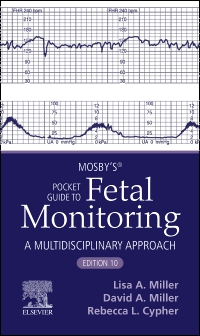
Provide your students with real-world, clinically useful information on all aspects of fetal monitoring! Authored by a nurse-midwife, a perinatologist, and a nurse, Mosby's Pocket Guide to Fetal Monitoring: A Multidisciplinary Approach, 10th Edition, is an essential, evidence-based resource for students in nursing, medical, and midwifery programs. Ideal for use in the clinical environment, it provides a single source for interpretation and management of electronic fetal monitoring in labor and delivery, the intensive care unit, inpatient antepartum units, or the obstetric or midwifery office.
Provide your students with real-world, clinically useful information on all aspects of fetal monitoring! Authored by a nurse-midwife, a perinatologist, and a nurse, Mosby's Pocket Guide to Fetal Monitoring: A Multidisciplinary Approach, 10th Edition, is an essential, evidence-based resource for students in nursing, medical, and midwifery programs. Ideal for use in the clinical environment, it provides a single source for interpretation and management of electronic fetal monitoring in labor and delivery, the intensive care unit, inpatient antepartum units, or the obstetric or midwifery office.
-
- New content explores the use of artificial intelligence (AI) in fetal monitoring
- Information on the wireless Patch System intrapartum maternal/fetal monitor explores how it noninvasively measures and displays fetal heart rate, maternal heart rate, and uterine activity
- Restructured content related to monitoring and clinical management of the preterm fetus includes periviability and multiple gestations
- Enhanced coverage addresses maternal cardiac arrest and resuscitative cesarean delivery
- Updated recommendations for initiation of antepartum testing include highlighted conditions, gestational age, and frequency
- In-depth review of documentation from a risk-management perspective highlights core components of quality charting for nurses, midwives, and physicians, along with the role of the electronic health record
- Updated practice recommendations include the latest information on amnioinfusion
-
- New content explores the use of artificial intelligence (AI) in fetal monitoring
- Information on the wireless Patch System intrapartum maternal/fetal monitor explores how it noninvasively measures and displays fetal heart rate, maternal heart rate, and uterine activity
- Restructured content related to monitoring and clinical management of the preterm fetus includes periviability and multiple gestations
- Enhanced coverage addresses maternal cardiac arrest and resuscitative cesarean delivery
- Updated recommendations for initiation of antepartum testing include highlighted conditions, gestational age, and frequency
- In-depth review of documentation from a risk-management perspective highlights core components of quality charting for nurses, midwives, and physicians, as well as the role of the electronic health record
- Updated practice recommendations include the latest information on amnioinfusion.
- Compact format with vibrant two-color design offers quick and easy access to key information
- Prioritization of fetal heart rate and uterine activity assessment, interpretation, and clinical management, grounded in evidence-based practice and current literature, guides students in delivering focused, effective care
- Explanations of the relationship between specific fetal heart rate patterns and fetal acidemia provide critical insights for managing condition-specific care
- Guidance for safe and competent care is reinforced through patient safety and risk management strategies, illustrated by case studies and legal commentary
- Comprehensive guidance on best practices for accurate and timely electronic fetal monitoring documentation covers essential components of fetal heart rate and uterine activity assessment to support clear communication, informed clinical decisions, and legal compliance
- Overview of contemporary obstetric models of care — ranging from midwifery-led to physician-led and collaborative approaches — highlights their impact on maternal and neonatal outcomes
- Appendix on reviewing electronic fetal monitor tracings serves as a valuable reference and a test bank of questions to aid in certification preparation and knowledge reinforcement
- Renowned author team features recognized leaders in the United States and a strong international presence
-
1. Physiologic Basis for Electronic Fetal Monitoring
2. Methods and Instrumentation
3. Evaluation and Management of Uterine Activity
4. Fetal Heart Rate Pattern Recognition and Interpretation
5. Intrapartum Management of the Fetal Heart Rate Tracing
6. Influence of Gestational Age on Fetal Heart Rate
7. Fetal Assessment in Nonobstetric Settings
8. Antepartum Fetal Testing
9. Patient Safety and Risk Management
10. Fetal Monitoring Documentation
11. Obstetric Models of Care and International Fetal Surveillance Concepts
APPENDIX A: Intrapartum Amnioinfusion
APPENDIX B: Fetal Heart Rate Tracings Review
Key for Appendix B Fetal Heart Rate Tracings
APPENDIX C: Self‑Assessment
Answer Key for Self‑Assessment -
-
Ways of Reading
- The appearance of the text and page layout can be modified according to the capabilities of the reading system (font family and font size, spaces between paragraphs, sentences, words, and letters, as well as color of background and text)
- This e-publication is accessible to the full extent that the file format and types of content allow, on a specific reading device, by default, without necessarily including any additions such as textual descriptions of images or enhanced navigation
- All content can be read as read aloud speech or dynamic braille
- Has alternative text descriptions for images
-
Conformance
- The certifier's credential is https://bornaccessible.benetech.org/certified-publishers/
- For detailed accessibility information, see Elsevier's website at https://www.elsevier.com/about/accessibility
- For queries regarding accessibility information, contact [email protected]
- The publication was certified on 13-02-2026
-
Navigation
- Table of contents to all chapters of the text via links
- Index with links to referenced entries
- Elements such as headings, tables, etc. for structured navigation
- Page list to go to pages from the print source version
-
Rich Content
- Information-rich images are described by extended descriptions
-
Hazards
- The publication contains no hazards
-
Product Content
- Content includes any type of illustrations.
- The primary content is text.
- Content includes maps and/or other cartographic content.
- Content includes a significant number of actionable (clickable) web links to external content, downloadable resources, supplementary material, etc.
- Content includes a significant number of actionable (clickable) cross-references, hyperlinked notes and annotations, or with other actionable links between largely textual elements (e.g., quiz/test questions, 'choose your own ending', etc.).
- Content includes photographs, whether in a plate section / insert or not.
- Content includes figures, diagrams, charts and/or graphs, including other 'mechanical' (i.e. non-photographic) illustrations.
- Content includes images displayed in a specific order for the purpose of graphic storytelling or giving information (e.g. graphic novels, comics and manga). May include text integrated into the image (as speech and thought bubbles, textual 'sound' effects, captions etc.).
- Content includes text within images, including text-as-text embedded in diagrams, charts, or within images containing speech balloons, thought bubbles, captions, etc.
- Content includes visual content that is purely decorative and is not necessary to understanding of the content.
- At least some text - including text within other images - is 'text as an image' (i.e., a picture of text).
-
Legal Considerations
- No information is available
-
Additional Accessibility Information
- Content is enhanced with ARIA roles to optimize organization and facilitate navigation
- Page breaks included from the original print source
- For readers with color vision deficiency, use of color (e.g., in diagrams, graphics and charts, in prompts, or on buttons inviting a response) is not the sole means of graphical distinction or of conveying information
- The body text is presented with a contrast ratio of at least 4.5:1 (or 3:1 for large/heading text)
- Ultra-high contrast between text and background
- E-publication includes basic navigation (usually less detailed than TOC-based navigation)
- Where links, controls or buttons are included in the content, the purpose or functionality of each link, control or button is apparent from the associated text alone - or where it is unclear, separate link, control or button descriptions are provided
- All (or substantially all) textual matter is arranged in a single logical reading order (including text that is visually presented as separate from the main text flow, e.g., in boxouts, captions, tables, footnotes, endnotes, citations, etc.). Non-textual content is also linked from within this logical reading order. (Purely decorative non-text content can be ignored).
- Content provides explanations for unusual words, abbreviations, acronyms, idioms, jargon in an accessible form, such as glossaries, scripted pop-ups.
- Where interactive content is included in the product, controls are provided (e.g., for speed, pause and resume, reset) and labelled to make their use clear.
- The language of the text has been specified (e.g., via the HTML or XML lang attribute) to optimise text-to-speech (and other alternative renderings), both at the whole document level and, where appropriate, for individual words, phrases or passages in a different language.
-
Ways of Reading

Most review copies are eBooks – how fast!
A review copy request is most likely to be fulfilled as an eBook on VitalSource rather than a print product, unless no eBook is available. eBooks become available in as little as a few hours. Print products will take between 7 and 10 days to arrive. To request a print copy, please contact us through the Evolve Support Center for further assistance or contact your Elsevier Sales Rep.

 as described in our