
ISBN:
9780443283383
Copyright:
2027
Publication Date:
07-09-2026
Page Count:
520
Imprint:
Elsevier
List Price:
$80.99
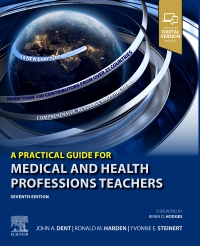
A Practical Guide for Medical and Health Professions Teachers, 7th Edition
by John Dent, MMEd, MD, FHEA, FRCSEd, Ronald M. Harden, OBE MD FRCP(Glas) FRCSEd FRCPC and Yvonne Steinert, PhD
Paperback
ISBN:
9780443283383
Copyright:
2027
Publication Date:
07-09-2026
Page Count:
520
Imprint:
Elsevier
List Price:
$80.99
In Stock
Most review copies are eBooks – how fast!
A review copy request is most likely to be fulfilled as an eBook on VitalSource rather than a print product, unless no eBook is available. eBooks become available in as little as a few hours. Print products will take between 7 and 10 days to arrive. To request a print copy, please contact us through the Evolve Support Center for further assistance or contact your Elsevier Sales Rep.
Bridging the gap between education theory and the delivery of excellent teaching, A Practical Guide for Medical and Health Professions Teachers, 7th Edition, provides accessible, highly readable, and practical information for those teaching or preparing to teach in the areas of basic science, clinical practice, and education in all the health professions. Highly regarded in these fields, this text offers valuable insights from global contributors who provide an international perspective as well as a multi-professional approach to topics relevant to all healthcare teachers. This fully revised edition provides timely updates on recent growth areas—from artificial intelligence, to the evolution of precision learning, to cultural awareness. It remains one of the foremost guides from top educationalists in the field.
-
- Emphasizes the importance of developing educational skills in the delivery of enthusiastic and effective teaching
- Offers comprehensive, succinct sections on curriculum development, learning situations and strategies, curriculum themes, assessment, student engagement, and more
- Includes new content on artificial intelligence, public health medicine, social accountability, cultural awareness, student well-being and mindfulness, cost and sustainability in medical education, learning analytics, precision learning, peer-assisted learning, and professional identity, to highlight some
- Features an expanded section, “Patients,” that stresses the importance of the patients as a partners in education and assessment
- Helpful boxes highlight practical tips, quotes, and trends seen in today’s approach to education
- Delivers the knowledge and expertise of more than 60 new authors and some 130 contributors from 27 countries, providing representation across the health professions
- An eBook version is included with purchase. The eBook allows access to all of the text, figures, and references, with the ability to search, make notes and highlights, and have content read aloud
-
SECTION 1 Curriculum Development—The ‘Why’ of Learning
1. The Future of Health Professions Education
2. What Is the Curriculum?
3. Theories of Teaching and Learning
4. The Continuum of Education for the Health Professions
5. The Undergraduate Curriculum
6. Postgraduate Education in the Health Professions: Pathways to Practice
7. Continuing Professional Development
8. The International and Global Dimensions of Education in the Health Professions
SECTION 2 Learning Situations—The ‘How’ of Learning
9. Learning in Large Groups
10. Learning in Small Groups
11. Learning in the Workplace
12. Independent Learning and Distance Education
13. Learning in Hospitals
14. Learning Medicine in Rural and Urban Communities
15. Learning in a Simulated Environment
SECTION 3 Educational Strategies and Technologies—The ‘Approaches’ to Learning
16. Outcome-Based Education
17. Integrated Learning
18. Interprofessional Education and Learning
19. Problem-Based Learning: A Flexible Approach
20. Team-Based Learning
21. Technology and Professional Education
22. Artificial Intelligence and the Clinical Teacher
23. Precision Learning
SECTION 4 Curriculum Themes—The ‘What’ of Teaching and Learning
24. Relevance of Foundational Sciences to the Curriculum
25. Social and Behavioural Sciences in Medical School Curricula
26. Clinical Communications Skills and Empathy
27. Bioethics
28. Professionalism and Supporting Professional Identity
29. Utilizing Education Research to Deliver Evidence-Based Teaching
30. Patient Safety and Quality of Care
31. Health Humanities in Health Professions Education
32. Integrative Medicine in the Training of Health Professionals
33. Clinical Reasoning
34. Well-being, Mindfulness and Yarigai
35. Planetary Health
36. Cultural Competence and Humility
37. Future-Proofing the Student
38. Public Health in Health Professions Education
SECTION 5 Assessment—The ‘Measure’ of Learning
39. Concepts in Assessment Including Standard Setting
40. Written Assessments
41. Performance and Workplace Assessment
42. Portfolios, Projects and Theses
43. Assessment as Learning
44. The Assessment of Attitudes and Professionalism
45. Programmatic Assessment
SECTION 6 Staff—The ‘Who’ of Teaching and Learning
46. The Roles of the Teacher in Health Professions Education
47. Teacher Evaluation
48. The Teacher as a Scholar
49. Faculty Development
50. Mentoring in Health Professions Education
51. Faculty Well-being, Burnout and Stress
SECTION 7 Students
52. Selection of Students and Trainees
53. The Student as Teacher
54. Working with Students with Learning Difficulties
55. Student Engagement in the Educational Process
56. Career Choice
SECTION 8 Patients
57. The Patient as Educator
58. The Patient as Assessor
59. The Patient as Curriculum Developer
SECTION 9 Education Management
60. Curriculum Evaluation
61. Medical Education Leadership
62. The Health Professions Teacher and Social Accountability
63. The Educational Learning Environment
64. Health Professions Education Research
65. Diversity, Equity and Inclusion in Medical Education
66. The Cost and Sustainability of Health Professions Education
67. Health Professions Education in Disrupted and Conflict Settings
68. Evidence-Informed Health Professions Education -
No accessibility information is available for this product.
In Stock
Most review copies are eBooks – how fast!
A review copy request is most likely to be fulfilled as an eBook on VitalSource rather than a print product, unless no eBook is available. eBooks become available in as little as a few hours. Print products will take between 7 and 10 days to arrive. To request a print copy, please contact us through the Evolve Support Center for further assistance or contact your Elsevier Sales Rep.

 as described in our