
ISBN:
9780443287367
Copyright:
2027
Page Count:
880
Imprint:
Elsevier
List Price:
$131.99
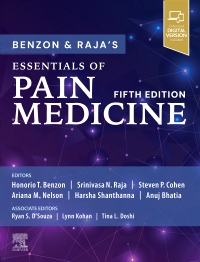
Benzon and Raja's Essentials of Pain Medicine, 5th Edition
by Honorio Benzon, MD, Srinivasa N. Raja, MD, Steven P. Cohen, MD, Anuj Bhatia, MBBS, MD, PhD, FRCA, FFPMRCA, FRCPC (Anesthesia & Pain Medicine), EDRA, CIPS, ASRA-PMUC, FIPP, Ariana M. Nelson, MD, MEHP and Harsha Shanthanna, MD, PhD
Paperback
ISBN:
9780443287367
Copyright:
2027
Page Count:
880
Imprint:
Elsevier
List Price:
$131.99
Not Yet Available
Most review copies are eBooks – how fast!
A review copy request is most likely to be fulfilled as an eBook on VitalSource rather than a print product, unless no eBook is available. eBooks become available in as little as a few hours. Print products will take between 7 and 10 days to arrive. To request a print copy, please contact us through the Evolve Support Center for further assistance or contact your Elsevier Sales Rep.
Coming Soon!
Expected availability date: 10-01-2026
Offering a complete, full-color overview of current theory and practice of pain medicine and regional anesthesia, Benzon and Raja's Essentials of Pain Medicine, 5th Edition, covers all you need to know to stay up to date in practice and excel at examinations. An expert team of editors, associate editors, and contributing authors provide practical guidance on the full range of today’s pharmacologic, interventional, neuromodulative, physiotherapeutic, and psychological management options for the evaluation, treatment, and rehabilitation of persons in pain. A practical, quick-reference format with short, easy-to-read chapters and bulleted key points make information easy to find, remember, and put to use in your practice.
-
- Covers the management of pain for every setting where it is practiced, including the emergency room, perioperative setting, pain clinic, critical care unit, physical or occupational therapy clinic, and other locations
- Discusses recent global developments and the latest best management techniques, including image-guided therapies, soft tissue, peripheral nerve, joint, facet and sacroiliac joint injections, new pharmacologic agents, and physical occupational therapies
- Contains new chapters on biomarkers impacting pain management, artificial intelligence, minimally invasive procedures for axial lower back pain, opioid-free anesthesia, pharmacogenetics, virtual reality/imagery to reduce postoperative and chronic pain, and more
- Features online access to new, interactive multiple-choice questions with answers and rationales that test and reinforce your knowledge of core concepts
- Covers pain management in special situations such as cancer pain and end-of-life pain, chronic pain in children and adolescents, geriatric pain, pain management during pregnancy and lactation, and more
- Provides visual guidance through anatomic illustrations, charts, graphs, and tables, and diagnostic and procedural imaging studies including ultrasound, CT, and MRI
- An eBook version is included with purchase. The eBook allows you to access all of the text, figures, and references, with the ability to search, make notes and highlights, and have content read aloud
-
Section 1: Basic Considerations
1. Anatomy and Physiology of the Pain Signaling Process
2. Neurochemistry of Somatosensory and Pain Processing
3. Taxonomy: Definition of Pain Terms and Chronic Pain Syndromes
Section 2: Clinical Evaluation and Diagnostic Examinations
4. Physical Examination of the Patient with Pain
5. Pain Assessment
6. Psychological Evaluation and Testing
7. Diagnostic and Statistical Manual of Mental Disorders and Pain Management
8. Neurophysiologic Testing for Pain
9. Anatomy, Imaging and Common Pain-Generating Degenerative Pathologies of the Spine
10. Determination of Disability
Section 3: Perioperative Pain Management
11. Preventive Analgesia
12. Perioperative Nonopioid Infusions for Postoperative Pain Management
13. Patient-Controlled Analgesia
14. Intrathecal Opioid Injections for Postoperative Pain
15. Epidural Opioids for Postoperative Pain
16. Continuous Peripheral Nerve Blocks
17. Pediatric Postoperative Pain
18. Chronic Pain After Surgery
Section 4: Chronic Pain Syndromes
19. Migraine Headache and the Trigeminal Autonomic Cephalalgias (TAC)
20. Tension-Type Headache, Chronic Tension-Type Headache, and Other Chronic Headache Types
21. Postmeningeal Puncture Headache and Spontaneous Intracranial Hypotension
22. Cervicogenic Headache
23. Orofacial Pain
24. Overview of Low Back Pain Disorders
25. Myofascial Pain Syndrome
26. Fibromyalgia and Centralized Pain States
27. Complex Regional Pain Syndrome
28. Herpes Zoster and Postherpetic Neuralgia
29. Postamputation Pain
30. Central Pain States
31. Pelvic Pain
32. Painful Peripheral Neuropathies
33. Entrapment Neuropathies
Section 5: Cancer Pain and Pain in Special Situations
34. Approach to Management of Cancer Pain
35. Management of Pain at End of Life
36. Pain Management in the Emergency Department
37. Chronic Pain Management in Children and Adolescents
38. Sickle Cell Pain
39. Pain Management During Pregnancy and Lactation
40. Pain Control in the Critically Ill Patient
41. Geriatric Pain Section 6: Pharmacology and Pharmacologic Modalities
42. Major Opioids and Pain Management
43. Opioids Used for Mild to Moderate Pain
44. The Prescription Drug Abuse Epidemic and Emerging Prescribing Guidelines
45. Legal and Regulatory Issues in Pain Management
46. Urine Drug Testing
47. Substance Use Disorders and Detoxification
48. Psychopharmacology for Pain Medicine
49. Membrane Stabilizers
50. Recommendations for Pharmacological Therapy of Neuropathic Pain
51. Nonopioid Analgesics: NSAIDs, COX-2 Inhibitors, and Acetaminophen
52. Intravenous Infusions for Refractory Cancer and Chronic Pain States
53. Pharmacologic Management of Myofascial Pain
54. Pharmacologic Management of CRPS
55. Pharmacology for the Interventional Pain Physician
56. Role of Cannabinoids in Pain Management
Section 7: Therapeutic Interventions
57. Ablative Neurosurgical Procedures for Treatment of Chronic Pain
58. Physical Medicine and Rehabilitation Approaches to Pain Management
59. Psychological Interventions for Chronic Pain
60. Acupuncture 61. Tai Chi and Chronic Pain
Section 8: Interventional Techniques for Pain Management
62. Interlaminar Epidural Steroid Injections for Lumbosacral Radicular Pain
63. Transforaminal Epidural Steroid Injections and Selective Nerve Root Blocks
64. ANTI TNF – a Drugs and DMARDs for Low Back Pain
65. Facet Syndrome
66. Sacroiliac Joint Syndrome
67. Piriformis Syndrome
68. Pulsed Radiofrequency, Water-Cooled Radiofrequency, and Cryoneurolysis
69. Discography
70. Vertebroplasty and Kyphoplasty
71. Neurolytic Sympathetic Blocks
72. Central and Peripheral Neurolysis
73. Spinal Cord Stimulation
74. Peripheral Nerve Stimulation
75. Dorsal Root Ganglion Stimulation
76. Implanted Drug Delivery Systems for the Control of Chronic Pain
77. Fluoroscopy and Radiation Safety
78. Efficacy of Interventional Procedures for Neuropathic Pain
Section 9: Other Nerve Blocks in Pain Medicine
79. Ultrasound-Guided Procedures for Pain Management
80. Deep Muscle Injections: Piriformis, Scalene Muscle, Iliposoas Injections
81. Ultrasound-Guided Musculoskeletal Injections--Shoulder, Hip, and Knee
82. Head and Neck Blocks
83. Truncal Blocks: Intercostal, Paravertebral, Interpleural, Tap, Suprascapular, Ilioinguinal, and Iliohypogastric Nerve Blocks
84. Sympathetic Blocks: Stellate Ganglion, Lumbar Sympathetic Blocks, and Visceral Sympathetic Blocks -- Fluoroscopy and Ultrasound-Guided
85. Interventional Pain Procedures in Patients on Anticoagulants
86. Interventional Pain Procedures and the Risk of Infection -
No accessibility information is available for this product.
Not Yet Available
Most review copies are eBooks – how fast!
A review copy request is most likely to be fulfilled as an eBook on VitalSource rather than a print product, unless no eBook is available. eBooks become available in as little as a few hours. Print products will take between 7 and 10 days to arrive. To request a print copy, please contact us through the Evolve Support Center for further assistance or contact your Elsevier Sales Rep.
Coming Soon!
Expected availability date: 10-01-2026

 as described in our