ISBN:
9780443348853
Copyright:
2025
Publication Date:
11-20-2024
Page Count:
448
Imprint:
Elsevier
List Price:
$124.99

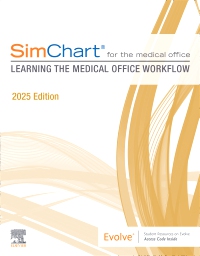
SimChart for the Medical Office: Learning the Medical Office Workflow - 2025 Edition - Elsevier eBook on VitalSource, 1st Edition
by Elsevier Inc
Elsevier eBook on VitalSource
ISBN:
9780443348853
Copyright:
2025
Publication Date:
11-20-2024
Page Count:
448
Imprint:
Elsevier
List Price:
$124.99
Most review copies are eBooks – how fast!
A review copy request is most likely to be fulfilled as an eBook on VitalSource rather than a print product, unless no eBook is available. eBooks become available in as little as a few hours. Print products will take between 7 and 10 days to arrive. To request a print copy, please contact us through the Evolve Support Center for further assistance or contact your Elsevier Sales Rep.
Give your students a hands-on introduction to the medical office electronic health record! Learning the Medical Office Workflow, 2025 Edition, uses a guided approach to provide full access to SimChart® for the Medical Office (SCMO), Elsevier’s educational simulated electronic health record (EHR), plus clear, step-by-step instructions for all the medical assisting simulations. With SCMO access included with purchase, students will become acclimated to these simulations by completing more than 50 hours of practice tasks that address essential ABHES and CAAHEP Medical Assisting educational competencies. This procedure manual uses screenshots and best practices to make it easier for your students to work through SimChart for the Medical Office tasks and assignments in order to master documentation skills to prepare for externship and practice.
New Edition Expected Availability: 01-01-2026

SimChart for the Medical Office: Learning the Medical Office Workflow - 2026 Edition - Elsevier eBook on VitalSource
Elsevier eBook on VitalSource
ISBN: 9780443433757
-
- Each task is mapped to the latest Medical Assisting CAAHEP accreditation competencies, as well as applicable ABHES and CAHIIM guidelines
- Full access to SimChart® for the Medical Office is included with purchase
- Intuitive and realistic learning environment provides students with a safe classroom environment to develop key documentation skills
- UNIQUE! 110 interactive assignments are aligned with ABHES, CAAHEP, and applicable CAHIIM competencies, from front office skills to clinical skills to practice management skills — providing more than 50 hours of documentation practice
- Step-by-step instructions and accompanying SCMO screen shots help students break down common tasks and learn to work accurately and efficiently
- Hands-on practice makes it easier for students to learn core competencies, with scenarios simulating the real-world administrative duties of the medical assistant
- Administrative tasks give students practice managing patient scheduling in a multi-doctor practice, documenting a variety of services, processing insurance claims, posting payments, and much more
- Simulation Playground with instructions and screenshots supplements the prebuilt assignments to give students unlimited practice with the material
- Automatic grading of quizzes and reports shows you which competencies were taught, when they were taught, and their success rate — providing a convenient resource for accreditation review
-
Unit 1 Navigating SimChart for the Medical Office
Unit 2 Front Office
Unit 3 Clinical Care
Unit 4 Coding & Billing -
-
Ways of Reading
- The appearance of the text and page layout can be modified according to the capabilities of the reading system (font family and font size, spaces between paragraphs, sentences, words, and letters, as well as color of background and text)
- This e-publication is accessible to the full extent that the file format and types of content allow, on a specific reading device, by default, without necessarily including any additions such as textual descriptions of images or enhanced navigation
- All content can be read as read aloud speech or dynamic braille
- Has alternative text descriptions for images
-
Conformance
- The publication contains a conformance statement that it meets the EPUB Accessibility 1.1, WCAG 2.1, Level AA standard. Please see https://bornaccessible.benetech.org/certified-publishers/ for further details of our compatibility testing.
- The certifier's credential is https://bornaccessible.benetech.org/certified-publishers/
- For detailed accessibility information, see Elsevier's website at https://www.elsevier.com/about/accessibility
- For queries regarding accessibility information, contact [email protected]
- The publication was certified on 08-02-2026
-
Navigation
- Table of contents to all chapters of the text via links
- Elements such as headings, tables, etc. for structured navigation
- Page list to go to pages from the print source version
-
Rich Content
- Information-rich images are described by extended descriptions
-
Hazards
- The publication contains no hazards
-
Product Content
- The primary content is text.
- Content includes a significant number of actionable (clickable) web links to external content, downloadable resources, supplementary material, etc.
- Content includes a significant number of actionable (clickable) cross-references, hyperlinked notes and annotations, or with other actionable links between largely textual elements (e.g., quiz/test questions, 'choose your own ending', etc.).
- Content includes figures, diagrams, charts and/or graphs, including other 'mechanical' (i.e. non-photographic) illustrations.
- Content includes text within images, including text-as-text embedded in diagrams, charts, or within images containing speech balloons, thought bubbles, captions, etc.
- Content includes visual content that is purely decorative and is not necessary to understanding of the content.
- At least some text - including text within other images - is 'text as an image' (i.e., a picture of text).
-
Legal Considerations
- No information is available
-
Additional Accessibility Information
- Content is enhanced with ARIA roles to optimize organization and facilitate navigation
- Page breaks included from the original print source
- For readers with color vision deficiency, use of color (e.g., in diagrams, graphics and charts, in prompts, or on buttons inviting a response) is not the sole means of graphical distinction or of conveying information
- The body text is presented with a contrast ratio of at least 4.5:1 (or 3:1 for large/heading text)
- Ultra-high contrast between text and background
- E-publication includes basic navigation (usually less detailed than TOC-based navigation)
- Where links, controls or buttons are included in the content, the purpose or functionality of each link, control or button is apparent from the associated text alone - or where it is unclear, separate link, control or button descriptions are provided
- All (or substantially all) textual matter is arranged in a single logical reading order (including text that is visually presented as separate from the main text flow, e.g., in boxouts, captions, tables, footnotes, endnotes, citations, etc.). Non-textual content is also linked from within this logical reading order. (Purely decorative non-text content can be ignored).
- Where interactive content is included in the product, controls are provided (e.g., for speed, pause and resume, reset) and labelled to make their use clear.
- The language of the text has been specified (e.g., via the HTML or XML lang attribute) to optimise text-to-speech (and other alternative renderings), both at the whole document level and, where appropriate, for individual words, phrases or passages in a different language.
-
Ways of Reading
Most review copies are eBooks – how fast!
A review copy request is most likely to be fulfilled as an eBook on VitalSource rather than a print product, unless no eBook is available. eBooks become available in as little as a few hours. Print products will take between 7 and 10 days to arrive. To request a print copy, please contact us through the Evolve Support Center for further assistance or contact your Elsevier Sales Rep.

 as described in our