ISBN:
9780702057397
Copyright:
2015
Publication Date:
04-06-2015
Page Count:
286
Imprint:
Butterworth-Heinemann
List Price:
$43.99

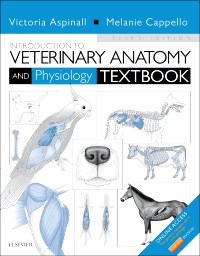
Introduction to Veterinary Anatomy and Physiology Textbook - Elsevier eBook On VitalSource, 3rd Edition
by Victoria Aspinall, BVSc, MRCVS and Melanie Cappello, BSc(Hons)Zoology, PGCE, VN
Elsevier eBook on VitalSource
ISBN:
9780702057397
Copyright:
2015
Publication Date:
04-06-2015
Page Count:
286
Imprint:
Butterworth-Heinemann
List Price:
$43.99
Was
$43.99
Now $39.59
Or $0.00 with a valid access code
A sound knowledge of anatomy and physiology is an essential basis for the effective clinical treatment of companion animals. The Introduction to Veterinary Anatomy and Physiology Textbook, Third Edition offers clear and comprehensive of the common companion animal species.
Updated throughout with a new section added on large animals, the new edition features augmented online learning resources with new questions and quizzes. Students can test their knowledge with multi-choice questions, drag and drop exercises and an image bank, while instructors can download questions, figures and exercises to use as teaching aids.
-
- An essential first purchase for all those embarking upon a veterinary career
- Includes augmented on-line resources with self-assessment tools and teaching aids
- Comprehensive coverage of all major companion animal species
- New large animal section added covering the cow, sheep and pig
- 'Applied Anatomy' tips relate theory to clinical practice, showing the relationship between anatomy and physiology and the disease process
-
Section 1: The Dog and Cat
1. Principles of Cell Biology
2. Tissues and Body Cavities
3. Skeletal System
4. Muscular System
5. Nervous System and Special Senses
6. Endocrine System
7. Blood Vascular System
8. Respiratory System
9. Digestive System
10. Urinary System
11. Reproductive System
12. Common Integument
Section 2: Exotic Species
13. Birds
14. Mammals
15. Reptiles and Fish
16. The Horse
Section 3: Large Animals
17. The Cow
18. The Sheep
19. The Pig -
-
Ways of Reading
- The appearance of the text and page layout can be modified according to the capabilities of the reading system (font family and font size, spaces between paragraphs, sentences, words, and letters, as well as color of background and text)
- This e-publication is accessible to the full extent that the file format and types of content allow, on a specific reading device, by default, without necessarily including any additions such as textual descriptions of images or enhanced navigation
- No information about nonvisual reading is available
-
Conformance
- No information is available
-
Navigation
- Table of contents to all chapters of the text via links
- Page list to go to pages from the print source version
-
Rich Content
- No information is available
-
Hazards
- No information is available
-
Product Content
- No information is available
-
Legal Considerations
- No information is available
-
Additional Accessibility Information
- Page breaks included from the original print source
- For readers with color vision deficiency, use of color (e.g., in diagrams, graphics and charts, in prompts, or on buttons inviting a response) is not the sole means of graphical distinction or of conveying information
- E-publication includes basic navigation (usually less detailed than TOC-based navigation)
- Where links, controls or buttons are included in the content, the purpose or functionality of each link, control or button is apparent from the associated text alone - or where it is unclear, separate link, control or button descriptions are provided
- All (or substantially all) textual matter is arranged in a single logical reading order (including text that is visually presented as separate from the main text flow, e.g., in boxouts, captions, tables, footnotes, endnotes, citations, etc.). Non-textual content is also linked from within this logical reading order. (Purely decorative non-text content can be ignored).
- The language of the text has been specified (e.g., via the HTML or XML lang attribute) to optimise text-to-speech (and other alternative renderings), both at the whole document level and, where appropriate, for individual words, phrases or passages in a different language.
-
Ways of Reading


Was
$43.99
Now $39.59
Or $0.00 with a valid access code

 as described in our