ISBN:
9780702059780
Copyright:
2018
Publication Date:
02-12-2019
Page Count:
576
Imprint:
Elsevier
List Price:
$69.99

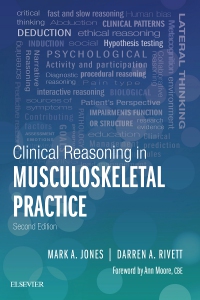
Clinical Reasoning in Musculoskeletal Practice - Elsevier eBook on VitalSource, 2nd Edition
by Mark A Jones, BSc(Psych), PT, GradDipManipTher, MAppSc and Darren A Rivett, BAppSc(Phty), GradDipManipTher, MAppSc(ManipPhty), PhD
Elsevier eBook on VitalSource
ISBN:
9780702059780
Copyright:
2018
Publication Date:
02-12-2019
Page Count:
576
Imprint:
Elsevier
List Price:
$69.99
Was
$69.99
Now $48.99
Or $0.00 with a valid access code
Clinical reasoning is a key skill underpinning clinical expertise. Clinical Reasoning in Musculoskeletal Practice, Second Edition is essential reading for the musculoskeletal practitioner to gain the contemporary knowledge and thinking capacity necessary to advance their reasoning skills. Now in its 2nd edition, it is the only all-in-one volume of up-to-date clinical reasoning knowledge with real-world case examples illustrating expert clinical reasoning.
-
- Comprehensively updated material and brand new chapters on pain science, psychosocial factors, and clinical prediction rules
- The latest clinical reasoning theory and practical strategies for learning and facilitating clinical reasoning skills
- Cutting-edge pain research and relevant psychosocial clinical considerations made accessible for the musculoskeletal practitioner
- The role of clinical prediction rules in musculoskeletal clinical reasoning
- 25 all new real-world, clinical cases by internationally renowned expert clinicians allowing you to compare your reasoning to that of the best
-
1. Clinical Reasoning: Fast and Slow Thinking in Musculoskeletal Practice
2. Understanding Pain in Order to Treat Patients in Pain
3. Influence of Stress, Coping and Social Factors on Pain and Disability in Musculoskeletal Practice
4. Assessment, Reasoning and Management of Psychological Factors in Musculoskeletal Practice
4.1. Clinical Prediction Rules: Their Benefits and Limitations in Clinical Reasoning
4.2. A Multifaceted Presentation of Knee Pain in a Forty-Year-Old Woman
4.3. Lateral Elbow Pain with Cervical and Nerve-Related Components
5. Nonspecific Low Back pain: Manipulation as the Approach to Management
6. Chronic Facial Pain in a 24-Year-Old University Student: Touch-Based Therapy Accessed via Auditory Pathways
7. Targeting Treatment Distally at the Foot for Bilateral Persistent Patellofemoral Pain in a 23-Year-Old: A New Answer to an Old Problem?
8. Post-Partum Thoracolumbar Pain with Associated Diastasis Rectus Abdominis
9. A Construction Project Manager with Insidious Onset of Lateral Hip Pain
10. A Pain Science Approach to Postoperative Lumbar Surgery Rehabilitation
11. A Lawyer with Whiplash
12. Management of Profound Pain and Functional Deficits from Achilles Insertional Tendinopathy
13. Cervicogenic Headache
14. Shoulder Pain: To Operate or Not To Operate?
15. Post-Traumatic Neck Pain, Headache and Knee Pain Following a Cycling Accident
16. Orofacial, Nasal Respiratory and Lower Quarter Symptoms in a Complex Presentation with Dental Malocclusion and Facial Scoliosis
17. Cervical Radiculopathy with Neurological Deficit
18. Incontinence in an International Hockey Player
19. Neck and Upper Extremity Pain in a Female Office Assistant: Where Does the Problem Lie?
20. Managing a Chronic Whiplash Problem when the Patient Lives 900 Kilometres Away
21. A Professional Football Career Lost: Chronic Low Back Pain in a 22-Year-Old
22. Applying Contemporary Pain Neuroscience for a Patient with Maladaptive Central Sensitization Pain
23. Thoracic Spine Pain in a Soccer Player: A Combined Movement Therapy Approach
24. Incorporating Biomechanical Data in the Analysis of a University Student with Shoulder Pain and Scapula Dyskinesis
25. Acute Exacerbation of Chronic Low Back Pain with Right-Leg Numbness in a Crop Farmer
26. Physical Therapy Chosen Over Lumbar Microdiscectomy: A Functional Movement Systems Approach
27. A 30-Year History of Left-Sided 'Chronic Sciatica'
28. Strategies to Facilitate Clinical Reasoning Development -
-
Ways of Reading
- The appearance of the text and page layout can be modified according to the capabilities of the reading system (font family and font size, spaces between paragraphs, sentences, words, and letters, as well as color of background and text)
- This e-publication is accessible to the full extent that the file format and types of content allow, on a specific reading device, by default, without necessarily including any additions such as textual descriptions of images or enhanced navigation
- No information about nonvisual reading is available
-
Conformance
- No information is available
-
Navigation
- Table of contents to all chapters of the text via links
- Page list to go to pages from the print source version
-
Rich Content
- No information is available
-
Hazards
- No information is available
-
Product Content
- No information is available
-
Legal Considerations
- No information is available
-
Additional Accessibility Information
- Page breaks included from the original print source
- For readers with color vision deficiency, use of color (e.g., in diagrams, graphics and charts, in prompts, or on buttons inviting a response) is not the sole means of graphical distinction or of conveying information
- E-publication includes basic navigation (usually less detailed than TOC-based navigation)
- Where links, controls or buttons are included in the content, the purpose or functionality of each link, control or button is apparent from the associated text alone - or where it is unclear, separate link, control or button descriptions are provided
- All (or substantially all) textual matter is arranged in a single logical reading order (including text that is visually presented as separate from the main text flow, e.g., in boxouts, captions, tables, footnotes, endnotes, citations, etc.). Non-textual content is also linked from within this logical reading order. (Purely decorative non-text content can be ignored).
- The language of the text has been specified (e.g., via the HTML or XML lang attribute) to optimise text-to-speech (and other alternative renderings), both at the whole document level and, where appropriate, for individual words, phrases or passages in a different language.
-
Ways of Reading

Was
$69.99
Now $48.99
Or $0.00 with a valid access code

 as described in our