ISBN:
9780702062810
Copyright:
2014
Publication Date:
04-21-2014
Page Count:
552
Imprint:
Churchill Livingstone
List Price:
$59.99

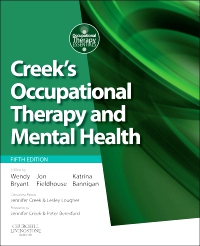
Creek's Occupational Therapy and Mental Health - Elsevier eBook on VitalSource, 5th Edition
by Wendy Bryant, PhD, Jon Fieldhouse and Katrina Bannigan, BSc, PhD
Elsevier eBook on VitalSource
ISBN:
9780702062810
Copyright:
2014
Publication Date:
04-21-2014
Page Count:
552
Imprint:
Churchill Livingstone
List Price:
$59.99
Most review copies are eBooks – how fast!
A review copy request is most likely to be fulfilled as an eBook on VitalSource rather than a print product, unless no eBook is available. eBooks become available in as little as a few hours. Print products will take between 7 and 10 days to arrive. To request a print copy, please contact us through the Evolve Support Center for further assistance or contact your Elsevier Sales Rep.
Now in its fifth edition, this seminal textbook for occupational therapy students and practitioners has retained the comprehensive detail of previous editions with significant updates, including the recovery approach informed by a social perspective. Emerging settings for practice are explored and many more service users have been involved as authors, writing commentaries on 14 chapters.
All chapters are revised and there are also new chapters, such as mental health and wellbeing, professional accountability, intersectionality, green care and working with marginalized populations. Chapter 11 is written by two people who have received occupational therapy, examining different perspectives on the experience of using services.
This edition is divided into clear sections, exploring theory and practice issues in detail. The first section covers the historical, theoretical and philosophical basis for occupational therapy in the promotion of mental health and wellbeing. The second section examines the occupational therapy process, followed by a third section on ensuring quality in contemporary practice. The fourth section offers insights into issues arising from the changing contexts for occupational therapy including an analysis of the implications for occupational therapy education. The fifth section has eight chapters on specific occupations that can be applied across the varied settings which are covered in the sixth and final section.
Occupational Therapy and Mental Health is essential reading for students and practitioners across all areas of health and/or social care, in statutory, private or third (voluntary) sectors, and in institutional and community-based settings.
"The book manages to pack a great deal into the 500 or so pages and is highly recommended for those new to occupational therapy and mental health as it provides a valuable and broad overview of the subject." --Dr Jean McQueen, The Forensic Network, NHS Scotland Date: Jan 2015
All chapters are revised and there are also new chapters, such as mental health and wellbeing, professional accountability, intersectionality, green care and working with marginalized populations. Chapter 11 is written by two people who have received occupational therapy, examining different perspectives on the experience of using services.
This edition is divided into clear sections, exploring theory and practice issues in detail. The first section covers the historical, theoretical and philosophical basis for occupational therapy in the promotion of mental health and wellbeing. The second section examines the occupational therapy process, followed by a third section on ensuring quality in contemporary practice. The fourth section offers insights into issues arising from the changing contexts for occupational therapy including an analysis of the implications for occupational therapy education. The fifth section has eight chapters on specific occupations that can be applied across the varied settings which are covered in the sixth and final section.
Occupational Therapy and Mental Health is essential reading for students and practitioners across all areas of health and/or social care, in statutory, private or third (voluntary) sectors, and in institutional and community-based settings.
"The book manages to pack a great deal into the 500 or so pages and is highly recommended for those new to occupational therapy and mental health as it provides a valuable and broad overview of the subject." --Dr Jean McQueen, The Forensic Network, NHS Scotland Date: Jan 2015
New Edition Expected Availability: 06-14-2022

Creek's Occupational Therapy and Mental Health Elsevier eBook on VitalSource
Elsevier eBook on VitalSource
ISBN: 9780702077470
-
- Presents different theories and approaches
- Outlines the occupational therapy process
- Discusses the implications of a wide range of practice contexts
- Describes a broad range of techniques used by occupational therapists
- Provides many different perspectives through service user commentaries
-
Section 1 INFORMING PHILOSOPHY AND THEORY
1 A short history of occupational therapy in mental health
Catherine F. Paterson
Service User Commentary by Matthew Pickles
2 Mental health and well-being
Jon Fieldhouse, Katrina Bannigan
3 The knowledge base of occupational therapy
Jennifer Creek
Service User Commentary by Philippa Lalor
Section 2 THE OCCUPATIONAL THERAPY PROCESS
4 Approaches to practice
Jennifer Creek
5 Assessment and outcome measurement
Alison Bullock
6 Planning and implementing interventions
Sonya Mccullough
Section 3 ENSURING QUALITY
7 Professional accountability
Clare Beighton, Bob Collins8 Management and leadership
Gabrielle Richards
9 Research and evidence-based practice
Katrina Bannigan
Service User Commentary by Karan Essien
Section 4 THE CONTEXT OF OCCUPATIONAL THERAPY
10 Ethics
Diane E. Cotterill
11 Perspectives on using and providing services
Anne-Laure Donskoy, Rosemarie Stevens, Wendy Bryant
12 Developing the student practitioner
Anne Lawson-Porter
Service User Commentary by Lisa J Ward
13 An intersectional approach to inequity
Marina Morrow, Susan Lynn Hardie
Section 5 OCCUPATIONS
14 Physical activity for mental health and well-being
Fiona Cole
Service User Commentary by Daljit Saini
15 Cognitive approaches to intervention
Sarah Lee, Rachel West
Service User Commentary by Sarah Mercer
16 Client-centred groups
Marli Cole
Service User Commentary by Lucia Franco
17 Creative activities
Julie Walters, Wendy Sherwood, Helen Mason
Service User Commentary by Ruth Sayers
18 Play
Rob Brooks, Carolyn Dunford
19 Life skills
Kevin Cordingley, Hannah Pell
20 Green care and occupational therapy
Jon Fieldhouse, Joe Sempik
Service User Commentary by Dinah Laprairie
21 Work and vocational pursuits
Ellie Fossey, Sally Bramley
Section 6 PEOPLE AND SETTINGS
22 The acute setting
Katherine Sims
Service User Commentary by Mary Nettle
23 Community work with severe and enduring mental health problems
Simon Hughes, Hazel Parker
24 Older people
Jennifer Wenborn
25 Emotional health and well-being of children and young people
Susan Evans, Jagoda Banovic
Service User Commentary by Sarah Marley
26 Learning disabilities
Jane Goodman, Wendy Wright
Service User Commentary by Eric Seall
27 Forensic and prison services
Sharon Mcneil, Katrina Bannigan
28 Substance misuse
Jenny Lancaster, John Chacksfield
Service User Commentary by Trish Staples
29 Working on the margins: occupational therapy and social inclusion
E. Madeleine Duncan, Jennifer Creek -
-
Ways of Reading
- The appearance of the text and page layout can be modified according to the capabilities of the reading system (font family and font size, spaces between paragraphs, sentences, words, and letters, as well as color of background and text)
- This e-publication is accessible to the full extent that the file format and types of content allow, on a specific reading device, by default, without necessarily including any additions such as textual descriptions of images or enhanced navigation
- No information about nonvisual reading is available
-
Conformance
- The publication was certified on 27-05-2026
-
Navigation
- Table of contents to all chapters of the text via links
- Page list to go to pages from the print source version
-
Rich Content
- No information is available
-
Hazards
- No information is available
-
Product Content
- No information is available
-
Legal Considerations
- No information is available
-
Additional Accessibility Information
- Page breaks included from the original print source
- For readers with color vision deficiency, use of color (e.g., in diagrams, graphics and charts, in prompts, or on buttons inviting a response) is not the sole means of graphical distinction or of conveying information
- E-publication includes basic navigation (usually less detailed than TOC-based navigation)
- Where links, controls or buttons are included in the content, the purpose or functionality of each link, control or button is apparent from the associated text alone - or where it is unclear, separate link, control or button descriptions are provided
- All (or substantially all) textual matter is arranged in a single logical reading order (including text that is visually presented as separate from the main text flow, e.g., in boxouts, captions, tables, footnotes, endnotes, citations, etc.). Non-textual content is also linked from within this logical reading order. (Purely decorative non-text content can be ignored).
- The language of the text has been specified (e.g., via the HTML or XML lang attribute) to optimise text-to-speech (and other alternative renderings), both at the whole document level and, where appropriate, for individual words, phrases or passages in a different language.
-
Ways of Reading
Most review copies are eBooks – how fast!
A review copy request is most likely to be fulfilled as an eBook on VitalSource rather than a print product, unless no eBook is available. eBooks become available in as little as a few hours. Print products will take between 7 and 10 days to arrive. To request a print copy, please contact us through the Evolve Support Center for further assistance or contact your Elsevier Sales Rep.

 as described in our