ISBN:
9780702063336
Copyright:
2015
Publication Date:
10-20-2014
Page Count:
448
Imprint:
Churchill Livingstone
List Price:
$58.99

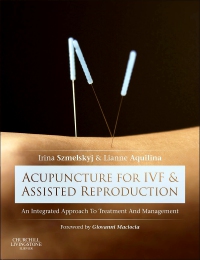
Acupuncture for IVF and Assisted Reproduction - Elsevier eBook on VitalSource, 1st Edition
by Irina Szmelskyj, DipAc MSc MBAcC, Lianne Aquilina, BSc Hons MBAcC ATCM and Alan Szmelskyj, DO MSc AdvDipClinHyp FRSPH
Elsevier eBook on VitalSource
ISBN:
9780702063336
Copyright:
2015
Publication Date:
10-20-2014
Page Count:
448
Imprint:
Churchill Livingstone
List Price:
$58.99
Most review copies are eBooks – how fast!
A review copy request is most likely to be fulfilled as an eBook on VitalSource rather than a print product, unless no eBook is available. eBooks become available in as little as a few hours. Print products will take between 7 and 10 days to arrive. To request a print copy, please contact us through the Evolve Support Center for further assistance or contact your Elsevier Sales Rep.
-
- NEW! Nora AI - an AI-powered learning assistant exclusive to Elsevier ebooks on VitalSource's Bookshelf® platform - offers built-in AI learning support that provides personalized answers based on content from the Elsevier ebook
- Simplifies complex information into easily accessible and understandable material
- Explains reproductive anatomy and physiology from the perspectives of both orthodox medicine and TCM
- Explains the underlying basis of orthodox medical fertility tests and investigations
- Explores the pathology and aetiology of TCM syndromes
- Provides detailed information on how to take a fertility medical history and how to diagnose TCM syndromes
- Presents the evidence for the influence of various lifestyle factors on fertility and ART success rates
- Provides guidelines on how to regulate the menstrual cycle in preparation for IVF treatment
- Explains how common fertility-related conditions such as endometriosis, Polycystic Ovary Syndrome, thyroid disease, and male factor infertility affect ART success rates
- Explains how to adapt acupuncture treatment to different ART protocols
- Provides case history templates, algorithmic acupuncture treatment pathways and patient fact sheets
- Explains how to manage patients with complex medical histories
- Looks at Repeated Implantation Failure, reproductive immunology dysfunction, and recurrent miscarriages
- Explains how to support patients if their IVF is unsuccessful and how to treat patients during early pregnancy
- Examines ethical considerations relevant to fertility acupuncture practice
-
1. Subfertility overview
2. Anatomy and physiology of the reproductive system: pre-requirements for conception
3. The magic of conception
4. Orthodox medical tests and investigations: Optimizing patient care
5. Investigations from a TCM perspective
6. The fundamentals of ART
7. Preconception care in preparation for ART
8. Identification and management of conditions detrimental to IVF outcome
9. Acupuncture during ART
10. Clinical issues during ART
11. ART complications
12. Managing the patient with a complex medical history
13. The therapeutic relationship in acupuncture practice
14. Aftercare
-
-
Ways of Reading
- The appearance of the text and page layout can be modified according to the capabilities of the reading system (font family and font size, spaces between paragraphs, sentences, words, and letters, as well as color of background and text)
- This e-publication is accessible to the full extent that the file format and types of content allow, on a specific reading device, by default, without necessarily including any additions such as textual descriptions of images or enhanced navigation
- No information about nonvisual reading is available
-
Conformance
- No information is available
-
Navigation
- Table of contents to all chapters of the text via links
- Page list to go to pages from the print source version
-
Rich Content
- No information is available
-
Hazards
- No information is available
-
Product Content
- No information is available
-
Legal Considerations
- No information is available
-
Additional Accessibility Information
- Page breaks included from the original print source
- For readers with color vision deficiency, use of color (e.g., in diagrams, graphics and charts, in prompts, or on buttons inviting a response) is not the sole means of graphical distinction or of conveying information
- E-publication includes basic navigation (usually less detailed than TOC-based navigation)
- Where links, controls or buttons are included in the content, the purpose or functionality of each link, control or button is apparent from the associated text alone - or where it is unclear, separate link, control or button descriptions are provided
- All (or substantially all) textual matter is arranged in a single logical reading order (including text that is visually presented as separate from the main text flow, e.g., in boxouts, captions, tables, footnotes, endnotes, citations, etc.). Non-textual content is also linked from within this logical reading order. (Purely decorative non-text content can be ignored).
- The language of the text has been specified (e.g., via the HTML or XML lang attribute) to optimise text-to-speech (and other alternative renderings), both at the whole document level and, where appropriate, for individual words, phrases or passages in a different language.
-
Ways of Reading

Most review copies are eBooks – how fast!
A review copy request is most likely to be fulfilled as an eBook on VitalSource rather than a print product, unless no eBook is available. eBooks become available in as little as a few hours. Print products will take between 7 and 10 days to arrive. To request a print copy, please contact us through the Evolve Support Center for further assistance or contact your Elsevier Sales Rep.

 as described in our