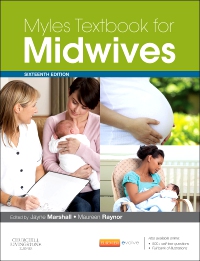

Myles Textbook for Midwives - Paegburst eBook on VitalSource, 16th Edition
Elsevier eBook on VitalSource
New Edition Expected Availability: 05-29-2020

Myles Textbook for Midwives Elsevier eBook on Vitalsource
-
- Designed to enable midwifery practitioners to provide safe and competent care, which is tailored to the patient’s individual needs
- Extensively illustrated to assist visual learning with additional ‘pull out’ textboxes to highlight key information
- Streamlined chapters with similar themes and approach help consolidate learning
- Reflects all modern midwifery curricula by presenting a strong emphasis on evidenced-based practice and the use of technology
- Over 500 on-line multiple-choice questions to enable readers to test their knowledge
- Offers a full image bank of downloadable illustrations to assist with personal projects and/or further learning
- References, Further Reading and Useful Websites promote further learning
- Glossary of Terms and Acronyms provide simple definitions of more complex terminologies
-
SECTION 1 THE MIDWIFE IN CONTEXT
1 The midwife in contemporary midwifery practice
2 Professional issues concerning the midwife and midwifery practice
SECTION 2 HUMAN ANATOMY AND REPRODUCTION
3 The female pelvis and the reproductive organs
4 The female urinary tract
5 Hormonal cycles: fertilization and early development
6 The placenta
7 The fetus
SECTION 3 PREGNANCY
8 Antenatal education for birth and parenting
9 Change and adaptation in pregnancy
10 Antenatal care
11 Antenatal screening of the mother and fetus
12 Common problems associated with early and advanced pregnancy
13 Medical conditions of significance to midwifery practice
14 Multiple pregnancy
SECTION 4 LABOUR
15 Care of the perineum, repair and female genital mutilation
16 Physiology and care during the first stage of labour
17 Physiology and care during the transition and second stage phases of labour
18 Physiology and care during the third stage of labour
19 Prolonged pregnancy and disorders of uterine action
20 Malpositions of the occiput and malpresentations
21 Operative births
22 Midwifery and obstetric emergencies
SECTION 5 PUERPERIUM
23 Physiology and care during the puerperium
24 Physical health problems and complications in the puerperium
25 Perinatal mental health
26 Bereavement and loss in maternity care
27 Contraception and sexual health in a global society
SECTION 6 THE NEONATE
28 Recognizing the healthy baby at term through examination of the newborn screening
29 Resuscitation of the healthy baby at birth: the importance of drying, airway management and establishment of breathing
30 The healthy low birth weight baby
31 Trauma during birth, haemorrhages and convulsions
32 Congenital malformations
33 Significant problems in the newborn baby
34 Infant feeding
Glossary of selected terms -
-
Ways of Reading
- The appearance of the text and page layout can be modified according to the capabilities of the reading system (font family and font size, spaces between paragraphs, sentences, words, and letters, as well as color of background and text)
- This e-publication is accessible to the full extent that the file format and types of content allow, on a specific reading device, by default, without necessarily including any additions such as textual descriptions of images or enhanced navigation
- No information about nonvisual reading is available
-
Conformance
- The publication was certified on 27-05-2026
-
Navigation
- Table of contents to all chapters of the text via links
- Page list to go to pages from the print source version
-
Rich Content
- No information is available
-
Hazards
- No information is available
-
Product Content
- No information is available
-
Legal Considerations
- No information is available
-
Additional Accessibility Information
- Page breaks included from the original print source
- For readers with color vision deficiency, use of color (e.g., in diagrams, graphics and charts, in prompts, or on buttons inviting a response) is not the sole means of graphical distinction or of conveying information
- E-publication includes basic navigation (usually less detailed than TOC-based navigation)
- Where links, controls or buttons are included in the content, the purpose or functionality of each link, control or button is apparent from the associated text alone - or where it is unclear, separate link, control or button descriptions are provided
- All (or substantially all) textual matter is arranged in a single logical reading order (including text that is visually presented as separate from the main text flow, e.g., in boxouts, captions, tables, footnotes, endnotes, citations, etc.). Non-textual content is also linked from within this logical reading order. (Purely decorative non-text content can be ignored).
- The language of the text has been specified (e.g., via the HTML or XML lang attribute) to optimise text-to-speech (and other alternative renderings), both at the whole document level and, where appropriate, for individual words, phrases or passages in a different language.
-
Ways of Reading


 as described in our