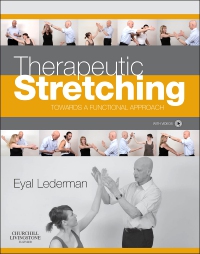

Therapeutic Stretching - Elsevier eBook on VitalSource, 1st Edition
Elsevier eBook on VitalSource
-
- Helps transform thinking about the therapeutic value of stretching and how it is best applied in the clinical setting
- Examines the difference between therapeutic and recreational stretching
- Focuses on the use of stretching in conditions where individuals experience a loss in range of movement (ROM)
- Explores what makes stretching effective, identifying behaviour as a main driving force for adaptive changes
- Discusses the experience of pain, sensitization and pain tolerance in relation to stretching and ROM recovery
- Contains over 150 photographs and 45 minutes of video describing this new revolutionary approach
- Applicable to a variety of perspectives including osteopathy, chiropractic, physical therapy, sports and personal trainers
- Ideal for experienced practitioners as well as those taking undergraduate and postgraduate courses
-
Chapter 1 – Introduction to therapeutic and functional stretching
Chapter 2 – Functional and dysfunctional ROM
Chapter 3 – Causes of ROM loss and therapeutic potential of rehabilitation
Chapter 4 – Adaptation in ROM loss and recovery
Chapter 5 – Specificity in ROM rehabilitation
Chapter 6 – The overloading condition for recovery
Chapter 7 – Exposure and scheduling the ROM challenge
Chapter 8 – Rehabilitating the active ROM: neuromuscular rehabilitation
Chapter 9 – Pain management and ROM-desensitization
Chapter 10 – Stretch tolerance model
Chapter 11 – Psychological and behavioral considerations in ROM rehabilitation
Chapter 12 – Towards a functional approach
Chapter 13 – Demonstration of functional approach in ROM rehabilitation
Chapter 14 – Summary
-
-
Ways of Reading
- The appearance of the text and page layout can be modified according to the capabilities of the reading system (font family and font size, spaces between paragraphs, sentences, words, and letters, as well as color of background and text)
- This e-publication is accessible to the full extent that the file format and types of content allow, on a specific reading device, by default, without necessarily including any additions such as textual descriptions of images or enhanced navigation
- No information about nonvisual reading is available
-
Conformance
- No information is available
-
Navigation
- Table of contents to all chapters of the text via links
- Page list to go to pages from the print source version
-
Rich Content
- No information is available
-
Hazards
- No information is available
-
Product Content
- No information is available
-
Legal Considerations
- No information is available
-
Additional Accessibility Information
- Page breaks included from the original print source
- For readers with color vision deficiency, use of color (e.g., in diagrams, graphics and charts, in prompts, or on buttons inviting a response) is not the sole means of graphical distinction or of conveying information
- E-publication includes basic navigation (usually less detailed than TOC-based navigation)
- Where links, controls or buttons are included in the content, the purpose or functionality of each link, control or button is apparent from the associated text alone - or where it is unclear, separate link, control or button descriptions are provided
- All (or substantially all) textual matter is arranged in a single logical reading order (including text that is visually presented as separate from the main text flow, e.g., in boxouts, captions, tables, footnotes, endnotes, citations, etc.). Non-textual content is also linked from within this logical reading order. (Purely decorative non-text content can be ignored).
- The language of the text has been specified (e.g., via the HTML or XML lang attribute) to optimise text-to-speech (and other alternative renderings), both at the whole document level and, where appropriate, for individual words, phrases or passages in a different language.
-
Ways of Reading

 as described in our