ISBN:
9780702065729
Copyright:
2013
Publication Date:
04-01-2013
Page Count:
696
Imprint:
Saunders
List Price:
$125.99

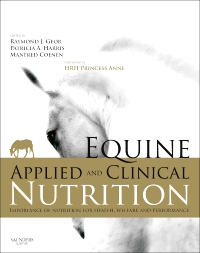
Equine Applied and Clinical Nutrition - Elsevier eBook on VitalSource, 1st Edition
by Raymond J. Geor, BVSc, MVSc, PhD, Diplomate ACVIM (Large Animal Internal Medicine, Nutrition) and ACVSMR (Equine), Patricia Harris, MA, PhD, Vet MB, MRCVS, Diplomate, European College of Veterinary Clinical Nutrition and Manfred Coenen, DrMed Vet, PhD, Diplomate, European College Veterinary Clinical Nutrition
Elsevier eBook on VitalSource
ISBN:
9780702065729
Copyright:
2013
Publication Date:
04-01-2013
Page Count:
696
Imprint:
Saunders
List Price:
$125.99
Most review copies are eBooks – how fast!
A review copy request is most likely to be fulfilled as an eBook on VitalSource rather than a print product, unless no eBook is available. eBooks become available in as little as a few hours. Print products will take between 7 and 10 days to arrive. To request a print copy, please contact us through the Evolve Support Center for further assistance or contact your Elsevier Sales Rep.
Equine Applied and Clinical Nutrition is a landmark text that provides a comprehensive source of information on the nutrition and feeding management of horses. In this authoritative and accessible account, experts from around the world provide a global perspective while the editors tackle key controversial areas. Topics covered include the basic foundations of equine nutrition (digestive and metabolic physiology, nutrient functions and requirements), nutritional management by life stage or function, the assessment of feedstuffs and feeding programs, and clinical nutrition. Also included is discussion on feed hygiene and the role of manufacturers in feed quality and safety. The book contains abundant practical nutritional advice for the treatment of clinical conditions seen by veterinarians in their daily practice, together with the fundamental information needed to make recommendations for the nutritional management of healthy horses.
Equine Applied and Clinical Nutrition provides the most substantial overview currently available of the nutritional management of key equine clinical conditions. It further presents the up-to-date scientific background needed to underpin recommendations. It will be of core relevance to equine veterinarians and nutritionists, and a valuable resource for undergraduate and graduate students, as well as lay horsemen and women who wish to be better informed about their horses’ nutritional needs.
Equine Applied and Clinical Nutrition provides the most substantial overview currently available of the nutritional management of key equine clinical conditions. It further presents the up-to-date scientific background needed to underpin recommendations. It will be of core relevance to equine veterinarians and nutritionists, and a valuable resource for undergraduate and graduate students, as well as lay horsemen and women who wish to be better informed about their horses’ nutritional needs.
-
- Comprehensive coverage of key topics in equine nutrition, both from a scientific and applied perspective
- Practical advice with clear take-home messages
- Accessible text with many summary boxes, illustrations and graphics to emphasize important concepts and recommendations
- Likely to become the standard reference for practical nutrition in the equine field
-
-
 Equine Applied and Clinical NutritionHardcover
-
-
SECTION 1: CORE NUTRITION
Digestive physiology
Metabolic physiology
Feeding behaviour
Research techniques in equine nutrition
Energy
Amino acids and protein
Fats and fatty acids
Carbohydrates
Vitamins
Minerals
Water
SECTION 2: APPLIED NUTRITION AND FEEDING MANAGEMENT
A. General considerations
Feedstuffs for horses
Pastures and pasture management
Supplements and nutraceuticals (including ergogenics)
Ration evaluation and formulation (with discussion on feed manufacturing practices)
International feeding practices
B. Feeding through the lifestages
Broodmare and stallion
Growing animals
Mature horses
Old horses
Athletic horses (possibly several chapters under this heading - a basic core chapter, then a group of small chapters that deals with different disciplines e.g. racehorses, endurance, 3-day event)
C. Special considerations
Ponies, donkeys, miniature horses
Wild equids
Orphan foals
SECTION 3: CLINICAL NUTRITION
Clinical assessment of nutritional status
Muscle disorders
Laminitis
Obesity
Thin and starved horses
Endocrine diseases (equine metabolic syndrome; equine Cushing’s disease)
Developmental orthopaedic disease
Osteoarthritis
Gastrointestinal diseases (gastric ulcers, colic, diarrhea)
Allergic and inflammatory airway diseases
Renal and hepatic
Skin diseases/atopy
Central nervous system diseases (e.g. equine motor neuron disease; grass sickness)
Behavioural abnormalities (stereotypies)
Assisted enteral and parenteral feeding
Feed-related toxicities
APPENDICES
Nutrient requirements
Nutrient composition of feeds
Reference ranges for blood metabolites, minerals and vitamins
Milk composition -
-
Ways of Reading
- The appearance of the text and page layout can be modified according to the capabilities of the reading system (font family and font size, spaces between paragraphs, sentences, words, and letters, as well as color of background and text)
- This e-publication is accessible to the full extent that the file format and types of content allow, on a specific reading device, by default, without necessarily including any additions such as textual descriptions of images or enhanced navigation
- No information about nonvisual reading is available
-
Conformance
- No information is available
-
Navigation
- Table of contents to all chapters of the text via links
- Page list to go to pages from the print source version
-
Rich Content
- No information is available
-
Hazards
- No information is available
-
Product Content
- No information is available
-
Legal Considerations
- No information is available
-
Additional Accessibility Information
- Page breaks included from the original print source
- For readers with color vision deficiency, use of color (e.g., in diagrams, graphics and charts, in prompts, or on buttons inviting a response) is not the sole means of graphical distinction or of conveying information
- E-publication includes basic navigation (usually less detailed than TOC-based navigation)
- Where links, controls or buttons are included in the content, the purpose or functionality of each link, control or button is apparent from the associated text alone - or where it is unclear, separate link, control or button descriptions are provided
- All (or substantially all) textual matter is arranged in a single logical reading order (including text that is visually presented as separate from the main text flow, e.g., in boxouts, captions, tables, footnotes, endnotes, citations, etc.). Non-textual content is also linked from within this logical reading order. (Purely decorative non-text content can be ignored).
- The language of the text has been specified (e.g., via the HTML or XML lang attribute) to optimise text-to-speech (and other alternative renderings), both at the whole document level and, where appropriate, for individual words, phrases or passages in a different language.
-
Ways of Reading
Most review copies are eBooks – how fast!
A review copy request is most likely to be fulfilled as an eBook on VitalSource rather than a print product, unless no eBook is available. eBooks become available in as little as a few hours. Print products will take between 7 and 10 days to arrive. To request a print copy, please contact us through the Evolve Support Center for further assistance or contact your Elsevier Sales Rep.

 as described in our