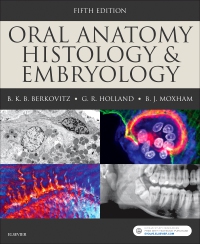

Oral Anatomy, Histology and Embryology Elsevier eBook on VitalSource, 5th Edition
Elsevier eBook on VitalSource
New Edition Expected Availability: 10-07-2024

Oral Anatomy, Histology and Embryology - Elsevier E-Book on VitalSource
-
- Written by dentists for dentists – authors who know exactly what students need for safe clinical practice!
- Contains full coverage of topics such as tooth eruption, tooth support, the effects of aging on teeth and associated soft tissues, periodontal regeneration, and the use of isotope analysis
- Includes sectional anatomy and functional anatomy (covering mastication, swallowing, speech, taste and olfaction, thermoreception)
- Many chapters include Clinical Considerations which explore associated pathological findings as well as other topics of consideration such as the use of local anaesthesia, temporomandibular joint disorders and malocclusion
- Explores bone structure and remodelling – including potential bone atrophy following tooth extraction, its relevance to orthodontic treatment and implantology, trauma and malignancy
- Rich with over 1300 images including schematic artworks, radiological images, electron-micrographs, cadaveric and clinical photographs, all specially selected to make learning and recall as easy as possible
-
1. In vivo appearance of the oral cavity
2. Dento-osseous structures
3. Regional topography of the mouth and related areas
4. Vasculature and innervation of the mouth
5. Sectional anatomy of the oral cavity and related areas
6. Functional anatomy
7. Enamel
8. Investing organic layers on enamel surfaces
9. Dentine
10. Dental pulp
11. Cementum
12. Periodontal ligament
13. Alveolar bone
14. Oral mucosa
15. Temporomandibular joint
16. Salivary glands
17. Development of the face
18. Development of the palate
19. Development of the jaws
20. Development of the tongue and salivary glands
21. Early tooth development
22. Amelogenesis
23. Dentinogenesis
24. Development of the dental pulp
25. Development of the root and periodontal ligament
26. Development of the dentitions
27. Ageing and archaeological and dental anthropological applications of tooth structure -
-
Ways of Reading
- The appearance of the text and page layout can be modified according to the capabilities of the reading system (font family and font size, spaces between paragraphs, sentences, words, and letters, as well as color of background and text)
- This e-publication is accessible to the full extent that the file format and types of content allow, on a specific reading device, by default, without necessarily including any additions such as textual descriptions of images or enhanced navigation
- No information about nonvisual reading is available
-
Conformance
- No information is available
-
Navigation
- Table of contents to all chapters of the text via links
- Page list to go to pages from the print source version
-
Rich Content
- No information is available
-
Hazards
- No information is available
-
Product Content
- No information is available
-
Legal Considerations
- No information is available
-
Additional Accessibility Information
- Page breaks included from the original print source
- For readers with color vision deficiency, use of color (e.g., in diagrams, graphics and charts, in prompts, or on buttons inviting a response) is not the sole means of graphical distinction or of conveying information
- E-publication includes basic navigation (usually less detailed than TOC-based navigation)
- Where links, controls or buttons are included in the content, the purpose or functionality of each link, control or button is apparent from the associated text alone - or where it is unclear, separate link, control or button descriptions are provided
- All (or substantially all) textual matter is arranged in a single logical reading order (including text that is visually presented as separate from the main text flow, e.g., in boxouts, captions, tables, footnotes, endnotes, citations, etc.). Non-textual content is also linked from within this logical reading order. (Purely decorative non-text content can be ignored).
- The language of the text has been specified (e.g., via the HTML or XML lang attribute) to optimise text-to-speech (and other alternative renderings), both at the whole document level and, where appropriate, for individual words, phrases or passages in a different language.
-
Ways of Reading


 as described in our