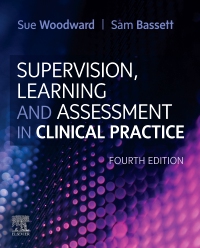

Supervision, Learning and Assessment in Clinical Practice, Elsevier eBook on VitalSource, 4th Edition
Elsevier eBook on VitalSource
Now $28.69
-
- NEW! Nora AI - an AI-powered learning assistant exclusive to Elsevier ebooks on VitalSource's Bookshelf® platform - offers built-in AI learning support that provides personalized answers based on content from the Elsevier ebook
- Comprehensive Guidance: Practical strategies to manage the complexities and challenges of mentoring, learning, and assessing in clinical practice
- Focus on Accountability: Critical exploration of professional responsibility and accountability, including the legal ramifications surrounding clinical assessment
- Inclusive Education: Enhanced focus on meeting the needs of students with special requirements, including those with dyslexia, in compliance with the Disability Act of 2010
- Regulatory Alignment: Direct application for mentoring and assessment of health care students in professions regulated by the Health and Care Professions Council (HCPC)
- Professional Conduct: New material on monitoring and assessing professional conduct and behaviours, including a comprehensive list of professional behaviours for assessment
- Addressing 'Failure to Fail': Practical advice on managing assessment problems, including when students need to be failed and why assessors often give underperforming students the benefit of the doubt
-
1. The Purposes and Nature of Assessment and Clinical Assessment
2. Responsibility and Accountability Surrounding Clinical Assessment
3. What do we Assess?
4. How do we Assess?
5. Conducting Defensible and Fair Assessments
6. Assessment as a Process to Support Learning
7. Monitoring Progress, Managing Feedback and making Assessment Decisions
8. Clinical Learning Environment as a Setting for Learning and Professional Development
9. Learning through Clinical Practice–Unearthing Meaning from Experience
Appendix
1: Declaration of Good Health and Good Character in Support of an Application for Admission to a Part of the Nursing and Midwifery Council’s Professional Register
2: Sample Unit With Its Elements and One Element of Competence With Its Associated Performance Criteria
3: Skills Checklist
4: Professional Behaviours Inventory -
-
Ways of Reading
- The appearance of the text and page layout can be modified according to the capabilities of the reading system (font family and font size, spaces between paragraphs, sentences, words, and letters, as well as color of background and text)
- This e-publication is accessible to the full extent that the file format and types of content allow, on a specific reading device, by default, without necessarily including any additions such as textual descriptions of images or enhanced navigation
- No information about nonvisual reading is available
-
Conformance
- No information is available
-
Navigation
- Table of contents to all chapters of the text via links
- Page list to go to pages from the print source version
-
Rich Content
- No information is available
-
Hazards
- No information is available
-
Product Content
- No information is available
-
Legal Considerations
- No information is available
-
Additional Accessibility Information
- Content is enhanced with ARIA roles to optimize organization and facilitate navigation
- Page breaks included from the original print source
- For readers with color vision deficiency, use of color (e.g., in diagrams, graphics and charts, in prompts, or on buttons inviting a response) is not the sole means of graphical distinction or of conveying information
- E-publication includes basic navigation (usually less detailed than TOC-based navigation)
- Where links, controls or buttons are included in the content, the purpose or functionality of each link, control or button is apparent from the associated text alone - or where it is unclear, separate link, control or button descriptions are provided
- All (or substantially all) textual matter is arranged in a single logical reading order (including text that is visually presented as separate from the main text flow, e.g., in boxouts, captions, tables, footnotes, endnotes, citations, etc.). Non-textual content is also linked from within this logical reading order. (Purely decorative non-text content can be ignored).
- The language of the text has been specified (e.g., via the HTML or XML lang attribute) to optimise text-to-speech (and other alternative renderings), both at the whole document level and, where appropriate, for individual words, phrases or passages in a different language.
-
Ways of Reading


 as described in our