ISBN:
9780702078514
Copyright:
2015
Publication Date:
06-29-2018
Page Count:
384
Imprint:
Churchill Livingstone
List Price:
$49.99

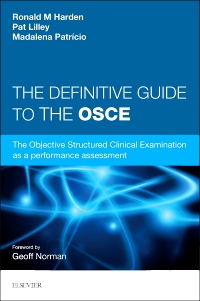
The Definitive Guide to the OSCE - Elsevier eBook on VitalSource Technology, 1st Edition
by Ronald M. Harden, OBE MD FRCP(Glas) FRCSEd FRCPC, Pat Lilley, BA (Hons) and Madalena Patricio, PhD
Elsevier eBook on VitalSource
ISBN:
9780702078514
Copyright:
2015
Publication Date:
06-29-2018
Page Count:
384
Imprint:
Churchill Livingstone
List Price:
$49.99
Most review copies are eBooks – how fast!
A review copy request is most likely to be fulfilled as an eBook on VitalSource rather than a print product, unless no eBook is available. eBooks become available in as little as a few hours. Print products will take between 7 and 10 days to arrive. To request a print copy, please contact us through the Evolve Support Center for further assistance or contact your Elsevier Sales Rep.
-
- This book provides a full understanding of the basic concepts underpinning the OSCE and shows how to implement an OSCE effectively and efficiently in a variety of contexts.
- It includes case studies demonstrating the use of the OSCE in practice in a range of different fields.
- Practical guidelines and tips are provided based on the authors’ extensive experience.
-
-
 The Definitive Guide to the OSCEPaperback
-
-
An introduction to the Objective Structured Clinical Examination
- What is an OSCE?
- The inside story of the development of the OSCE
- The OSCE as the gold standard for performance assessment
- How the OSCE can contribute to the education programme
- What is assessed in an OSCE?
Implementation of an OSCE
- Choosing a format for an OSCE
- The setting for an OSCE
- The patient
- The examiner
- Implementing an OSCE
- Evaluating the examinee’s performance
- Providing feedback to the learner
- The examinee’s perspective
- Evaluating an OSCE
- Costs and implementing an OSCE with limited resources
Some final thoughts
- Limitations of the OSCE
- Conclusions and looking to the future
Examples of the use of the OSCE in different settings and contexts: case studies
-
-
Ways of Reading
- The appearance of the text and page layout can be modified according to the capabilities of the reading system (font family and font size, spaces between paragraphs, sentences, words, and letters, as well as color of background and text)
- This e-publication is accessible to the full extent that the file format and types of content allow, on a specific reading device, by default, without necessarily including any additions such as textual descriptions of images or enhanced navigation
- No information about nonvisual reading is available
-
Conformance
- No information is available
-
Navigation
- Table of contents to all chapters of the text via links
- Page list to go to pages from the print source version
-
Rich Content
- No information is available
-
Hazards
- No information is available
-
Product Content
- No information is available
-
Legal Considerations
- No information is available
-
Additional Accessibility Information
- Page breaks included from the original print source
- For readers with color vision deficiency, use of color (e.g., in diagrams, graphics and charts, in prompts, or on buttons inviting a response) is not the sole means of graphical distinction or of conveying information
- E-publication includes basic navigation (usually less detailed than TOC-based navigation)
- Where links, controls or buttons are included in the content, the purpose or functionality of each link, control or button is apparent from the associated text alone - or where it is unclear, separate link, control or button descriptions are provided
- All (or substantially all) textual matter is arranged in a single logical reading order (including text that is visually presented as separate from the main text flow, e.g., in boxouts, captions, tables, footnotes, endnotes, citations, etc.). Non-textual content is also linked from within this logical reading order. (Purely decorative non-text content can be ignored).
- The language of the text has been specified (e.g., via the HTML or XML lang attribute) to optimise text-to-speech (and other alternative renderings), both at the whole document level and, where appropriate, for individual words, phrases or passages in a different language.
-
Ways of Reading
Most review copies are eBooks – how fast!
A review copy request is most likely to be fulfilled as an eBook on VitalSource rather than a print product, unless no eBook is available. eBooks become available in as little as a few hours. Print products will take between 7 and 10 days to arrive. To request a print copy, please contact us through the Evolve Support Center for further assistance or contact your Elsevier Sales Rep.

 as described in our