ISBN:
9780702079801
Copyright:
2025
Publication Date:
01-16-2024
Page Count:
536
Imprint:
Elsevier
List Price:
$43.99

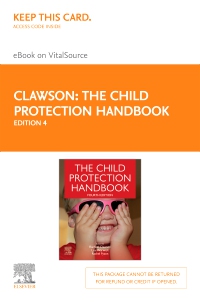
The Child Protection Handbook - Elsevier eBook on VitalSource (Retail Access Card), 4th Edition
by Rachael Clawson, Lisa Warwick and Rachel Fyson
Elsevier eBook on VitalSource - Access Card
ISBN:
9780702079801
Copyright:
2025
Publication Date:
01-16-2024
Page Count:
536
Imprint:
Elsevier
List Price:
$43.99
This item has low stock levels and may be back-ordered. We'll let you know if it is back-ordered, and you will not be charged until the item ships.
The Child Protection Handbook, Fourth Edition explains how to recognise abuse and how to protect children and young people at risk of abuse. The book is aimed at students and practitioners in safeguarding roles, including those working in social care, health, criminal justice, education, sport and leisure.
Since the last edition in 2007, the Handbook has been fully revised and updated to reflect not only the current legal and policy frameworks that govern statutory child protection intervention in the UK but also the impacts of new technology. It offers a comprehensive overview of the contexts which frame child protection – including organisational issues, children’s rights, the needs of those from diverse backgrounds and the impacts of the Covid-19 pandemic on child protection work – as well as explaining how to stay alert to the various forms of abuse and maltreatment which children and young people may experience.
With accessible, up-to-date information presented in an easy-to-navigate format, the Handbook is ideal for all those wanting to improve outcomes for children, young people and their families. All concepts are explained in straightforward, jargon-free language and the Handbook is equally effective when read cover-to-cover or used as a reference book.
Since the last edition in 2007, the Handbook has been fully revised and updated to reflect not only the current legal and policy frameworks that govern statutory child protection intervention in the UK but also the impacts of new technology. It offers a comprehensive overview of the contexts which frame child protection – including organisational issues, children’s rights, the needs of those from diverse backgrounds and the impacts of the Covid-19 pandemic on child protection work – as well as explaining how to stay alert to the various forms of abuse and maltreatment which children and young people may experience.
With accessible, up-to-date information presented in an easy-to-navigate format, the Handbook is ideal for all those wanting to improve outcomes for children, young people and their families. All concepts are explained in straightforward, jargon-free language and the Handbook is equally effective when read cover-to-cover or used as a reference book.
-
- Illustrative boxes drawing on practice examples to highlight issues and dilemmas
- Key points to encourage the reader to think about their practice and apply new knowledge
- Reflective questions to check understanding and explore concepts further
- Links to resources and further reading
-
-
 The Child Protection Handbook - Elsevier eBook on VitalSourceElsevier eBook on VitalSource
-
-
PART 1 The Context for Child Safeguarding
1. From relationships and community to risk and compliance: reflections on fifty years of protecting children
2. The rights of the child
3. Humane practice in child protection: the story of one project
4. Poverty and child protection
5. Child protection and the family court: an introduction to legislation, policy and practice
6. Inter-agency practice in safeguarding children
7. Supporting social workers: the role of supervision
PART 2 Key Issues in Child Safeguarding
8. Cumulative risk of harm
9. Enduring forms of child abuse (neglect, sexual, physical, emotional and future harm)
10. ‘new’ forms of child abuse (editors’ introduction)
10a. Technology-assisted child sexual abuse: as a frame through which to develop and broaden understandings of abuse involving technologies and the online
10b. Child sexual exploitation
10c. Gangs and child criminal exploitation
10d. Radicalisation
10e. Forced marriage of children and young people
10f. Female genital mutilation
10g. Child abuse linked to faith or belief
11. Characteristics that accentuate vulnerability (editors’ introduction)
11a. Disabled child protection – evidence for improved practice in the uk
11b. Being a looked after child
11c. Being a refugee or asylum seeker
11d. Being a young carer
12. From 10s to teens: working with young people (editors introduction)
12a. Child protection in adolescence
12b. Leaving care
12c. Safeguarding and children in conflict with the law
12d. Children and young people who sexually harm others
12e. Child to parent violence and abuse
PART 3 Child Protection Practices
13. Culturally sensitive child protection practice
14. Models of child protection practice
15. Safeguarding children: the assessment challenges
16. Child protection legislation in emergency situations
17. Child protection and the criminal justice system
18. Direct work with children
19. Working with parents (editor’s introduction)
19a. Working with parents with learning disabilities
19b. Working with parents experiencing mental distress
19c. Young parents
19d. Compassionate and effective practice with parents at risk of repeat removal of their children through care proceedings
20. Safeguarding in educational settings
21. Safeguarding children in healthcare contexts
22. Safeguarding in sport and leisure
23. Editors’ final thoughts: child protection beyond the pandemic -
No accessibility information is available for this product.

 as described in our