ISBN:
9780702080715
Copyright:
2021
Publication Date:
01-19-2021
Page Count:
304
Imprint:
Elsevier
List Price:
$49.99

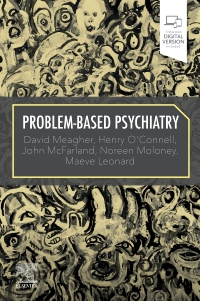
Problem-Based Psychiatry Elsevier E-Book on VitalSource, 1st Edition
by David Meagher, MB, BCh, BAO, DPM MSc, MHSc, MD, PhD, MRCPsych., Henry O’Connell, MB, BCh, BAO, MRCPsych, MD, MHSc, John McFarland, Noreen Moloney and Maeve Leonard
Elsevier eBook on VitalSource
ISBN:
9780702080715
Copyright:
2021
Publication Date:
01-19-2021
Page Count:
304
Imprint:
Elsevier
List Price:
$49.99
Was
$49.99
Now $44.99
Or $0.00 with a valid access code
Problem-Based Psychiatry is a comprehensive resource covering the key principles of evidence-based approaches to diagnosis and treatment of the full range of psychiatric disorders.
The text is highly engaging and interactive. It offers a unique patient-centred, multidisciplinary perspective, taking students through a series of narratives designed to prompt deeper understanding and learning.
Ideal for medical students and educators alike, this text will also be a valuable resource for doctors engaged in postgraduate training in psychiatry and other medical disciplines, as well as for the range of allied mental health professionals.
-
- 26 chapters designed for individual teaching sessions
- Evidence-based treatment options for all major psychiatric disorders and presentations, including autism spectrum disorders, PTSD, gender dysphoria and schizophrenia
- Problem-based format allows for learning in a real-world, practical context
- Narratives and scenario-based learning to promote deep understanding
- Enhanced eBook version included with purchase. Your enhanced eBook allows you to access all of the text, figures, and references from the book on a variety of devices
-
-
 Problem-Based PsychiatryPaperback
-
-
1. Shane: Mania
2. Aaron: Acute Psychosis
3. Anna: Recurrent Depressive Disorder
4. Laura: Post Traumatic Stress Disorder
5. Jane: Alcohol Use Disorder
6. Marguerite: Delirium
7. Colin: Anxiety Disorders
8. Norma: Perinatal Mental Illness
9. Kathleen: Obsessive Compulsive Disorder
10. Walter: Treatment Resistant Depression
11. Emma: Eating Disorders
12. John: Polysubstance Misuse
13. Natasha: Medically Unexplained Symptoms
14. Michael: Attention Deficit Hyperactivity Disorder
15. Caroline: Bipolar Affective Disorder
16. Declan: Mental Illness in Autistic Spectrum Disorders
17. Francine: Borderline Personality Disorder
18. Trevor: Antisocial Personality Disorder
19. Frankie: Gender Dysphoria
20. Eric: Dementia
21. Linda: Opiate Misuse and Pregnancy
22. Larry: Mental Illness in Intellectual Disability
23. Luke: A Case of Suicide
24. Pious, Bernadette, Dervla, Emmett and Karim: Adverse Effects of Medication
25. Piotr: Schizophrenia
26. Mark: School Refusal -
-
Ways of Reading
- The appearance of the text and page layout can be modified according to the capabilities of the reading system (font family and font size, spaces between paragraphs, sentences, words, and letters, as well as color of background and text)
- This e-publication is accessible to the full extent that the file format and types of content allow, on a specific reading device, by default, without necessarily including any additions such as textual descriptions of images or enhanced navigation
- No information about nonvisual reading is available
-
Conformance
- No information is available
-
Navigation
- Table of contents to all chapters of the text via links
- Page list to go to pages from the print source version
-
Rich Content
- No information is available
-
Hazards
- No information is available
-
Product Content
- No information is available
-
Legal Considerations
- No information is available
-
Additional Accessibility Information
- Page breaks included from the original print source
- For readers with color vision deficiency, use of color (e.g., in diagrams, graphics and charts, in prompts, or on buttons inviting a response) is not the sole means of graphical distinction or of conveying information
- E-publication includes basic navigation (usually less detailed than TOC-based navigation)
- Where links, controls or buttons are included in the content, the purpose or functionality of each link, control or button is apparent from the associated text alone - or where it is unclear, separate link, control or button descriptions are provided
- All (or substantially all) textual matter is arranged in a single logical reading order (including text that is visually presented as separate from the main text flow, e.g., in boxouts, captions, tables, footnotes, endnotes, citations, etc.). Non-textual content is also linked from within this logical reading order. (Purely decorative non-text content can be ignored).
- The language of the text has been specified (e.g., via the HTML or XML lang attribute) to optimise text-to-speech (and other alternative renderings), both at the whole document level and, where appropriate, for individual words, phrases or passages in a different language.
-
Ways of Reading
Was
$49.99
Now $44.99
Or $0.00 with a valid access code

 as described in our