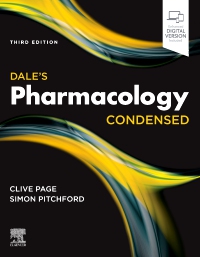

Dale's Pharmacology Condensed,Elsevier E-Book on VitalSource, 3rd Edition
Elsevier eBook on VitalSource
-
- All content has been thoroughly revised and updated, with new coverage of fast-moving therapeutic areas such as the development of biologics, new therapeutics for cancer treatments, dermatology and immune mediated diseases, and new advances in pharmacological principles such as biased agonism
- Each chapter condenses key information to provide the necessary core knowledge, as well as essential therapeutic information
- Written by experienced teachers who provide a clear focus on what today’s students need to know
- Ideal for exam preparation with explanatory diagrams throughout, important drugs identified with bold type, and multiple choice questions for self-assessment and review
- Enhanced eBook version included with purchase. Your enhanced eBook allows you to access all of the text, figures, and references from the book on a variety of devices
-
Section 1: Pharmacology and Drug Use
1. Preface
2. Pharmacology, Drug Names, and Classification Systems
Section 2: Fundamentals of Pharmacology
3. General Principles of Drug Action
4. Molecular Aspects of Drug Action
5. Pharmacokinetic and Other Factors Influencing Drug Action
6. Pharmacodynamics and the Measurement of Drug Action
Section 3: Drug Development
7. Drug Discovery and the Development of Small Molecules
8. Drug Discovery and the Development of Biologicals
9. Drug Safety, Toxicology, and Pharmacovigilance
10. Regulation of Drug Use
Section 4: Drug Actions on Body Systems
11. Outline of Transmission and Drug Action in the Nervous System
12. Drugs and Neurological Disorders
13. Drugs and Pain
14. Drugs and the Cardiovascular System
15. Drugs and Blood: Haematopoiesis and Haemostasis
16. Drugs and the Inflammatory and Immune Response
17. Drugs and the Endocrine and Metabolic Systems
18. Drugs and the Renal System
19. Drugs and the Pulmonary System
20. Drugs and the Musculoskeletal System
21. Drugs and the Gastrointestinal System
22. Drugs and the Kidney and Genitourinary System
23. Drugs and the Skin
24. Drugs and the Eye
25. Drugs and the Ear
26. Drugs Used in Anaesthesia
27. Drug Use in Disorders of Nutrition
28. Drug Use in Dentistry
Section 5: Drugs to Treat Infectious Diseases and Neoplasms
29. Antiviral Drugs
30. Antibacterial Drugs
31. Antifungal Drugs
32. Drugs and Parasites: Anti-protozoal and Antihelminthic Drugs
33. Drugs and Cancer
Section 6: Drugs in the Community
34. Prescribing and Personalising Drug Treatments
35. Venoms, Toxins, Poisons, and Herbs
36. Drug Dependence and Drug Abuse -
-
Ways of Reading
- The appearance of the text and page layout can be modified according to the capabilities of the reading system (font family and font size, spaces between paragraphs, sentences, words, and letters, as well as color of background and text)
- This e-publication is accessible to the full extent that the file format and types of content allow, on a specific reading device, by default, without necessarily including any additions such as textual descriptions of images or enhanced navigation
- No information about nonvisual reading is available
-
Conformance
- No information is available
-
Navigation
- Table of contents to all chapters of the text via links
- Page list to go to pages from the print source version
-
Rich Content
- No information is available
-
Hazards
- No information is available
-
Product Content
- No information is available
-
Legal Considerations
- No information is available
-
Additional Accessibility Information
- Page breaks included from the original print source
- For readers with color vision deficiency, use of color (e.g., in diagrams, graphics and charts, in prompts, or on buttons inviting a response) is not the sole means of graphical distinction or of conveying information
- E-publication includes basic navigation (usually less detailed than TOC-based navigation)
- Where links, controls or buttons are included in the content, the purpose or functionality of each link, control or button is apparent from the associated text alone - or where it is unclear, separate link, control or button descriptions are provided
- All (or substantially all) textual matter is arranged in a single logical reading order (including text that is visually presented as separate from the main text flow, e.g., in boxouts, captions, tables, footnotes, endnotes, citations, etc.). Non-textual content is also linked from within this logical reading order. (Purely decorative non-text content can be ignored).
- The language of the text has been specified (e.g., via the HTML or XML lang attribute) to optimise text-to-speech (and other alternative renderings), both at the whole document level and, where appropriate, for individual words, phrases or passages in a different language.
-
Ways of Reading

 as described in our